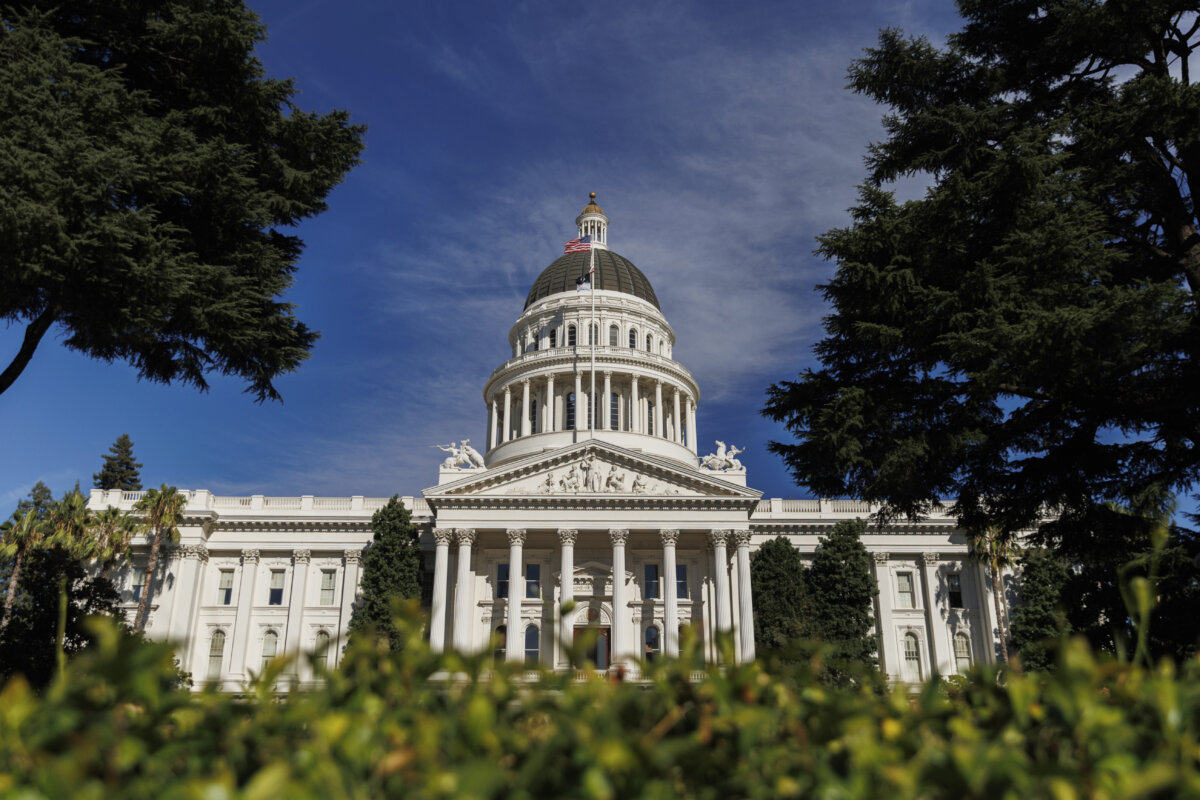

This week, the California Legislature will begin considering legislation to authorize a referendum to decide whether to temporarily bypass California’s independent redistricting commission and allow voters to decide on whether to accept congressional maps redrawn to favor Democrats in upcoming elections.
The Legislature is meeting amid an escalating national standoff between the two major parties, as Republicans in Texas are moving forward—on the request of the U.S. Justice Department and President Donald Trump—with action that could see their state’s voters hand Republicans five extra seats in the U.S. House in the midterm elections.
California Gov. Gavin Newsom and his allies are calling for the passage of a bill that would allow a referendum to decide whether to use Democrat-drawn congressional maps as soon as 2026 in a rare mid-decade redistricting effort to target five of the remaining nine Congressional districts still held by Republicans.
California currently holds 52 seats in the U.S. House, with 43 held by a Democratic supermajority.
Newsom and other California Democrats have said that the plan “fights fire with fire” and is intended as a response to the similar redistricting efforts ongoing in Texas. The legislation states that the redrawn maps would be used only in the case that Texas Republicans succeed with their redistricting efforts.
The plan is drawing national attention, prompting responses from prominent California lawmakers in both parties.
Referendum
Under a 2008 constitutional amendment, redistricting in California is handled by an independent commission.
To get around that, Newsom has proposed—and is encouraging the passage of—a new referendum to temporarily bypass the nonpartisan commission and allow the voting public to approve the Democrat-proposed maps. It would go through the California Legislature as the Election Rigging Response Act.
California Democrats’ plan would redraw district boundaries to increase the portion of blue voters in currently red districts, aiming to further increase Democrats’ share of the House by five seats to counter the Texas effort.
Democratic lawmakers—who control supermajorities in both chambers of Congress—released the new map to be proposed in the referendum on Aug. 15.
California lawmakers returned to Sacramento on Aug. 18, and redistricting will be their top priority, at Newsom’s request. They’ll need to vote on the bill by Aug. 22 for the measure to appear on the state’s Nov. 4 ballot.
They’ll hold hearings on the map, and leaders indicate that they will almost certainly pass the bill, paving the way for a referendum that will be held on Nov. 4, the same day as several municipal elections.
“We are prepared and we will fight fire with fire,” Assembly Speaker Robert Rivas said. “We will do whatever it takes to defend our democracy. We will do whatever it takes to protect the voices, the votes, and the rights of every American.”
State Senate President pro tempore Mike McGuire said, “It is our sacred responsibility to defend the people of California and our democracy from this madness, so if Texas moves forward, we will be forced to do the same.”
If approved in a referendum, the new map would remain in effect through 2030, at which point it would be replaced under the standard California process.
Neama Rahmani, a California-based lawyer who provides commentary on national politics, previously told The Epoch Times that the measure is likely to pass if placed on the ballot later this year.
“California is a heavily blue state throwing a lot of money at this. You can win any ballot initiative here,” Rahmani said.
Criticism
The push for a referendum has been met with criticism by the state’s Republicans.
State Assemblyman Carl DeMaio, a Republican from San Diego, called the move a “corrupt, illegitimate, and illegal effort by politicians to remove citizens from [the process of] drawing the lines and [give] the power back to politicians.” Citizens will be voting only for or against the predetermined maps in the referendum and not on how the maps should be drawn.
DeMaio said the 2008 amendment to approve an independent redistricting panel “eliminates” any role for the state Legislature or governor in redistricting. The current push is “simply not legally permissible,” he said.
DeMaio was also critical of Texas’s Republican-led efforts to redraw its maps.
“We want the citizens to be able to draw the lines, not the politicians,” he said.
In response to criticisms about the bid to skirt the independent commission, Newsom has defended the plan.
“We’re working through a very transparent, temporary, and public process,” the governor said during an Aug. 14 rally to discuss the bill.
Rep. Kevin Kiley (R-Calif.), one of the House lawmakers most at risk from the changes to the map, is pushing to ban all mid-decade redistricting in California, Texas, and elsewhere.
Asked about the situation in Texas, where more than 51 Democratic lawmakers fled the state to delay a vote on redistricting, Kiley told a local media outlet: “I think people are looking at that and saying, ‘This is not the way the political process is supposed to work.’ I think it does underscore the need to restore sanity to this whole process.”
A bill introduced by Kiley would ban mid-decade redistricting entirely.
What’s Next
With the California bill on track to pass the state Legislature, some of the Texas Democrats who fled the state, taking refuge in blue states such as Illinois, New York, and California, may soon return to Texas.
California’s move, if approved by the Legislature and in the referendum, will offset any effectiveness of similar efforts in Texas.
Currently, California and Texas—the country’s largest and second-largest states, respectively—are the only ones taking part in the redistricting battle.
However, others, including Republican states such as Ohio, Missouri, Indiana, and Florida and Democratic states such as New York and Illinois are considering similar measures.
 Friends Read Free
Copy
Facebook
Tweet
Friends Read Free
Copy
Facebook
Tweet