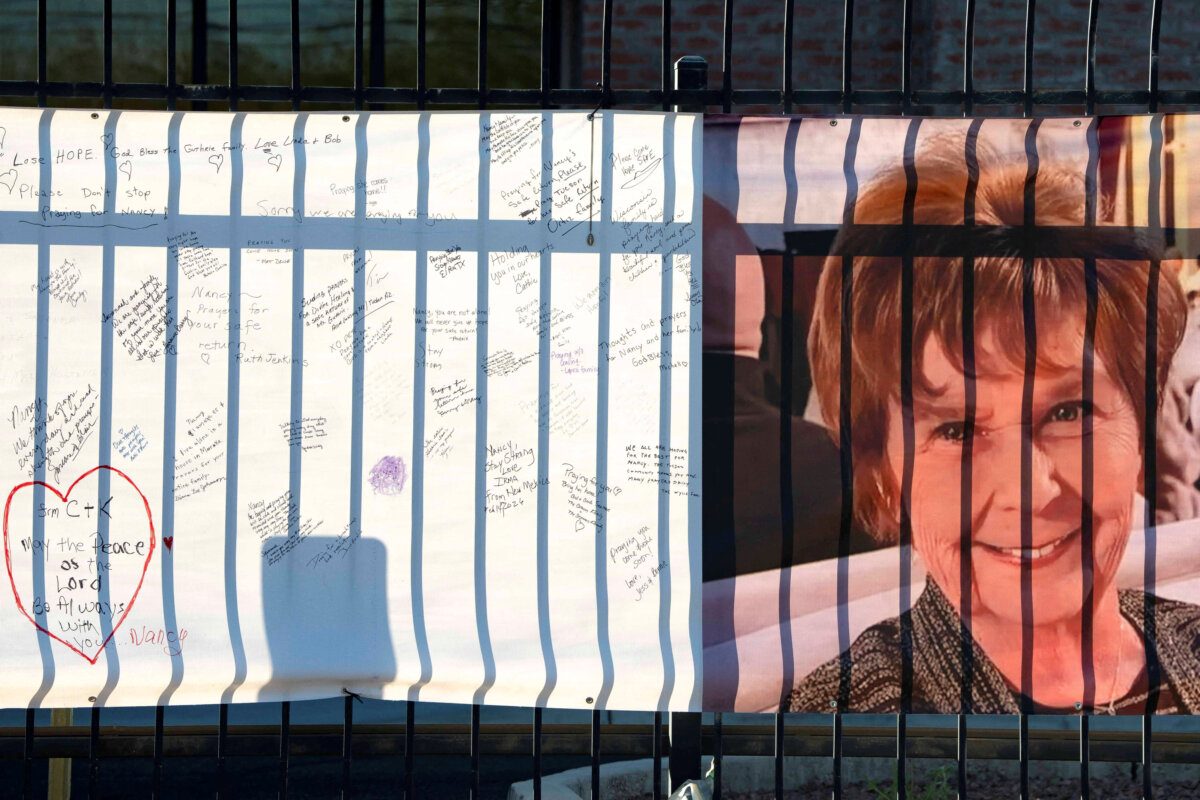

A Los Angeles-area man has pleaded guilty to federal harassment charges for sending fake ransom notes claiming he had kidnapped the missing mother of “Today” show co-host Savannah Guthrie.
Derrick Callella, 42, pleaded guilty on July 2 to two counts of harassment by telecommunications device, marking the only criminal conviction to date stemming from the disappearance of 84-year-old Nancy Guthrie from her home in Tucson, Arizona, five months ago.
The charges carry a maximum penalty of two years in prison and a $250,000 fine.
The plea agreement with prosecutors calls for Callella, a resident of Hawthorne, California, to serve five years on probation, according to a U.S. Attorney’s Office spokesperson. Formal sentencing was set for Sept. 10.
Guthrie’s fate is still unknown, and the underlying kidnapping case remains unsolved.
Nancy Guthrie went out to dinner with family members on Jan. 31, in Catalina Foothills, a community of about 52,400 people just outside Tucson, before being driven home.
Investigators have said that early on Feb. 1, her doorbell camera detected movement and was disconnected.
Nancy Guthrie’s pacemaker then vanished from a monitoring app on her phone.
Later that day, when she did not appear at church, her relatives went to her home and then reported her missing.
The FBI and Pima County Sheriff Chris Nanos have said they believe she was abducted against her will in the early hours of Feb. 1, and they said blood was found near the front doorstep of her home.
Surveillance videos from outside the home were later released by the FBI, showing a masked person, believed to be a man, on the porch of the house.
FBI Phoenix said the suspect was estimated to be 5-foot-9 to 5-foot-10 with an average build. In a social media post, the agency said it believed the backpack he was carrying was a 25-liter “Ozark Trail Hiker Pack.”
Search teams, including volunteers, spent weeks scouring the area around Catalina Foothills, terrain that includes cactus trees, bushes, and boulders.
The FBI said on July 1 that it was still evaluating some of the ransom notes that were sent in after the disappearance but that many of them were just attempts at extortion by people who had no knowledge of her whereabouts.
“Some have been determined to be extortion attempts without legitimacy. Other ransom demands may potentially be legitimate and are still being investigated as such,” the FBI said.
Last month, KOLD-TV, based in Tucson, and CNN reported that they received a purported ransom note in February that said Guthrie’s 84-year-old mother had died.
Savannah Guthrie made an appeal on the “Today” show on June 23, urging people to come forward with information and promising they can remain anonymous.
“We need your help. We’re begging for your help,” she said.
The Pima County Sheriff’s Department, which is also investigating the case, declined to comment on the notes on July 1, but said every tip was taken seriously.
FBI Director Kash Patel has clashed with Nanos about whether he called the bureau in early enough.
Nanos has said he involved the FBI immediately, but Patel told Sean Hannity on a May 5 episode of his “Hang Out With Sean Hannity” podcast that the bureau was “kept out of the investigation” for four days.
Patel also criticized Nanos for using a private laboratory in Florida to conduct DNA tests, despite an open offer to fly it to the FBI’s labs in Quantico, Virginia.
The case echoes other famous abductions for ransom, including the Lindbergh kidnapping in March 1932.
In that case, the 20-month-old son of world-famous aviator Charles Lindbergh was abducted from the nursery of his family’s home in Hopewell, New Jersey, by kidnappers who left a $50,000 ransom note.
The body of Charles Augustus Lindbergh Jr. was found two months later, despite a $50,000 ransom having been paid.
Bruno Hauptmann, an illegal immigrant from Germany, was later convicted of murder and extortion and was executed by electrocution in 1936.
Reuters and Chris Summers contributed to this report.
 Friends Read Free
Copy
Facebook
Tweet
Friends Read Free
Copy
Facebook
Tweet