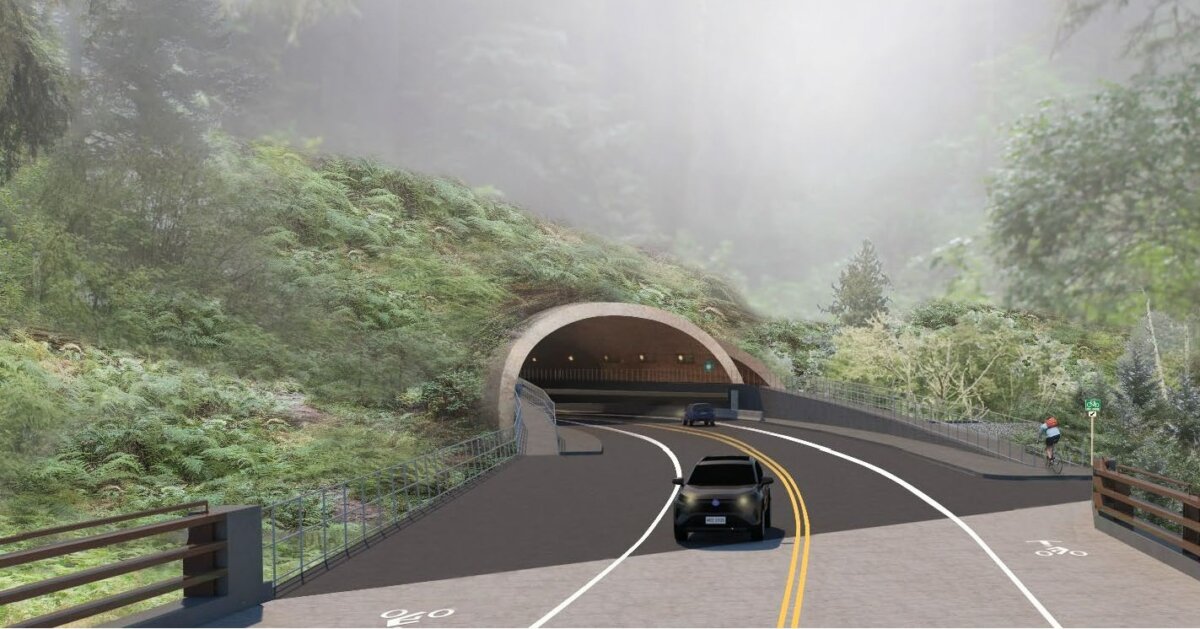

A remote region in Northern California, bordering Oregon, is getting a tunnel through the Last Chance Grade Project that will connect residents with their neighbors along U.S. Highway 101.
The coastal road south of Crescent City, the only town of border county Del Norte, has long been subjected to numerous landslides, ongoing maintenance costs, and indefinite closures.
“If there’s a closure at Last Chance Grade and there’s a detour, it’s six hours to get from where I live, Eureka, to Crescent City. Normally, it’s two hours,” Jaime Matteoli, corridor manager for Caltrans District 1 Last Chance Grade Project, told The Epoch Times.
Matteoli said Caltrans conducted a study in 2018 and found that if the road was closed for a full year, the region, which spans Humboldt and Del Norte counties in California, and Oregon’s Curry County—would lose hundreds of millions of dollars in business and about 3,800 jobs.
Caltrans announced in June 2024 that it had decided to construct a 6,000-foot-long tunnel, which is about 1.1 miles, to bypass landslides, making it the longest tunnel in Caltrans history.
The project’s environmental document should be finalized by late 2025. Construction is projected to start in 2031, and the tunnel could open as early as 2038, with an estimated cost of about $2.1 billion. In the meantime, Caltrans is trying to find funding for design, support, and other costs by December 2025, and needs to fund construction costs by 2029. The funding would come from a mix of sources including program, grant, competitive, and other federal and state level sources. Authorities are looking for ways to accelerate the timeline.
The hope is that the tunnel will help drivers avoid landslides, coastal erosion, and other environmental risks, and remain safe in the wake of an earthquake.
“It’s also one of the wettest places in the state. We have this chronic landslide that’s been moving for decades. It’s moved 40 feet horizontally and 30 feet vertically at the worst location. It’s about a mile long—the worst piece of the landslide. And there’s these deep-seated, complex landslides. There’s three of them, 200 feet plus deep,” Matteoli said.
Because of ongoing repairs, the road has been closed down to only one-way traffic for a total of nine years, he said. To make matters worse, a landslide on Feb. 14 forced roads to close for a few hours a day for several weeks. Authorities had to remove about 40,000 cubic yards of material, costing $10 million in repairs.
“I got a letter from a 12-year-old girl in Crescent City saying how important this tunnel is to her. … It talks about how mom and dad, if there’s traffic, they get stuck returning home from work,” Matteoli said. “So it’s a quality of life issue, and it’s an economic issue.”
The proposed tunnel would run through the mountain parallel to the current highway, going around the landslide at about the same elevation and slope. He said the tunnel would be excavated through rock with a method called sequential excavation.
“There’s a piece of equipment called a road header that kind of bores. It has [something] like a mining head on it, and there’s an excavator that can sort of dig out,” Matteoli said. “The nature of the geology is, it’s a mix of material, and you have some softer things that might dig really easily, and you might have some really hard, hard blocks of stone that might take more different methods.”
The next step in the design process is to obtain better data on the material for tunnel alignment.
To address earthquake and other seismic activity concerns native to the region, Matteoli said the tunnel is designed to perform well during such events. Safety systems would include an emergency egress, escape paths, surveillance cameras, fire detection systems, heat detection systems, sprinkler systems, jet fans, drainage systems, communication systems, signage, and lighting that would keep people safe during an emergency.
 Friends Read Free
Copy
Facebook
Tweet
Friends Read Free
Copy
Facebook
Tweet