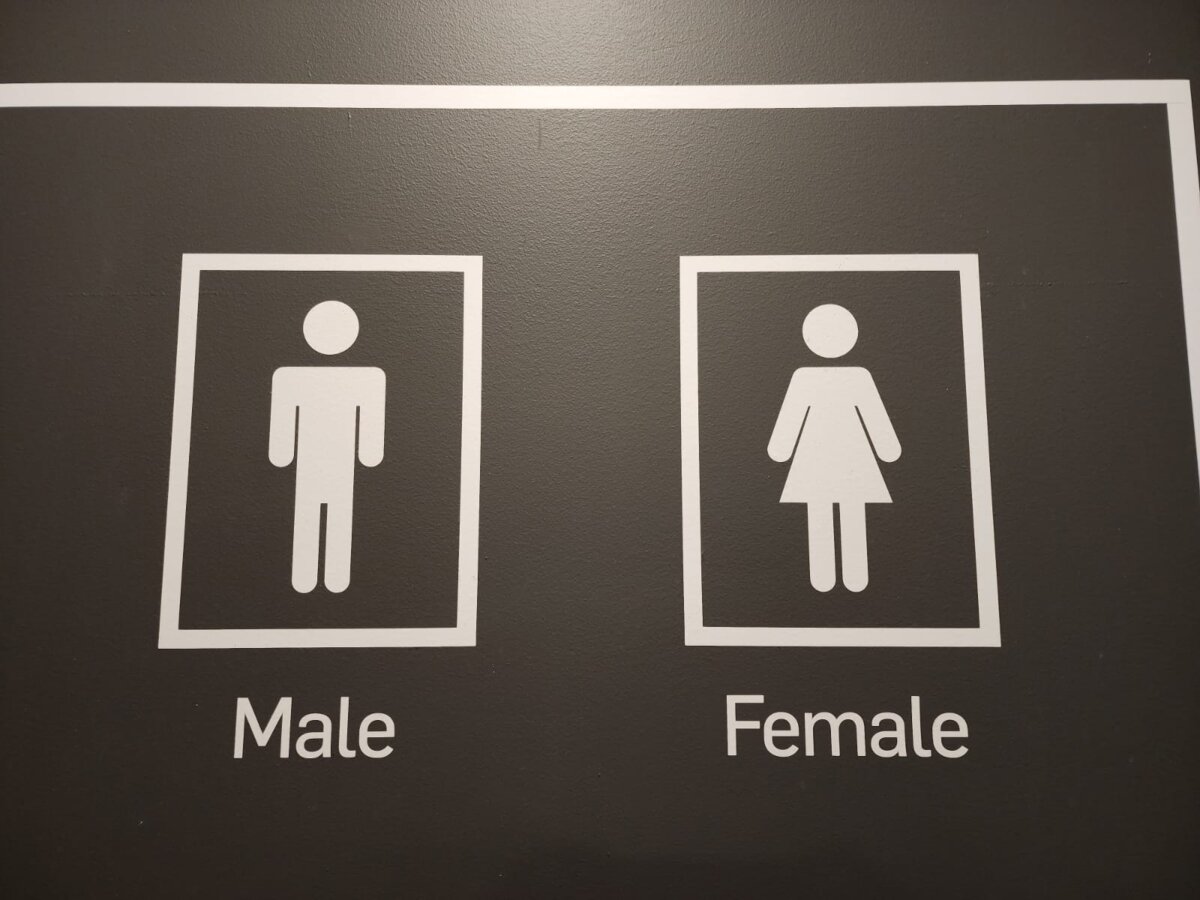

The Equal Employment Opportunity Commission (EEOC) on Thursday voted 2-1 to approve a decision recognizing that federal agencies can designate intimate spaces, such as bathrooms and locker rooms, on the basis of sex, and not gender identity, the agency said in a Feb. 26 statement.
The decision was taken while assessing a discrimination appeal filed by a transgender-identifying federal employee, who argued that an agency’s policy to assign bathrooms based on sex rather than “gender identity” violated Title VII of the Civil Rights Act of 1964. Title VII is a federal employment law that bans employment discrimination on the basis of race, sex, religion, national origin, and color.
Federal courts have not determined whether Title VII requires federal employers to permit transgender workers access to intimate spaces reserved for members of the opposite sex, according to the EEOC statement.
“In applying the traditional tools of statutory construction, the EEOC found that Title VII permits a federal agency employer to maintain single-sex bathrooms and similar intimate spaces; and permits a federal agency employer to exclude employees, including trans-identifying employees, from opposite sex-facilities,” the statement said.
The decision applies only to federal agencies that are subject to EEOC’s oversight, and not to private sector employees.
According to the decision document, the complainant worked for the Army as a civilian IT specialist at Fort Riley, Kansas. The male complainant for most of the tenure used male-designated bathrooms and locker rooms at the Army facility.
In summer 2025, the complainant informed local management that he now identified as a woman, and requested to use female-designated bathrooms and locker rooms.
The management denied the request, relying on President Donald Trump’s Jan. 20, 2025, executive order “Defending Women From Gender Ideology Extremism and Restoring Biological Truth to the Federal Government.”
The order stated that sex refers to an individual’s “immutable biological classification” as either male or female, and that the word does not include the concept of “gender identity.”
It asked agencies to ensure “intimate spaces designated for women, girls, or females (or for men, boys, or males) are designated by sex and not identity.”
In its decision, EEOC said that women have a “vital privacy interest” in using a workplace intimate space outside the presence of men. In the same way, men also have an interest in using a workplace intimate space outside the presence of women.
“Because their interests have different polarities, men and women cannot be similarly situated in this instance,” the agency said, while ruling that exclusion of an employee from an opposite-sex bathroom or similar intimate space does not constitute a claim for relief under Title VII.
The decision reverses a 2015 decision from EEOC, which held that federal agencies must allow transgender employees access to opposite-sex restrooms.
‘Biology Is Not Bigotry’
In a Feb. 26 statement, the Congressional Equality Caucus criticized the EEOC decision, calling it an “anti-trans move” by the agency.
Rep. Mark Takano (D-Calif.), chair of the caucus, said that overturning the 2015 decision amounts to EEOC Chair Andrea Lucas slapping the face of Americans who have faced discrimination based on their gender identity.
“Authorizing vigilante bathroom police doesn’t just endanger transgender people—it puts every girl and woman at risk, especially those who don’t fit Republican extremists’ idea of what women ‘should’ look like or act,” Takano said.
“The EEOC was created with the explicit mission of protecting American workers from discrimination—but under Trump and Chair Andrea Lucas, the Commission has abandoned its duty in order to push Trump’s radical, anti-equality, and anti-worker agenda.”
In the EEOC statement, Lucas said that the agency’s latest decision is in line with the plain meaning of “sex” as understood by Congress when Title VII was enacted.
It is also in line with “longstanding civil rights principles: that similarly situated employees must be treated equally,” Lucas said. “When it comes to bathrooms, male and female employees are not similarly situated. Biology is not bigotry.”
Meanwhile, the EEOC expanded its oversight against diversity, equity, and inclusion (DEI) initiatives in the corporate world with another recent action.
On Thursday, Lucas sent letters to the leaders of Fortune 500 companies, which collectively employ more than 30 million workers worldwide, reminding them to comply with nondiscrimination obligations under Title VII, which is also applicable to DEI practices, according to a Feb. 26 statement from the agency.
“I urge Corporate America to reject identity politics as its solution to society’s ills. The only lawful way to stop discrimination on the basis of race or sex, is to stop discriminating on the basis of race or sex,” Lucas said.
“Hiring workers based on their merit, excellence, and character—not skin color or sex—is the right thing to do and benefits employers and employees alike.”
 Friends Read Free
Copy
Facebook
Tweet
Friends Read Free
Copy
Facebook
Tweet