
President Donald Trump said on Jan. 20 that he does not need Congress to issue $2,000 tariff rebate checks.
“I don’t think we would have to go to the Congress, but we’ll find out,” Trump told reporters one day before attending the annual World Economic Forum in Davos, Switzerland.
For months, the administration has touted the possibility of sending rebate checks to U.S. households and paying down the $39 trillion national debt with the president’s import duties.
“The reason we’re even talking about it is that we have so much money coming in from tariffs,” Trump said.
“But we will be able to make a very substantial dividend to the people of our country.”
He also indicated that there would be income limits, reiterating last year’s remarks that the checks would go out to “everybody but the rich.”
Trump’s suggestion that he would not require congressional approval for tariff rebate checks differs from comments by Treasury Secretary Scott Bessent in November 2025.
“We need legislation for that,” Bessent said in an interview with Fox News’s “Sunday Morning Futures.”
Some lawmakers have indicated that they would be willing to advance legislation establishing tariff rebate checks.
In summer 2025, Sen. Josh Hawley (R-Mo.) introduced a bill—the American Worker Rebate Act—that would send rebate checks to Americans from revenue generated by the president’s levies.
Hawley proposed a rebate of at least $600 per adult and dependent child, totaling $2,400 for a family of four.
This fiscal year to date, federal tariff income has exceeded $101 billion, according to Jan. 16 data from the Treasury Department.
But the fate of dividend payments is up in the air, as the Supreme Court is expected to soon decide whether the president has the authority to impose import taxes without congressional approval.
Trump has stated that the high court ruling in the administration’s favor is critical to the U.S. economy and national security.
White House officials are confident that the Supreme Court will determine that the executive branch has the power to use the International Emergency Economic Powers Act.
“I believe that it is very unlikely that the Supreme Court will overrule a president’s signature economic policy,” Bessent said on NBC’s “Meet the Press.”
“They did not overrule Obamacare; I believe that the Supreme Court does not want to create chaos.”
Still, federal officials said the United States has other tools available to carry out the president’s agenda.
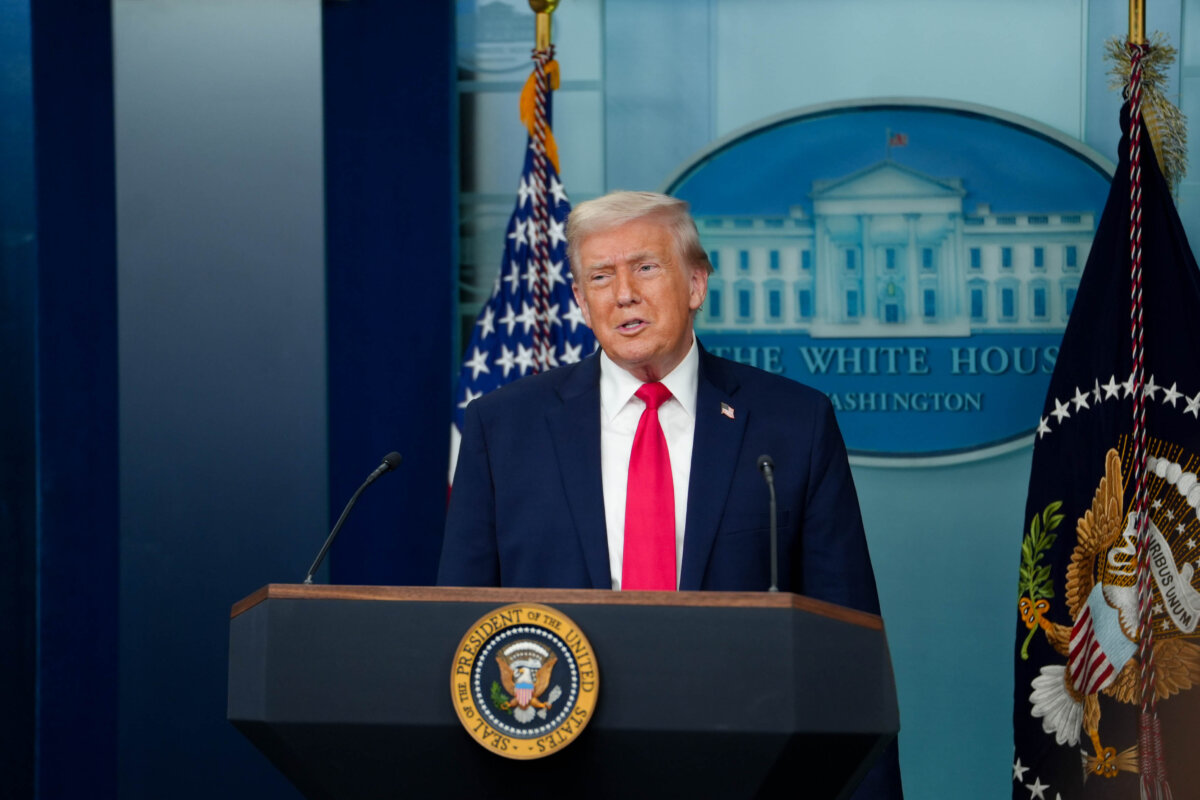
The president also acknowledged that it is unclear how importers would be repaid.
“We’ve taken in hundreds of billions of dollars, and if we lose that case, it’s possible we’re going to do the best we can in paying it back,” Trump said at the press briefing. “I don’t know how that’s going to be done, very easily, without hurting a lot of people.”
Dollars and Cents of Tariff Rebate Checks
While official details are scarce, economic observers have presented various estimates of the cost behind the proposed program.
A group of Tax Foundation economists determined that the cost of mailing out tariff dividends would exceed revenues.
They put together three models, with costs ranging from $279.8 billion to $606.8 billion. Revenues are forecast to reach $207.5 billion this year, the economists noted.
“All tariff dividend designs would cost more than the revenue that the president’s new tariffs will generate in 2025, and many designs would use all the revenue they will generate in 2026 too,” Tax Foundation economists wrote in a Nov. 18 report.
“In other words, sending out ‘tariff dividends’ in 2026 would leave no revenue to offset the cost of tax cuts or reduce the deficit in the near term.”
Assuming that checks are limited to individuals earning less than $80,000 per year, the price tag would be as much as $250 billion, according to Thomas Feltmate, senior economist at TD Economics.
Tariff checks may slightly stimulate consumer spending, adding close to three-quarters of a percentage point in 2026, he said.
At the same time, Congress might be hesitant to support tariff dividend checks.
“With Congress showing a reluctance to undertake further spending measures that will add further pressures to the deficit, it’s unlikely that the President’s plan will be implemented,” Feltmate said in a Dec. 5 research note.
The Epoch Times has contacted the White House for comment.
 Friends Read Free
Copy
Facebook
Tweet
Friends Read Free
Copy
Facebook
Tweet