Former Cuban leader Raúl Castro is facing murder charges from a U.S. indictment announced on May 20, and Cuban Americans have said it is more than just a symbolic gesture—it is a promise that the 94-year-old will soon be facing justice.
Sources told The Epoch Times that given the U.S. actions against Venezuela with the capture of leader Nicolás Maduro in Caracas, as well as the decapitation of the Iranian regime, it would be foolish of the communist Cuban government to dismiss U.S. President Donald Trump’s rhetoric toward the island nation.
“[The United States] is the superpower, we are the freest, best nation in the world, and if you are committing crimes against humanity in our hemisphere, it is our job to take care of that and bring justice to the people who are being affected,” one Cuban American man told The Epoch Times on May 22.
Castro is accused of playing a role in shooting down two Cessna planes in 1996 that belonged to the humanitarian group Brothers to the Rescue, killing three U.S. citizens and one lawful resident, according to the indictment filed in federal court in Miami.
He and five codefendants are charged with one count of conspiracy to kill U.S. nationals, four counts of murder, and two counts of destruction of aircraft.
Castro is the younger brother of longtime Cuban dictator Fidel Castro. Alongside Marxist revolutionary figure Che Guevara, the brothers led a bloody revolution to overthrow dictator Fulgencio Batista in 1959.
After Fidel Castro’s health deteriorated, Raúl Castro assumed control of the island and officially became the leader in 2008, until he gave control of Cuba to Miguel Díaz-Canel in 2018.
The indictment is the latest in a series of U.S. actions against a Cuban leadership facing sanctions, widespread blackouts, an oil blockade, an energy crisis, and an American aircraft carrier on its doorstep.
“[The indictment] represents a potential change in Cuba, one that we’ve been waiting for for almost 70 years at this point,” another Cuban American source told The Epoch Times on May 22.
Preparing for a Transition
Jordi Martínez-Cid, who runs his own law firm and is the president of the Cuban American Bar Association, said he and others in his organization are “absolutely delighted” with the Raúl Castro indictment. He shared details of a plan, 20 years in the making, to help Cuba transition once the regime collapses.
Martínez-Cid’s parents fled Cuba in the 1960s. His father was a “Peter Pan” child, part of a U.S. program called Operation Peter Pan that was created for children whose parents were fighting against the Castros.
From December 1960 to the end of 1962, more than 14,000 unaccompanied children, ranging in age from 4 to 16, were sent by their parents from Cuba to Miami, according to Smithsonian records. Martínez-Cid’s father went on to become one of the founders of the Cuban American Bar Association, and his brother was a former president of the group.
Martínez-Cid became head of the organization earlier this year. He told The Epoch Times that he had hoped to witness change in Cuba during his tenure but that he did not expect it to be happening so quickly.
“Thankfully, [the Cuban American Bar Association] has, on a certain level, been planning for this for quite a bit,” Martínez-Cid said. “We developed with other exiled groups around the world, actually other Cuban exiles around the world, and with input from dissidents on the island, a draft fundamental transition law.”
But it is not a full-fledged constitution, he said.
He described it as a simple document crafted over the span of 20 years that complies with international norms and that would help prevent any power vacuum if the Cuban regime were to fall, either on its own or with U.S. intervention.
“It would hopefully be the document that bridges the gap between the unworkable Cuban system right now and a more permanent constitution of Cuba that respects democratic principles and human rights and private property,” Martínez-Cid said.
Cubans in their homeland and in the United States are ready for a new form of governance, sources said. Many Cuban Americans, including Fidel Castro’s own daughter, have told The Epoch Times that regime change is overdue.
Widespread Support for Cuba
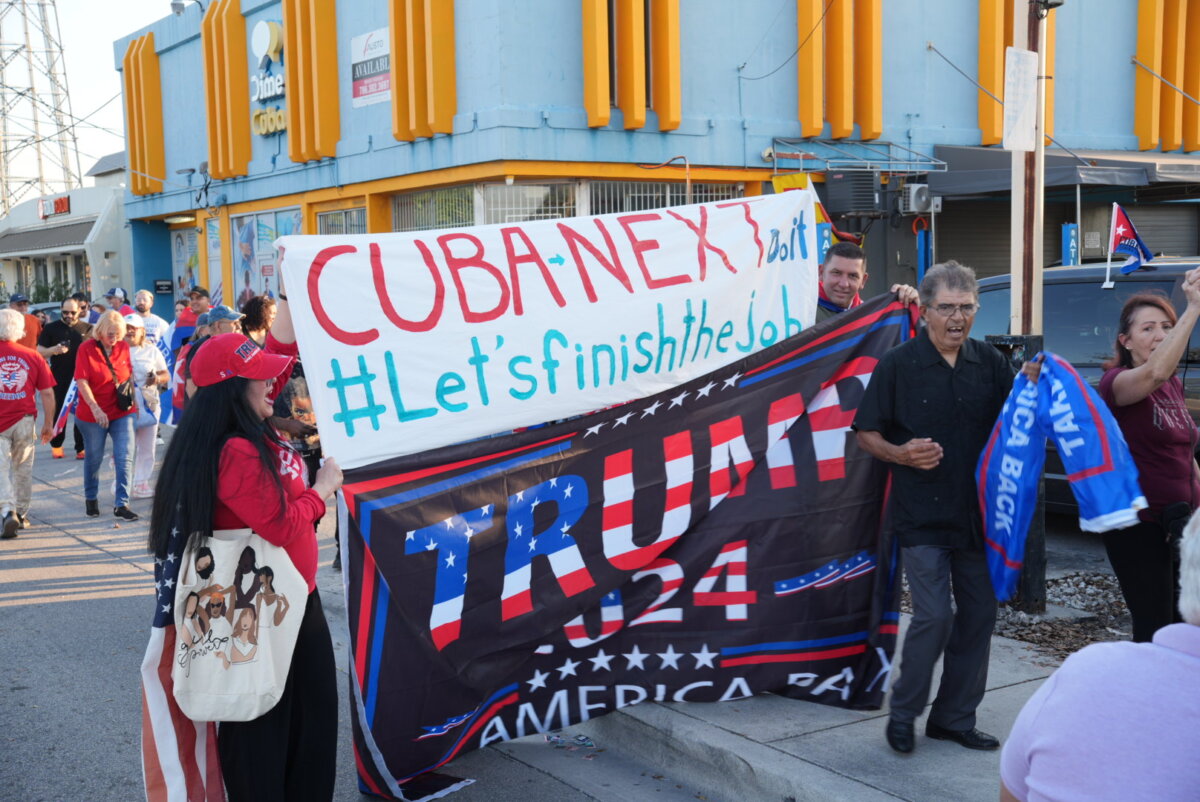
Cuban Americans, from youth groups to the very top of the federal government, have rejected communism in the island nation. Thousands of people flock to frequent “Free Cuba” rallies in Miami to support U.S. pressure and potential intervention.
Miguel Granda, president of Miami Young Republicans and candidate for a Florida House seat, said he has witnessed overwhelming support for regime change among the Cuban American population in South Florida.
He is a son of Cuban parents who escaped in the early 1960s and have never been back.
Cuban Americans have such passion for the state of their country because they either fled and survived or grew up hearing stories from their parents, Granda said.
“From a young age, we’re all involved in politics here in Miami, just to make sure that our state and our country doesn’t go down that same path,” Granda said.
Martínez-Cid also noted that there are Cuban American voices in the top leadership in the Trump administration such as Secretary of State Marco Rubio, who has often criticized the communist country and has called on Cubans to reject its leadership, and U.S. Attorney Jason Reding Quiñones, who is leading the indictment against Raúl Castro.
Martínez-Cid said that at the pace at which this administration has moved in capturing or taking out adversaries, as in Venezuela and Iran, he would not be surprised to see Raúl Castro in U.S. custody by this summer.
“This administration did something similar with Maduro,” he said. “There is no reason to believe that it would not do the same with Raúl [Castro].”
Granda concurred and said the hope that Raúl Castro will face justice in America is the “sentiment of pretty much everyone … in Miami.”
He has many family members still in Cuba, but he is not sure how many because he has never been, he said, noting that some of his relatives have been imprisoned by the regime. Neither he nor his parents are able to communicate much with them outside of Facebook or WhatsApp messaging.
“There’s probably dozens of family members that I’ve never met,” Granda said. “I want to be able to witness a president actually respecting the Hispanic community by just destroying the people that destroyed our family’s lives.”
 Friends Read Free
Copy
Facebook
Tweet
Friends Read Free
Copy
Facebook
Tweet