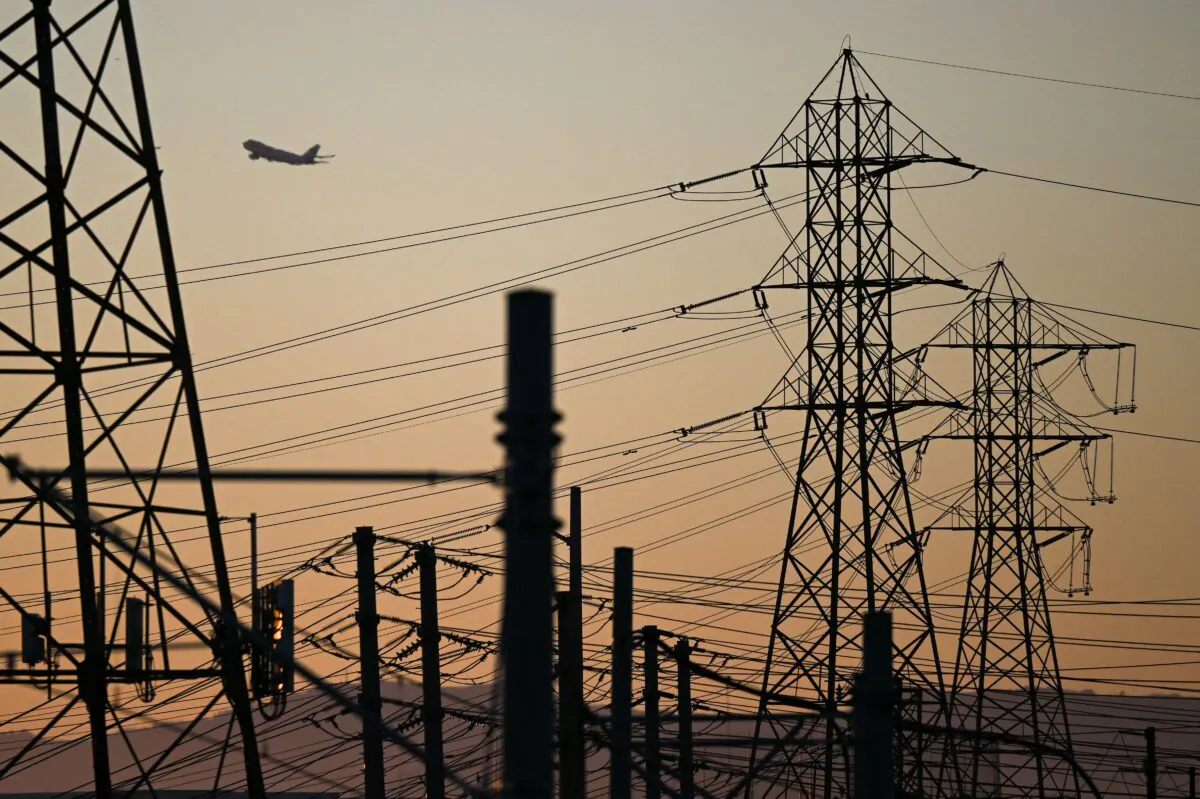

Driven by new data centers and artificial intelligence (AI) infrastructure, retail electricity sales to consumers across the United States are expected to grow at an annual rate of 2.2 percent in both 2025 and 2026.
This is a 175 percent jump compared with the 0.8 percent average growth during the 2020–2024 period, the Energy Information Administration (EIA) said in a July 31 analysis.
The Electric Reliability Council of Texas (ERCOT) serves 24 million customers in Texas, accounting for roughly 90 percent of the state’s electrical load, the EIA said. PJM Interconnection serves the District of Columbia and 13 states: Delaware, Illinois, Indiana, Kentucky, Maryland, Michigan, New Jersey, North Carolina, Ohio, Pennsylvania, Tennessee, Virginia, and West Virginia.
“After relatively little change in U.S. electricity demand between 2005 and 2020, retail sales of electricity have begun growing again, driven by rising demand in the commercial and industrial sectors,” the EIA stated.
“Developers have proposed numerous data centers and large manufacturing facilities that could consume significant amounts of electricity, and many of these projects are concentrated in the ERCOT and PJM regions.”
For instance, the Trump-endorsed Stargate Project, backed by OpenAI, plans to invest $500 billion to build new AI infrastructure in Abilene, Texas. Meanwhile, Elon Musk is rapidly expanding xAI’s $6 billion Colossus supercomputer in Tennessee.
On July 24, the Department of Energy said it has selected four sites to attract private investment to build AI data centers and energy generation projects, two of which are in PJM service areas.
The EIA said it was expecting electricity demand within the ERCOT region to grow by 7 percent and 14 percent in 2025 and 2026, respectively, “when some large data centers and cryptocurrency mining facilities come online.”
In the PJM service region, electricity sales are projected to rise by 3 percent this year and 4 percent in 2026, the agency said.
Residential Price Hikes
The EIA’s prediction of an electricity sales spike follows the agency’s forecasting in a May 14 statement that residential electricity prices this year are expected to rise by 13 percent from 2022 prices.
“Parts of the country with relatively high electricity prices may experience greater price increases than those with relatively low electricity prices,” the EIA stated.
“Residential electricity prices in the Pacific, Middle Atlantic, and New England census divisions—regions where consumers already pay much more per kilowatt-hour for electricity—could increase more than the national average.”
Meanwhile, data center-driven demand could pose a “significant near-term reliability challenge” for the stability of the U.S. power grid, the North American Electric Reliability Corporation (NERC) warned in a June 12 report.
The large electricity loads used by data centers are creating new reliability challenges, the NERC reported. Because data centers can be developed faster than the energy infrastructure needed to support them, this results in “lower system stability,” it said.
“Additionally, the voltage sensitivity and rapidly changing, often unpredictable, power usage of these facilities creates new operating challenges,” the NERC stated.
Plans for Nuclear Facilities
Big tech companies are looking to nuclear power plants to meet data center electricity demand.
In 2024, Amazon signed contracts with three states—Washington, Virginia, and Pennsylvania—to build small modular reactors. Meta and Google also announced similar plans last year.
In June, Dallas-based Fermi America, cofounded by former Energy Secretary Rick Perry, said it planned to construct 18 million square feet of AI data center space, set to be fully operational by 2032.
The energy to power the massive facility will come from the “largest nuclear power complex in America,” backed by “the nation’s biggest combined-cycle natural gas project, solar power, and battery storage,” the company said.
In a statement, Perry said the motivation to power the data center from nuclear energy came from President Donald Trump’s executive orders in May that seek to reinvigorate the nuclear sector in the United States.
“The Chinese are building 22 nuclear reactors today to power the future of AI,” Perry said. “America has none. We’re behind, and it’s all hands on deck.”
 Friends Read Free
Copy
Facebook
Tweet
Friends Read Free
Copy
Facebook
Tweet