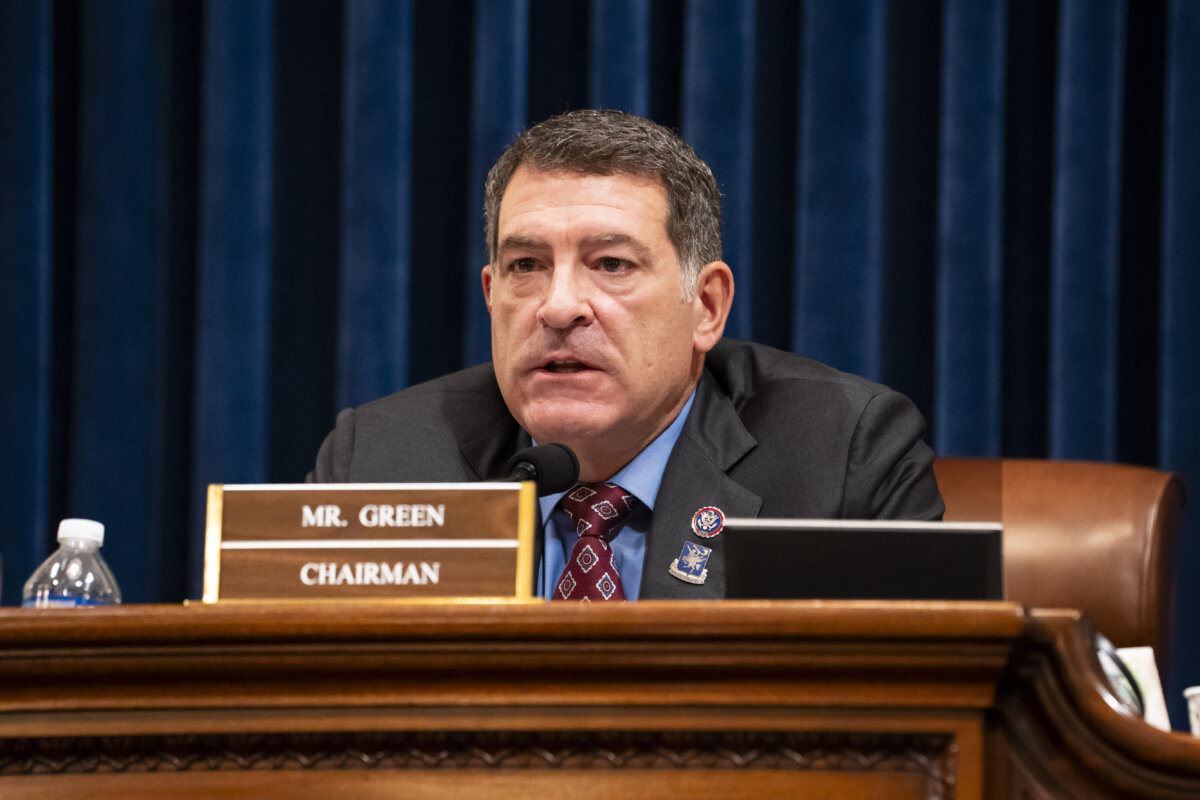

Democrats see an opportunity in Tennessee’s Seventh Congressional District this fall, as a special election to replace outgoing Republican Rep. Mark Green puts the deep-red district back in play—at least on paper.
However, experts say any path to a Democratic victory will be narrow and turnout-dependent.
In an opinion piece, former Democratic state House candidate Tyler Brasher said that Tennessee’s special election could take on outsized national importance, noting that the only other upcoming House special elections—in Texas’s 18th, Arizona’s Seventh, and Virginia’s 11th districts—are in safely Democratic territory.
“All eyes will be on Tennessee as the premier special election in the country,” he wrote. “For once, a Tennessee Democratic candidate will have significant resources from outside the state.”
He added that assuming those three Democrats win those races, Republican Speaker Mike Johnson will have a majority of only three members.
“Get your popcorn ready for a knockdown, drag-out fight for this seat,” Brasher added.
Green’s resignation will take effect on July 20. Tennessee law requires the governor to issue a call for an election within 10 days of a U.S. House vacancy.
The special primary must follow in 55 to 60 days, and the general election must happen 100 to 107 days after the writ. This means the vote must wrap up by early November. Tennessee Gov. Bill Lee, a Republican, has not yet issued the formal notice for an election.
Kent Syler, a political science professor at Middle Tennessee State University, said in an interview with The Epoch Times that the seat is safely Republican on the surface.
Syler noted that Rep. Green got 60 percent of the vote in 2024, while former Nashville Mayor Megan Barry, the Democratic nominee, received only 38 percent. That was despite that she ran “a strong, well-financed campaign.”
Still, Syler said, special elections can shift dynamics.
“Donald Trump had some long coattails then,” he said. “And so a special election—it reshuffles the deck. All special elections are about turnout and who can get their voters to the polls.”
He added there is no doubt there’s a “lot of energy” on the Democratic side and that this election, like all others before next year’s midterms, would be more of a referendum on President Donald Trump than the names on the ballot.
Democrats are hopeful the short timeline and controversies surrounding recent Republican legislation may energize their base, mirroring gains seen in Florida’s two special elections earlier this year.
In both contests, Republicans won but underperformed expectations. In Florida’s Sixth District, Randy Fine underperformed former Republican Rep. Mike Waltz by about 10 points, according to The Associated Press. In Florida’s First District, Democrat Gay Valimont also narrowed the GOP margin compared with 2024 results.
Democratic National Committee Chair Ken Martin at the time called it a “massive overperformance” in a district Trump won by 30 points and said Republicans “should be nervous for 2026.”
However, Syler cautioned against assuming the same will happen in Tennessee.
“The geography of the district certainly favors a Republican,” he said, adding that 22 percent of the district is urban—Davidson County, which includes Nashville—while 39 percent of it is suburban—Montgomery and Williamson—and 39 percent of it is rural.
“If you look at those three things, you know, the Republicans have a pretty big edge in around 78 percent of the district,” he said.
He said the GOP nominee will likely stick to a proven strategy: Run hard to the right in the primary, embrace Trump, and rely on the district’s partisan lean to win the general.
“That formula keeps working, and they’ll try it again,” Syler said.
Democratic candidates who have filed with the Federal Election Commission (FEC) to run are David O. Jones Jr., state Rep. Vincent Dixie, and state Rep. Aftyn Behn. State Rep. Bo Mitchell has also declared his intent to run but had not filed with the FEC as of July 16.
On the Republican side, those who had filed with the FEC to run as of July 16 are Tennessee General Services Commissioner Matt Van Epps, state Rep. Jody Barrett, state Rep. Lee Reeves, state Rep. Johnny Garrett, Montgomery County Commissioner Jason Knight, Stewart Parks, Jonathan Thorp, and Mason Foley.
Tennessee Democratic Party Chair Rachel Campbell said the party is encouraged by early enthusiasm.
“We’re excited that the people of Middle Tennessee will have an opportunity to send a real advocate to Congress,” Campbell said in an emailed statement to The Epoch Times.
“We’ve seen tremendous energy from folks who are feeling the effect of this irresponsible [Make America Great Again] agenda and shameful budget. We’re ready to take on whoever comes out of the Republican primary, because we know when the people make their voices heard: Democrats win.”
Digital strategist Mike Nellis, who runs a Democratic fundraising and ad firm, said it’s worth contesting the race even with long odds.
“Anything is possible, given how unpopular Donald Trump is nationally and how unpopular the Republican budget is,” Nellis told The Epoch Times. “It’s a challenging race for Democrats to win—R+10, and Donald Trump won it by over 20 points.”
Nellis added that it’s important for the party to find a good candidate who can “communicate, understands the district, and can bring in unlikely voters.”
“It’s important for us to run a good campaign,” he added. “It’s important for us to take every opportunity to show people that we’re fighting. I think you’ll likely see Democrats overperform in this special election compared to how we did in 2024. Tough road to sled, but stranger things have happened. I think it’s worth contesting.”
Max Weisman, a Democratic strategist based in Philadelphia, said the party can’t rely on old messaging.
“Being anti-Trump is not enough,” Weisman said. “A winning candidate will inspire with a vision of hope, change, and a unified country.”
Whether national Democrats will prioritize this race remains to be seen. Syler said it depends entirely on early polling and signs of competitiveness.
“They’ll get involved if they think there’s a real chance,” he said. “But if not, they’ll walk away. That’s just the way it works.”
Both candidates are leaning into issues such as rural health care, affordability, and economic fairness as central campaign themes. Behn is appealing to activist energy and a younger progressive base, while Mitchell is highlighting bipartisan pragmatism and legislative experience.
With the House Republican majority razor-thin, every seat counts. But unless Democrats can boost turnout in deep red areas, the Seventh District may remain out of reach.
The Tennessee Republican Party did not provide a comment before publication, and the Democratic National Committee declined to comment.
 Friends Read Free
Copy
Facebook
Tweet
Friends Read Free
Copy
Facebook
Tweet