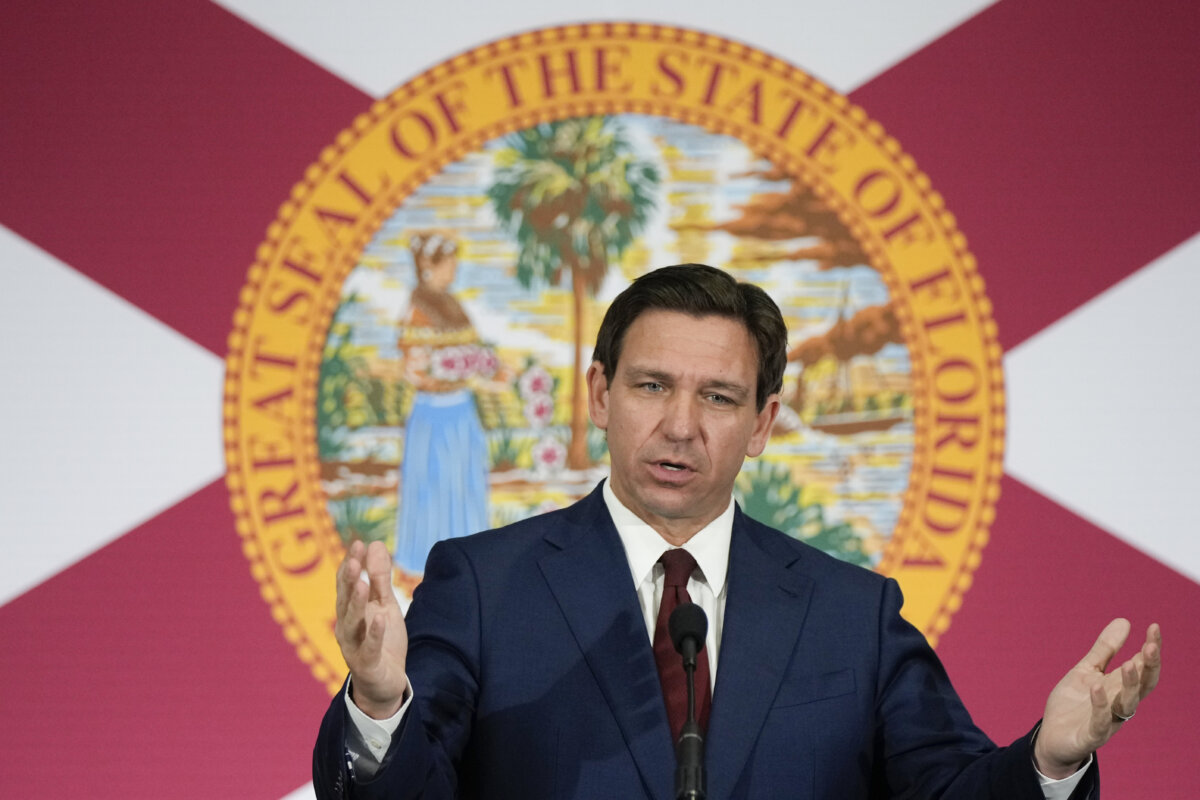
Florida Gov. Ron DeSantis stood before the state legislature and devoted most of his final State of the State address to summarizing how the Sunshine State has become a recognized example of the kind of freedom envisioned by the Founding Fathers.
“We can proudly claim that it is our Free State of Florida that best represents that enduring spirit of 1776, of all the 50 states,” he said on Jan. 13. “It is our Sunshine State that best fulfills the Founding Fathers’ vision of a republican government that protects freedom, promotes opportunity and provides an open field and fair chance for people to make the most of their God-given ability.”
Between rounds of standing ovations from both sides of the aisle, the governor, who is term-limited from running for a third term, provided data points across a wide variety of issues tackled by lawmakers over his two terms that he said put people’s freedom first.
These included nearly $10 billion in tax relief that the governor said helped make Florida the most taxpayer-friendly state government in the country. That relief included elimination of taxes on baby items, business rent, and disaster supplies, and amounted to nearly triple the relief provided by lawmakers in the previous eight years.
The governor addressed the state’s education reforms, which he said have made Florida a recognized leader in parental empowerment and education freedom and a leader in higher education.
“Seven years ago, many took for granted that education was held captive by the ideological fads championed by the political left. Not us,” he said. “We’ve defeated attempts to force boys into girls sports, to inject gender ideology into elementary schools and to deny parents the right to direct the education and upbringing of their children. We have ensured that our schools have a duty to educate, not a right to indoctrinate you.”
Key moves by the state government included implementing universal school choice, a revived emphasis on civic education and speech and debate, as well as eliminating diversity, equity, and inclusion programs, overhauling accreditation processes, and establishing classical curricula that “embrace the values that comprise the foundation, not just of the American republic, but of Western civilization itself.”
The governor also credited the increase in focus on law and order to the state’s success. That focus included increasing investments in law enforcement officers, eliminating what he termed “jailbreak” policies, imposing the death penalty on pedophiles, and implementing zero-tolerance policies for looters and protestors blocking traffic. In addition, the state’s recruitment bonus program has attracted nearly 10,000 law enforcement officers from across the country.
Tied to that emphasis on law and order was the work the state has done to crack down on illegal immigration, from eliminating sanctuary cities and education benefits for illegal immigrants to flying illegal immigrants to Martha’s Vineyard and opening Alligator Alcatraz and the Deportation Depot.
Under DeSantis’s leadership, Florida became the first state to require the cooperation of state and local agencies and officers with federal agents, he said, adding that nearly 20,000 illegal immigrants have been turned over by state authorities to the U.S. Department of Homeland Security in the last nine months.
He also gave credit to the state’s decision to stand firm against “medical authoritarianism” during and after the COVID-19 pandemic.
“People must have the right to make personalized choices about which medical products to consume or which medical interventions to undergo,” he said. “Informed consent must be the touchstone. Let’s make that the law of the land in the Free State of Florida.”
Other achievements highlighted by the governor included significant Everglades restoration, the reduction of Environmental Social Governance (ESG) policies, the optimization of the state’s disaster response capabilities, election integrity enforcement, and the creation and success of the HOPE Florida Initiative.
Florida’s economy grew by $800 billion across the last seven years, attracting more income during that time period than any other state in the nation’s history, the governor said. He stated that since 2020, the state’s economy has accounted for 14 percent of the new jobs produced in the country, and for the past three years, CNBC has ranked Florida’s economy number one in the nation.
“Over the past seven years, we witnessed a great experiment as different approaches to government have been tried in different states,” he said. “States that have followed Florida’s approach have seen population and business growth and have maintained [a] healthy fiscal and budget posture. States that have pursued a different course have hemorrhaged population, income and businesses, and many of them are in the midst of dire fiscal and budget crises.
“The results of this grand experiment are in people [who] have voted with their feet, we can confidently say that Americans prefer the warmth of Florida freedom to the frigidity of New York collectivism.”
Looking ahead, DeSantis told lawmakers to get to work in the final 60-day session, and pushed both chambers to produce a property tax elimination ballot measure that could go before the state’s voters this November.
“You should be able to own your home without paying perpetual rent to the government,” he said. “The legislature has the ability to place a measure on the ballot to provide transformational relief for taxpayers. Let’s resolve to all work together, get something done, and let the people have a say.”
He also warned of uncertainties surrounding the onset of artificial intelligence, and expressed hope that the state government would continue to be one of action after he leaves Tallahassee next year.
 Friends Read Free
Copy
Facebook
Tweet
Friends Read Free
Copy
Facebook
Tweet