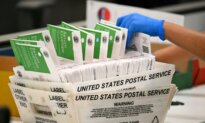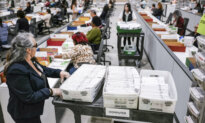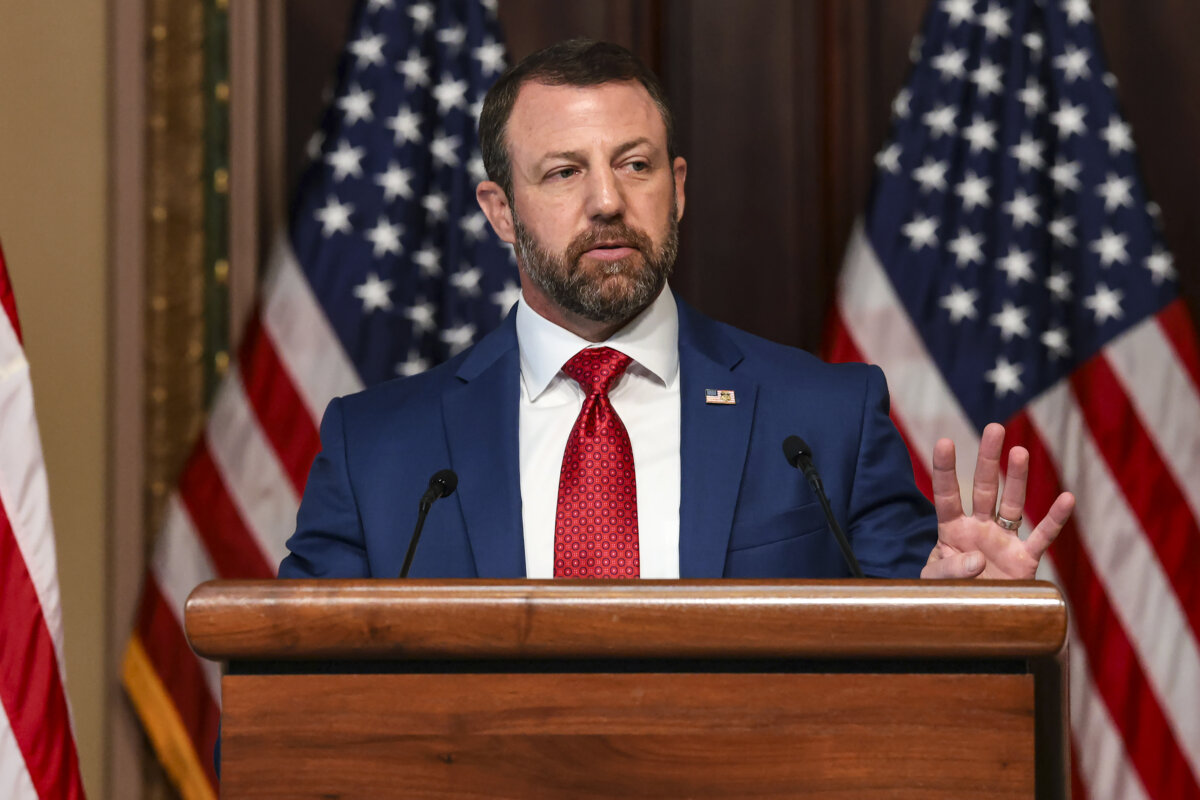

Parts of many voting machines used in the United States are made in China, the Department of Homeland Security (DHS) secretary said in a letter released on Aug. 27.
Companies that make more than 80 percent of the electronic voting machines used in the United States have acknowledged that parts of their machines are made in China, DHS Secretary Markwayne Mullin wrote to the White House Transparency Task Force in the letter, which was dated Aug. 24. Company officials have said that there are no alternative suppliers for some of the parts.
“Voting machines with components manufactured by foreign adversaries introduce significant security risks,” Mullin said. “These vulnerabilities mean that malicious actors could potentially compromise election infrastructure at any stage of the supply chain, even before the machines are assembled or deployed. If a component is tampered with during manufacturing, it could serve as a point-of-entry for hackers, allowing for the possibility of synchronized attacks across multiple machines and jurisdictions.”
The security concerns have resulted in a DHS grant program requiring states to “trust but verify the results produced by the voting machines,” Mullin said. To receive full grant awards under the program, states have to conduct random manual counts of paper ballots following the upcoming election “to ensure that any errors or manipulation is detected,” the homeland security secretary told the task force.
Mullin noted a recently declassified threat assessment that described China as “the most active and persistent cyber threat to U.S. Government, private-sector, and critical infrastructure networks,” as well as another declassified document that said China, Russia, and Iran “have the technical capability to access some US election-related networks and systems.”
Additional files identified a Chinese effort to produce thousands of fake American driver’s licenses in a bid to let Chinese immigrants vote for then-presidential candidate Joe Biden; Chinese operations related to the 2016 and 2020 elections; and China’s stealing, buying, and hacking of voter data belonging to more than 200 million Americans. That last effort amounted to “election interference,” top intelligence officials said in July.
The documents highlight the need for mitigation strategies, according to Mullin.
The DHS announced earlier in the year that states that want grants through the Homeland Security Grant Program, which has more than $1 billion available, have to submit plans for transitioning away from “unsecure” electronic voting programs that use bar codes or QR codes to count votes.
States need to use equipment that accepts hand-marked paper ballots, which creates a paper trail that makes it easy to verify results and detect irregularities, the DHS said at the time.
The agency also said that each state has to conduct a manual audit after every federal election of at least 5 percent of ballots cast.
 Friends Read Free
Copy
Facebook
Tweet
Friends Read Free
Copy
Facebook
Tweet