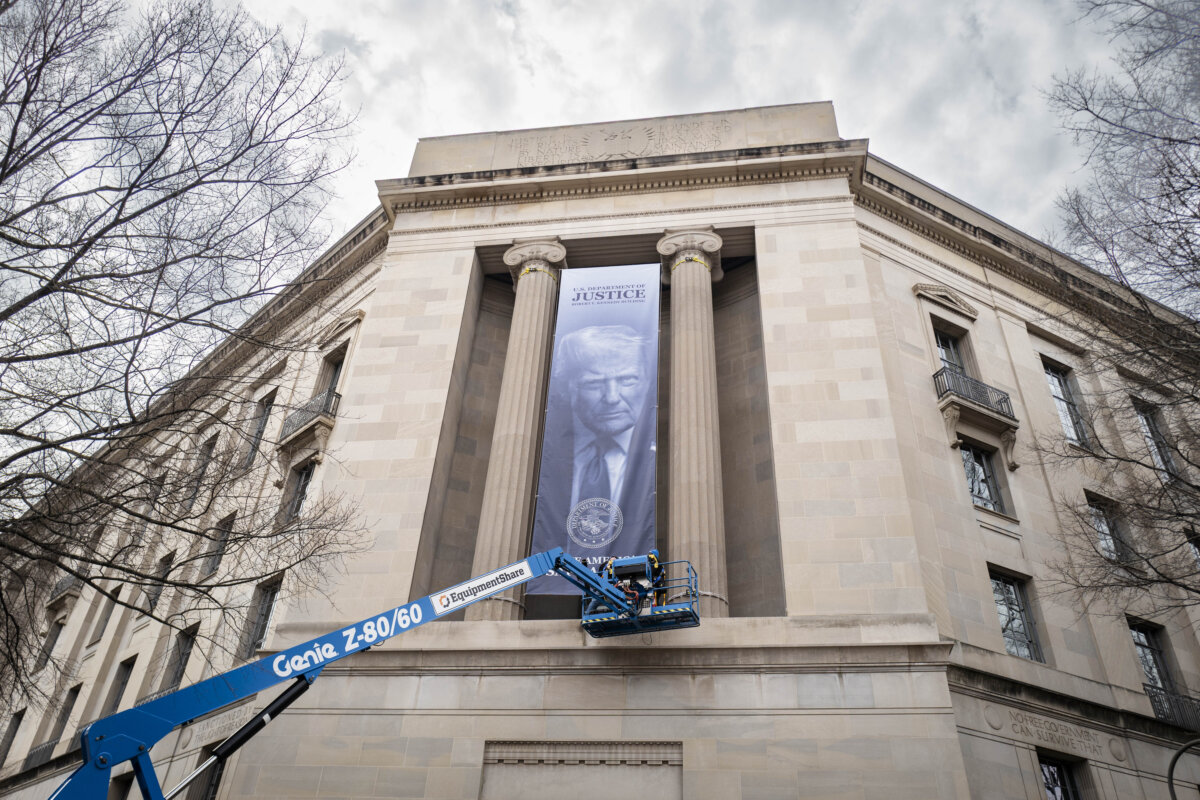

The Department of Justice (DOJ) is reversing course on its previous decision to drop its bid to revive President Donald Trump’s executive orders targeting several major law firms, according to a court filing.
The DOJ filed a motion to the U.S. Court of Appeals for the District of Columbia Circuit on March 3 asking to withdraw its March 2 motion to voluntarily dismiss its appeals of lower court rulings that had sided with four law firms.
The law firms in question are Perkins Coie, Jenner & Block, Susman Godfrey, and Wilmer Cutler Pickering Hale and Dorr (WilmerHale).
The DOJ did not provide an explanation for the request to withdraw its initial motion, but said it had reached out to attorneys for the four firms to seek their positions on the government’s decision.
The lawyers opposed the withdrawal, saying that “under no circumstances should the government’s unexplained about-face provide a basis for an extension of its brief,” according to the court filing.
The DOJ said that regardless of the firms’ position, the government has the right to pursue its appeals because the court has not yet ruled on the initial motion to dismiss.
Perkins Coie said in a statement on its website that the DOJ provided no explanation to the firms or the court for reversing its previous decision.
“Hours after asking the court to dismiss its appeal, the Department of Justice has abruptly reversed course and moved to continue its defense of the unconstitutional executive orders,” the law firm said. “We remain committed to defending our firm, our people, and our clients.”
Susman Godfrey said in a statement provided to multiple news outlets that it will defend itself “and the rule of law—without equivocation.”
WilmerHale and Jenner & Block did not respond by publication time to requests for comment.
The case stemmed from Trump’s executive orders issued individually against several major law firms in March 2025. The orders state that the firms abused their pro bono practice “to engage in activities that undermine justice and the interests of the United States,” citing alleged “partisan representations” and other factors.
Under the orders, all executive departments and agencies were instructed to suspend security clearances of individuals at the targeted law firms while those clearances were being reviewed to see whether they aligned with the national interest. Federal workers were also ordered to suspend or end their contracts with the firms and limit their employees’ access to government buildings.
The four law firms filed lawsuits challenging Trump’s orders, alleging that the orders were unconstitutional and violated their First Amendment rights. Federal judges handling the cases subsequently ruled in favor of the firms and struck down the orders in 2025.
The Trump administration reached deals with nine other law firms targeted by the orders, which agreed to provide pro bono legal services to the White House.
The Associated Press contributed to this report.
 Friends Read Free
Copy
Facebook
Tweet
Friends Read Free
Copy
Facebook
Tweet