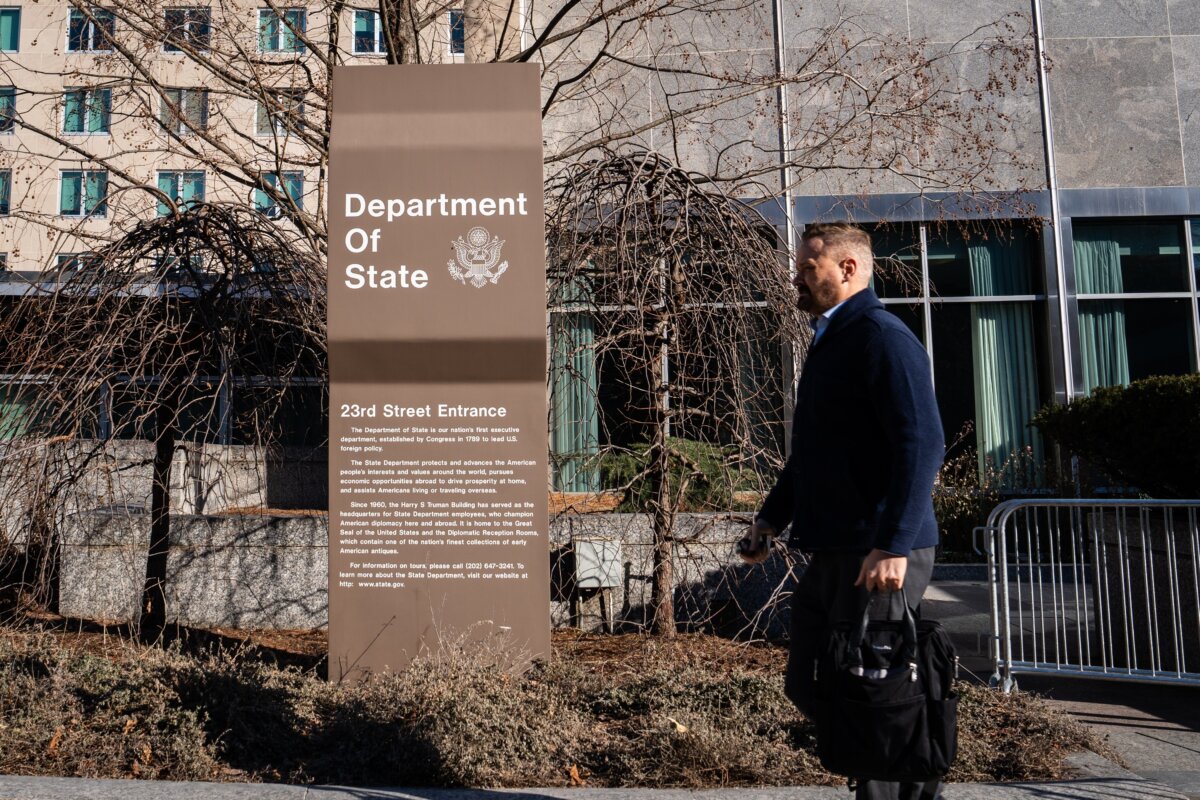

A Department of Justice (DOJ) body held that an independent board that reviews disciplinary actions against U.S. diplomats should no longer have the final say in such matters.
The DOJ’s Office of Legal Counsel (OLC) found in a new legal opinion released on Aug. 21 that the current arrangement that gives the Foreign Service Grievance Board (FSGB) unchecked final authority over personnel decisions violates the Constitution.
The board may continue to hear cases, but its decisions will now serve only as recommendations, with the secretary of state having the last word.
“Accountability for American foreign policy flows from the people to the foreign service through the President, our elected official charged by the Constitution to conduct foreign affairs, and his Secretary of State,” said Assistant Attorney General T. Elliot Gaiser, who signed the opinion.
“Our advice today restores that essential through-line,” he said in a statement.
The OLC provides legal advice to the president and the executive branch. Its opinions do not carry the same legal weight as court-issued opinions but are considered binding within the executive branch.
The FSGB hears grievances filed by members of the Foreign Service, including challenges to firings, discipline, and other personnel actions.
This opinion, which was prepared at the request of the Department of State’s legal adviser, concludes that the board’s authority to overrule the secretary of state on those decisions improperly puts executive power in the hands of inferior officers who are insulated from political control. [delete; pg1]
Members of the board are appointed by the secretary for two-year terms and traditionally have been treated as independent external neutral arbitrators rather than constitutional officers. The Foreign Service Act allows the secretary to remove FSGB members only for cause, and until now, gave the board final decision-making authority within the executive branch in most cases.
The new OLC opinion finds that giving the board that authority violates the Constitution’s Appointments Clause. It treats the board members as inferior officers—government officials who exercise significant executive power but rank below principal officers such as the secretary of state.
Under the Supreme Court’s 2021 decision in United States v. Arthrex Inc., the exercise of executive power by inferior officers “must at some level be subject to the direction and supervision of” a politically accountable officer.
“But that requirement has not been met here,” the opinion said. Although the secretary appoints board members and may remove them for cause, the Foreign Service Act gave the board final, unreviewable decision-making authority in most cases. That insulation from supervision is what makes the arrangement unconstitutional, according to the opinion.
The statute can be salvaged by severing the unconstitutional provision that makes the board’s decisions final. Going forward, the board may continue to hear grievances, but its decisions will function as recommendations subject to the secretary of state’s final review.
This change restores presidential and secretarial control over who serves in the Foreign Service, an area the opinion ties directly to the president’s constitutional responsibility for foreign affairs.
Rep. Gregory Meeks (D-N.Y.), ranking member of the House Foreign Affairs Committee, criticized the OLC opinion.
The Trump administration is “gutting an independent safeguard Congress put in place,” he said in a post on X. “This is part of a broader effort to politicize the federal civil service, purge career public servants, and replace them with unqualified political lackeys.”
 Friends Read Free
Copy
Facebook
Tweet
Friends Read Free
Copy
Facebook
Tweet