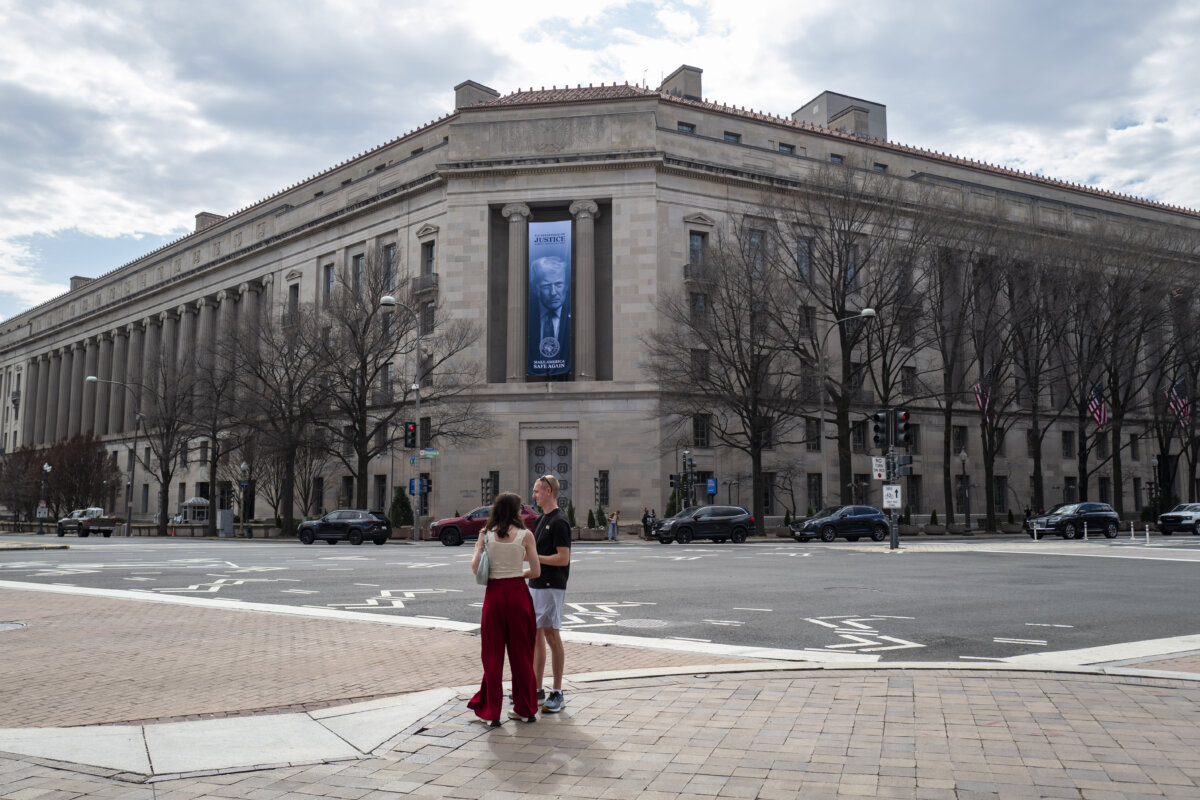

A district judge on Thursday approved a petition from the Department of Justice (DOJ) to enforce a subpoena issued to Rhode Island Hospital that seeks documents related to the alleged distribution of transgender-related drugs to minors at the medical facility.
In a May 1 statement, the DOJ announced it was filing the petition against the hospital under the Health Insurance Portability and Accountability Act (HIPAA) “as part of its investigation into the distribution of certain prescription drugs to minors with gender dysphoria and related disorders, including puberty blocking drugs and cross-sex hormones.”
“To date, Rhode Island Hospital has not complied with the subpoena,” it said.
Brett A. Shumate, assistant attorney general for the Civil Division, said the department expects and demands “full compliance” with valid subpoenas, like the one issued to Rhode Island (RI) Hospital. “Non-compliance with lawful process is never an option.”
According to the petition, filed on April 30 at the U.S. District Court for the Northern District of Texas, Fort Worth Division, the department had served the administrative subpoena to the hospital on July 5, 2025, with the return date set at Aug. 7, 2025.
“Yet, over ten months after service, RI Hospital has not complied with the subpoena. In fact, it has produced only one six-page document in response to the Department’s fifteen document requests. The Department therefore moves for an order compelling RI Hospital to fully comply,” states the petition.
“The subpoena is within the Department’s statutory authority to investigate violations of the Federal Food, Drug, and Cosmetic Act (FDCA), the information requested is relevant to the Department’s inquiry, and the subpoena is neither overbroad nor unduly burdensome.”
While the Food and Drug Administration has approved some of the gender-related drugs for use in certain cases, the agency has not determined that any of them are “safe or effective” for the treatment of gender dysphoria and has not approved them for treatment of such conditions or other psychiatric disorders, the petition said.
A key focus of the DOJ’s investigation is potential violation of the FDCA, which prohibits misbranding of drugs, it said. The HIPAA permits the Attorney General to issue a subpoena when investigating a “federal health care offense,” which includes violations related to health care benefit programs.
“Because public or private insurance plans were presented with claims related to offlabel use of puberty blockers and cross-sex hormones, such a violation of the FDCA could constitute a ‘federal health care offense,’” the petition said. “Accordingly, the Assistant Attorney General signed a HIPAA subpoena, which was served on RI Hospital on July 11, 2025.
“After the review of claims data and billing records, the Department is investigating whether RI Hospital patients have received misbranded drugs. Also, the Department has reason to suspect that RI Hospital employees might have engaged in false billing concerning patients suffering from gender dysphoria.”
Within hours of submitting the petition, the court issued an order on April 30 in the DOJ’s favor.
District Judge Reed O’Connor said that the subpoena was issued within the department’s authority, seeking documents relevant to its investigation, with demands that were reasonable.
“The Court further finds that the witness has neither filed a motion to quash nor shown just cause for noncompliance. The Court determines that the government’s petition to enforce should be and is hereby GRANTED,” the judge wrote in the order, while giving RI Hospital 14 days to provide “all records responsive to each request in the subpoena.”
The Epoch Times reached out to Rhode Island Hospital for comment but did not receive a response by publication time.
RI Hospital is affiliated with the Brown University Health system. A spokesperson for Brown University said, “We recently became aware of the motion filed by the Department of Justice and are currently reviewing it carefully with counsel.”
Trump Order, DOJ Subpoenas
In January last year, President Donald Trump signed an executive order cutting off any federal support for gender transition surgeries for children.
In the order, Trump cited the dangers of “chemical and surgical mutilation,” highlighting that many children do not fully understand the consequences of undergoing gender transitions.
“Countless children soon regret that they have been mutilated and begin to grasp the horrifying tragedy that they will never be able to conceive children of their own or nurture their children through breastfeeding,” the order said.
According to a March 2 statement from the American Civil Liberties Union (ACLU), the DOJ had issued subpoenas to more than 20 “gender affirming care” providers across the United States, seeking access to information such as patient records and medical diagnoses.
One of the subpoenas was issued to Washington-based QueerDoc, a medical clinic aiding people identifying as transgender, including adolescents, to obtain gender transition procedures through telehealth. In this case, the court sided with QueerDoc.
QueerDoc filed a lawsuit against the DOJ in July, alleging that the subpoena appeared to be part of the Trump administration’s “discriminatory campaign to stop transgender individuals from receiving gender affirming care and to prevent healthcare providers from delivering this care.”
In an order issued on Oct. 27, the court granted QueerDoc’s motion to quash the subpoena, observing that the DOJ “issued the subpoena for an improper purpose.” The department filed an appeal in November, and the case is ongoing.
Reuters contributed to this report.
 Friends Read Free
Copy
Facebook
Tweet
Friends Read Free
Copy
Facebook
Tweet