

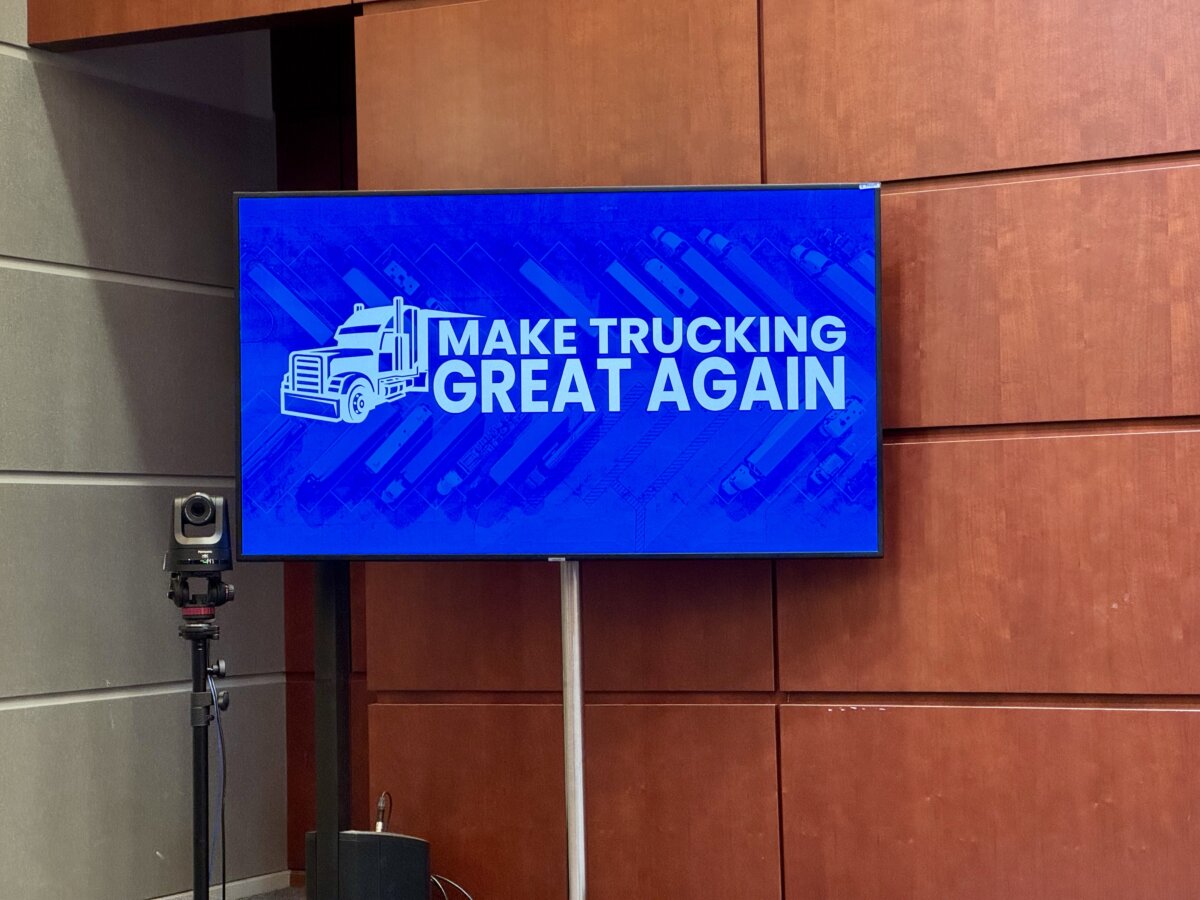
U.S. Secretary of Transportation Sean Duffy held a press conference on Oct. 30 explaining steps the department will take to prevent foreign nationals from driving commercial vehicles on U.S. highways.
Duffy said the Department of Transportation (DOT) would seek to withhold federal funds from states that issue “non-domiciled” commercial driver’s licenses (CDLs) to foreign nationals who are unlawfully present in the country. He referred to a recent action to suspend $40 million in payments to California, which he claimed was noncompliant with the department’s rules against issuing CDLs to illegal immigrants.
Duffy said states needed to ensure that any driver receiving a CDL was proficient in English, which he alleged was not the case. He also said that some driving schools that train such drivers to obtain CDLs were failing to do so properly, and that many trucking companies were also hiring them. For the latter, Duffy said there would be “serious consequences,” though he did not specify them.
“These are individuals that can drive fuel tankers, they can drive school buses, they can drive all of these very dangerous big rigs on our roads, and they are in the country unlawfully,” said Duffy, who was joined by Derek Bars, the administrator of the Federal Motor Carrier Safety Administration (FMCSA), which regulates such driving.
A CDL is required to drive a truck, bus, or other special vehicle commercially. Like regular driver’s licenses, states issue CDLs that are honored throughout the United States. A non-domiciled CDL is typically issued by a state to residents from another state who wish to drive commercially within its jurisdiction, as some states require commercial drivers working primarily within their boundaries to hold a license from that state.
During the press conference, Duffy referred to a recent arrest of 223 individuals by U.S. Immigration and Customs Enforcement in Indiana that was reported by the U.S. Department of Homeland Security. He said that approximately 140 of those arrested were commercial truck drivers, some with commercial driver’s licenses issued by the state.
The Trump administration recently highlighted road accidents involving commercial trucks driven by illegal immigrants. The most prominent case involves that of Jashanpreet Singh, an Indian citizen who allegedly crashed into cars on a highway in Ontario, California, on Oct. 22 while driving under the influence, killing three people. Footage of the incident has been widely circulated on social media.
The case involving Singh, a Sikh man, has also drawn attention from Harmeet Dhillon, assistant attorney general for civil rights at the U.S. Department of Justice and one of the highest-ranking Sikh American members of the Trump administration. Dhillon criticized anti-Sikh rhetoric on social media following the incident and vowed to investigate any official discrimination against them.
“Unfortunately, in the fog of outrage, some are using these tragedies as an opportunity to attack law-abiding Sikhs and Indian-origin drivers, simply because of who they are. … Most were born here or immigrated here lawfully,” Dhillon wrote on X. “It is illegal under federal law to discriminate against individuals or attack or violently threaten them because of their race, color, religion, or national origin. The [Civil Rights Division] will aggressively prosecute or pursue justice against those engaged in such discrimination.”
Many foreign nationals are lawfully admitted to the United States to work as commercial truck drivers each year, with firms and the industry citing a shortage of domestic labor to drive such trucks.
The trucking industry is facing a gap of 60,000 to 80,000 drivers, according to the National Immigration Forum.
“Foreign-born truckers play an outsized role in stabilizing supply chains. With an aging workforce—the average age of drivers of heavy trucks is 47—and declining interest from younger workers, the industry increasingly relies on immigrant drivers to meet demand,” it said.
Given such shortages, The Epoch Times asked Duffy whether the Trump administration had plans to increase the number of skilled domestic drivers who could drive trucks to account for shortages.
“There’re a lot of Americans who want to get behind the wheel of a big rig. These are, and have been, really great-paying jobs,” Duffy said. “When you bring someone in who doesn’t have a license … or someone who unlawfully got their license, they’ll drive for a much lower rate. … I do not buy the idea that there are not enough American truck drivers.”
 Friends Read Free
Copy
Facebook
Tweet
Friends Read Free
Copy
Facebook
Tweet