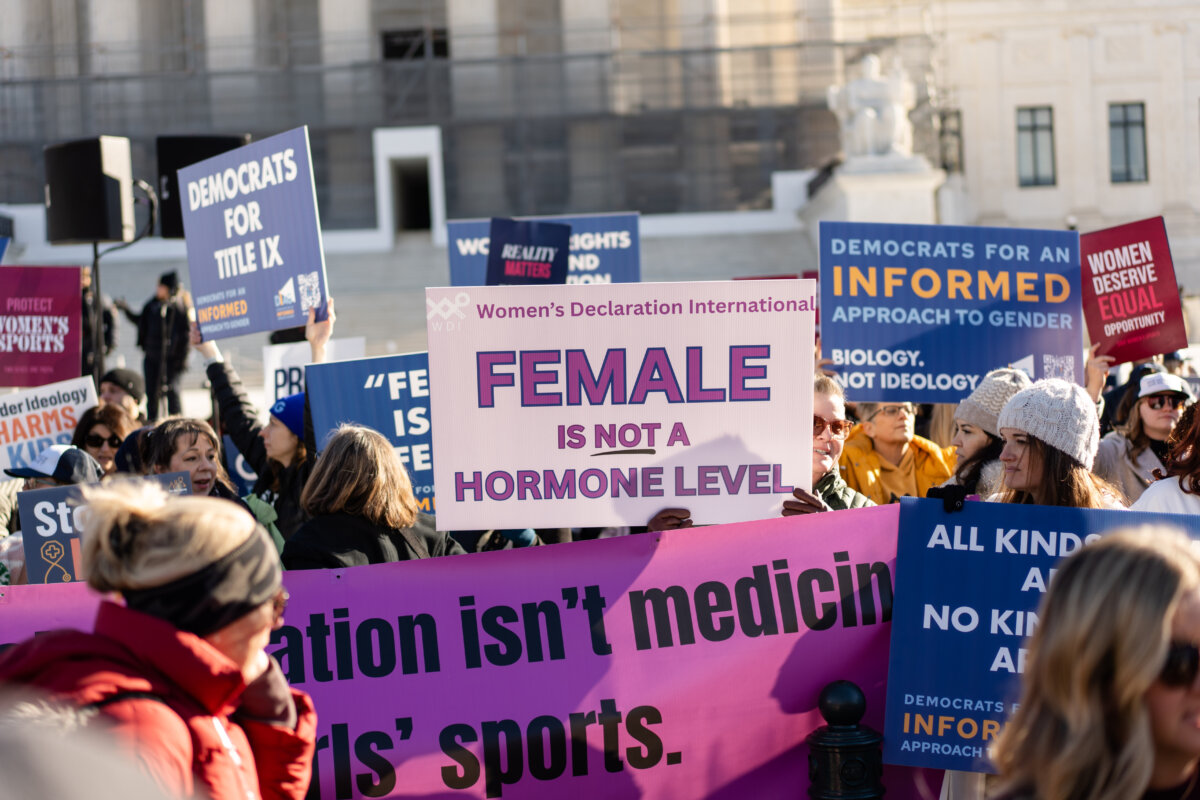

The U.S. Department of Education’s Office for Civil Rights (OCR) initiated investigations into 18 educational entities across 10 states based on complaints alleging Title IX violations, according to a Jan. 14 statement from the department.
According to the complaints, the institutions are engaging in discriminatory policies or practices that permit students to participate in sports based on their chosen “gender identities” and not based on biological sex. This has resulted in endangering the safety and opportunities of women and girls participating in sports activities, according to the statement.
Title IX is a federal civil rights law that prohibits sex-based discrimination in educational institutions that receive federal funding. Institutions mentioned in the Education Department statement are the following:
- Jurupa School District (California)
- Placentia-Yorba School District (California)
- Santa Monica College (California)
- Santa Rosa Junior College (California)
- Waterbury Public Schools (Connecticut)
- Hawaii State Department of Education
- Regional School Units 19 (Maine)
- Regional School Unit 57 (Maine)
- Foxborough Public Schools (Massachusetts)
- University of Nevada – Reno
- Bellmore-Merrick Central High School District (New York)
- New York City Department of Education
- Great Valley School District (Pennsylvania)
- Champlain Valley School District (Vermont)
- Cheney Public Schools (Washington)
- Sultan School District No. 311 (Washington)
- Tacoma Public Schools (Washington)
- Vancouver Public Schools (Washington)
“In the same week that the Supreme Court hears oral arguments on the future of Title IX, OCR is aggressively pursuing allegations of discrimination against women and girls by entities which reportedly allow males to compete in women’s sports,” Assistant Secretary for Civil Rights Kimberly Richey said.
“We will leave no stone unturned in these investigations to uphold women’s right to equal access in education programs—a fight that started over half a century ago and is far from finished.”
Supreme Court Cases
The U.S. Supreme Court is expected to uphold Idaho’s and West Virginia’s bans on boys competing against girls in school sports.
During the Jan. 13 oral arguments, Idaho Solicitor General Alan Hurst said his state’s law treats all males and females equally. The law “classifies on the basis of sex because sex is what matters in sports … [and] gender identity does not.”
Males have “countless athletic advantages,” and as a result, males have injured females in sports, Hurst said.
“If women don’t have their own competitions, they won’t be able to compete,” he said.
The other side is “seeking special treatment for males … but only if those males also identify as transgender.”
The American Civil Liberties Union (ACLU), which represents the transgender-identifying athletes in both Supreme Court cases, accused politicians of conspiring to “push transgender people out of public life altogether,” and not just from school sports.
“Many of the political attacks on transgender people have focused on areas of the law where we already experience discrimination–access to public bathrooms or the sex designation that goes on documents like driver’s licenses and passports, for example,” the ACLU said.
“Depending on the precise language of the court’s ruling, it could likewise implicate our fight for equality in those contexts and potentially many more, like our access to health care and our safety while incarcerated.”
Education Secretary Linda McMahon, in a speech on Jan. 13 outside the Supreme Court, said that the Trump administration is “committed to restoring an understanding of sex based in scientific reality.”
“This gender ideology has transformed once-great academic and athletic institutions into embarrassments—with tragic consequences for women and girls,” she said.
According to a February 2025 report by the Williams Institute at the University of California–Los Angeles School of Law, there are 27 U.S. states that have laws preventing males who identify as transgender from participating in female sports.
Based on the report, about 300,000 young people aged 13 to 17 identified as transgender in the United States, along with nearly 400,000 people aged 18 to 24.
A report published later in the year by the Center for Heterodox Social Science revealed that young Americans are increasingly declining to identify as transgender or queer.
“The transgender share among university students peaked in 2023 and has almost halved since, from nearly 7 percent to under 4 percent,” the report states.
“There is evidence that improved mental health has reduced BTQ+ identification.”
Matthew Vadum contributed to this report.
 Friends Read Free
Copy
Facebook
Tweet
Friends Read Free
Copy
Facebook
Tweet