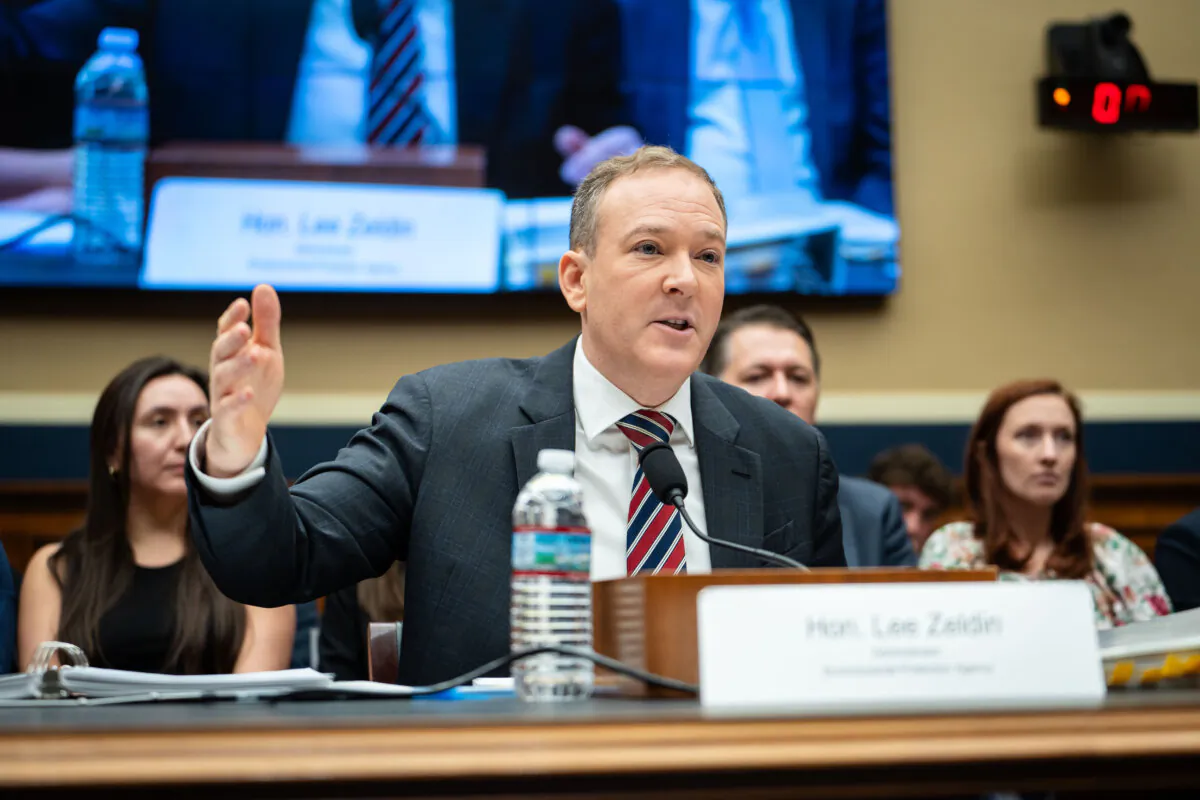

In a long-awaited decision, the Trump administration is fulfilling a pledge it made in the summer of 2025 to cancel a policy put in place by the Obama administration that has been used to impose greenhouse gas (GHG) emissions restrictions on American industries.
“This will be the largest deregulatory action in American history, and it will save the American people $1.3 trillion in crushing regulations,” White House press secretary Karoline Leavitt told reporters on Feb. 10.
The EPA’s endangerment finding has been the legal basis for emissions restrictions placed on cars and trucks sold in the United States as part of an attempt to end global warming. Rescinding the endangerment finding not only would end federal regulation of GHG emissions from vehicles but also could ultimately remove carbon dioxide (CO2) restrictions on power plants.
Many conservatives cheered the move as a check on federal regulators, who they say have exceeded the authority given to them by Congress.
“We strongly support the EPA’s proposal to rescind its 2009 endangerment finding,” Alex Stevens, manager of policy and communications at the Institute for Energy Research, told The Epoch Times.
“This sort of massive claim of authority is precisely the sort of major question that the Supreme Court in West Virginia v. EPA held can only be undertaken with a clear grant from Congress. Congress has made no such clear statement.”
In first announcing its intention to rescind the finding in July 2025, the EPA stated that without it, the EPA “lacks statutory authority under Section 202 of the Clean Air Act to prescribe standards for GHG emissions.” Revoking the finding meant that carmakers “would no longer have any future obligations for the measurement, control, and reporting of GHG emissions for any highway engine and vehicle, including model years manufactured prior to this proposal,” the EPA stated.
In March 2025, EPA Administrator Lee Zeldin said that by revoking the endangerment finding, the Trump administration was “driving a dagger straight into the heart of the climate change religion to drive down cost of living for American families, unleash American energy, bring auto jobs back to the U.S. and more.”
Rescinding the finding, he said, will “unleash American energy, lower costs for Americans, [and] revitalize the American auto industry.”
Origins of the Endangerment Finding
The endangerment finding was issued by the Obama administration in 2009 and gave the EPA the authority to regulate CO2 emissions under the Clean Air Act.
At that time, the EPA stated that six greenhouse gases—CO2, methane, nitrous oxide, hydrofluorocarbons, perfluorocarbons, and sulfur hexafluoride—“threaten the public health and welfare of current and future generations” by causing global warming. This action followed a 2007 Supreme Court decision in Massachusetts v. EPA, which ruled that greenhouse gases are air pollutants that are covered by the Clean Air Act.
Some analysts have said that the endangerment finding was not an easy fit with the Clean Air Act, which was intended to regulate toxic airborne pollutants, such as mercury, asbestos, lead, and carbon monoxide. GHGs, by contrast, were determined to be dangerous primarily based on “careful consideration of the full weight of scientific evidence” regarding global warming.
“The term ‘pollutant’ in the act should apply to substances causing direct toxic harm, not indirect climate effects from GHGs,” Stevens said. “Otherwise, the statute could absurdly extend to regulating water vapor or other natural byproducts.”
In addition, the role of GHGs in heating the planet remains controversial.
“The scientific underpinnings of the endangerment finding are weaker than previously believed and contradicted by empirical data, peer-reviewed studies, and scientific developments since it was first enacted in 2009,” Greg Wrightstone, executive director of the CO2 coalition, told The Epoch Times.
“Relying on false computer models and pseudoscience, the EPA erroneously claimed that carbon dioxide and other so-called greenhouse gases threatened to overheat the Earth. The agency disregards complexities of climate dynamics—from solar cycles to clouds to ocean currents—and a mountain of real-world data accumulated over decades and centuries that disprove the endangerment finding.”
Court Battle Will Likely Follow
The decision by the Trump administration to revoke the finding faces two major challenges: Climate activists will fight it in court, and a future Democratic administration could simply reverse it.
“The decision will be challenged in court, and that process will likely extend beyond President [Donald] Trump’s time in office, which opens plenty of opportunities for future administrations to challenge and delay a decision on this,” Stevens said. “In the short term, this means that it is likely that many industries will proceed under the assumption that the endangerment finding will remain in place just to mitigate risk.”
This could change, however, once the legal challenges are resolved in courts, he said.
The Environmental Defense Fund, an organization seeking to curtail the use of fossil fuels, is among the entities that have pledged to challenge the EPA’s decision in court. According to Fred Krupp, the fund’s president, if the EPA stops regulating GHG emissions, an economic and environmental crisis will ensue.
“Property values will decline, and flood and fire insurance premiums will increase. … Crop yields and water supplies will be threatened,” Krupp said. “Many have already lost loved ones and seen homes and businesses destroyed because of climate disasters that have cost the U.S. more than $3 trillion since 1980, and they’re only going to intensify with more pollution.”
Some dispute that GHGs are responsible for bad weather or natural disasters and have said that increased CO2 levels can be beneficial.
“Rather than an Earth that is spiraling into man-made climate crises, the facts reveal that the planet’s ecosystems are thriving and prospering and humanity is benefiting from modest warming and more CO2,” Wrightstone said. “Forests are expanding, deserts are shrinking, agricultural productivity is expanding, and drought is declining.”
Contradictory Precedents
The outcome of the legal challenges to the EPA is difficult to predict, given that various court decisions on the issue appear to conflict.
“Rescinding the endangerment finding is great, but it’s not the ball game,” Steve Milloy, former Trump EPA transition team adviser and senior fellow at the Energy & Environment Legal Institute, told The Epoch Times in an email. “Not only does the rescission have to stand up in court, it must result in the overturning of the 2007 Supreme Court decision in Massachusetts v. EPA, where the Court wrongly ruled that EPA could regulate greenhouse gases even though Congress did not expressly authorize it.”
The 2022 Supreme Court “major questions” decision in West Virginia v. EPA ruled that for issues that have a significant impact on Americans, federal agencies must have been given explicit authorization from lawmakers in Congress, who, by contrast to federal bureaucrats, are elected by the American public. This ruling was a reversal of a 1984 Supreme Court precedent in Chevron v. Natural Resources Defense Council, which gave federal agencies broad scope in interpreting what authority Congress had given them.
Legal analysts have said that although several recent court decisions limit the scope of agencies such as the EPA, the Supreme Court’s ruling in Massachusetts v. EPA, which designates GHGs as harmful pollutants, will give climate activists an avenue to reverse the rescission of the endangerment finding.
“Even if the Trump EPA wins in court with respect to rescinding the endangerment finding,” Milloy said, “without also overturning Massachusetts v. EPA, the next Democrat-run EPA will simply re-issue the endangerment finding and all the Trump EPA’s great work will have been erased.”
 Friends Read Free
Copy
Facebook
Tweet
Friends Read Free
Copy
Facebook
Tweet