
WASHINGTON—The Federal Aviation Administration (FAA) on July 31 defended the staffing levels for air traffic controllers at Ronald Reagan Washington National Airport when an Army helicopter collided with a commercial jet in January, while concerns were raised by an agency contractor at a hearing.
National Transportation Safety Board (NTSB) investigators probed that issue on Thursday, on the second day of their fact-finding hearing into the deadliest crash in American aviation since November 2001.
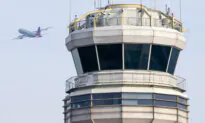
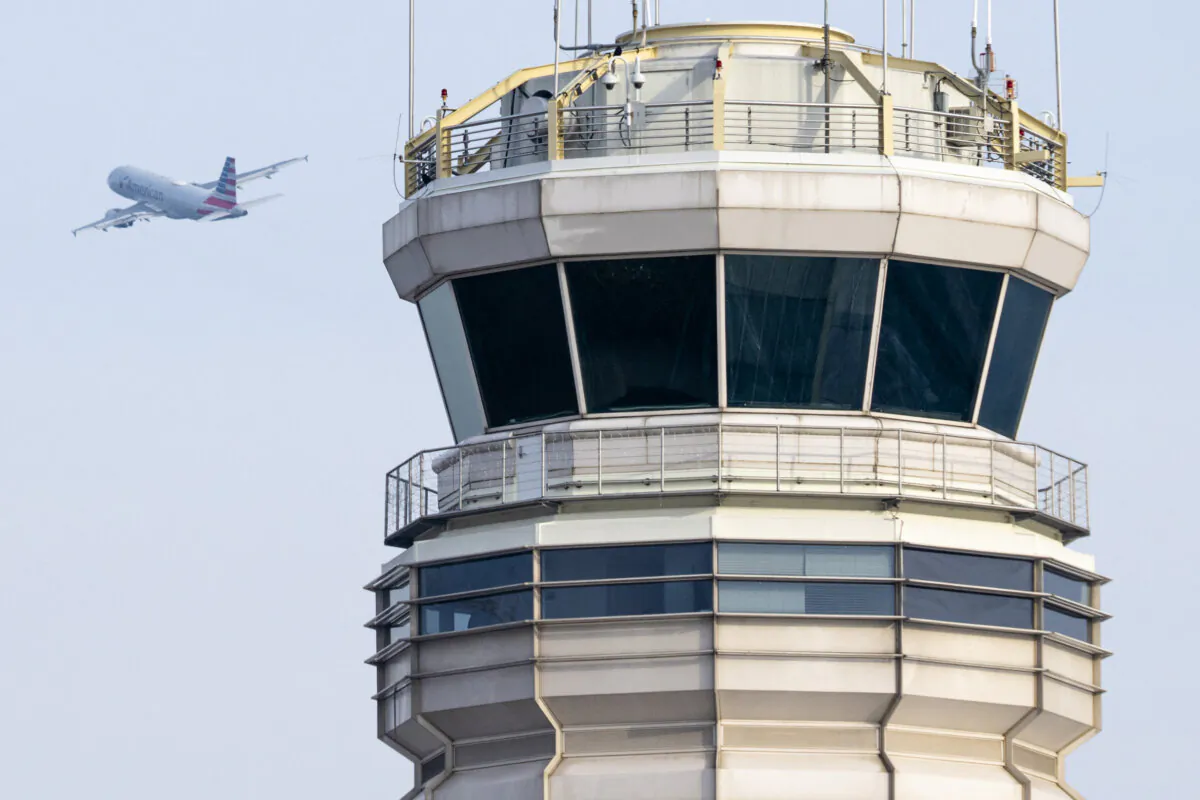
FAA Deputy Chief Operating Officer Nick Fuller told the NTSB that the control tower at Reagan National Airport was nearly fully staffed on Jan. 29, with 26 of 28 controller positions filled. As previous NTSB reports revealed, one controller was handling frequencies for both helicopters and airplanes at the same time on the night of the collision.
While aviation experts have told The Epoch Times that this is a regular practice in control towers—especially late at night or in the early morning hours when air traffic is lower than usual—both positions were combined earlier in the day than was typical for controllers.
James Jarvis, who works at defense, aviation, IT, and biomedical research company Leidos but was contracted by the FAA to conduct compliance verifications at Reagan National Airport from 2017 to 2023, said that staffing at the airport’s control tower had “always been on the lower number of staffing, not necessarily healthy.”
Jarvis said the staffing was a “concern of mine,” but he was rebuffed when calling for adding another operations manager and staff specialist to assist with the tower’s workload.
“At one point, I was told to quit bringing it up,” he said, adding that his comments were reflective of his own experiences and not on behalf of Leidos, his employer.
Investigators asked the panel of witnesses if they felt the airspace around Reagan National Airport was currently safe to fly in. Fuller, speaking for the FAA, was the first to respond.
“Absolutely, it’s safe to fly in,” Fuller said. “The controllers at [Reagan] are responsible, well-trained, and I would have no problem moving out on a flight in or out of that airport on any given day.”
Rick Dressler, an aviation site manager for Metro Aviation Inc., offered a more cautionary response.
“Since 1986, the helicopter routes were very successful. Obviously, that success ended quite tragically on Jan. 29,” Dressler said. “Today, the airspace is the least safe that it’s ever been.”
The FAA did not respond to a request for comment by publication time.
During day two of the NTSB’s fact-finding hearing into the deadly midair collision, the independent investigative agency put a microscope on the workload of air traffic controllers at Reagan National Airport’s control tower.
Investigators questioned the decision to combine both helicopter and plane communication duties into one position on the night of the crash, which usually does not occur until 9:30 p.m., when air traffic is lower.
The collision occurred at 8:47 p.m. when the Army Black Hawk helicopter exceeded its maximum-allowed altitude by roughly 100 feet, crossing into the path of a CRJ700 regional jet operated by PSA Airlines on behalf of American Airlines.
FAA air traffic controller specialist Clark Allen, the operations manager at Reagan National Airport when the accident occurred, said folding the two responsibilities into one position requires the controller to “develop the whole plan for the airspace” while handling both helicopter and airplane frequencies.
Investigators questioned the Reagan National Airport control tower’s “just make it work” mentality amid the high demands and low staffing levels, which Allen said have been normalized in recent years.
“There’s various factors with the compacted demand that occurs, whether when weather gets involved [or] when spacing isn’t being given,” Allen said. “There’s a limited real estate for the airport and where to put aircraft, and that can back up very easily.”
He said it’s a “high volume, high complex airport with not a lot of real estate,” and controllers have to “keep things moving.”
Fuller clarified that he believes “just make it work” reflects controllers getting passengers where they’re “going as safely as possible” whenever there is high demand, equipment failures, or when other controllers call in sick.
“It’s not to say that we are going to work in a constrained environment,” he said.
NTSB investigator Brian Soper said the issue is more than controllers taking the initiative to fill in the gaps at the control tower.
“This is a little different. This is, ‘We just make it work, because we don’t have another choice.’ There [are] airplanes coming, and everything was related to the capacity, the demand, or the amount of traffic that was coming in and having to meet that demand,” he said.
The NTSB will host the final session of its three-day hearing into the midair collision on Friday at 9 a.m.
 Friends Read Free
Copy
Facebook
Tweet
Friends Read Free
Copy
Facebook
Tweet