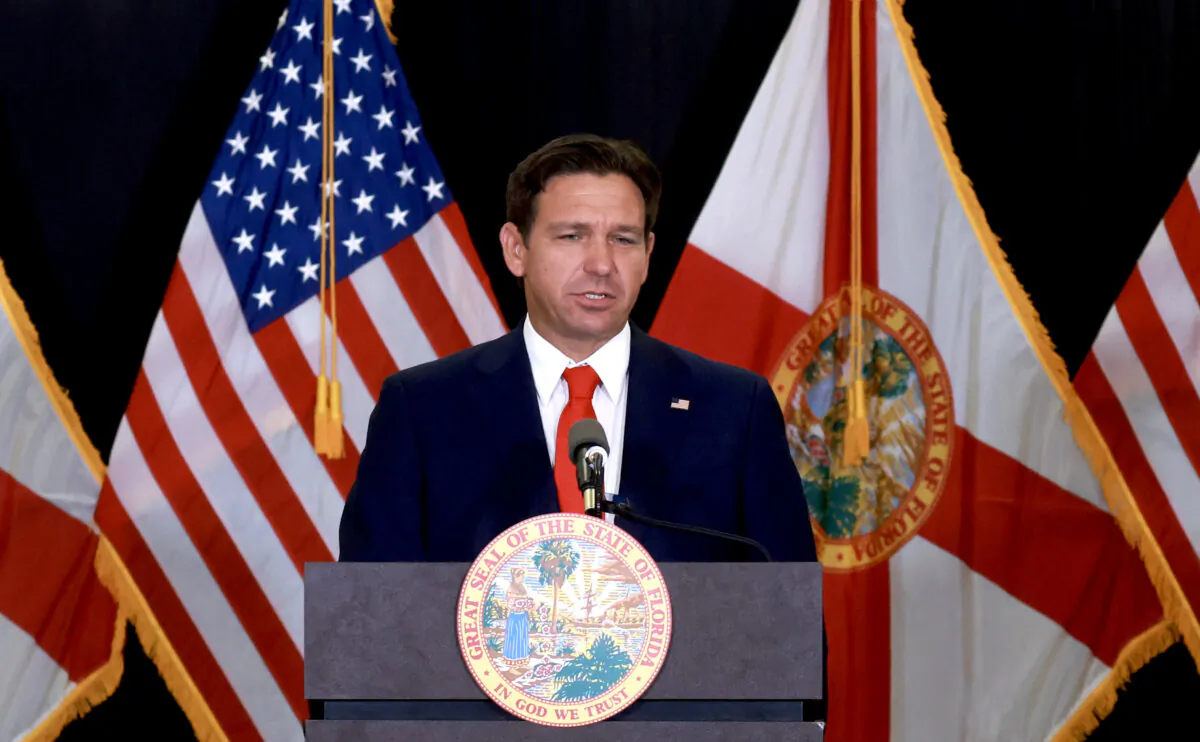

Florida Gov. Ron DeSantis on Jan. 7 announced that he plans to join the other states locked in a redistricting battle in an attempt to gain more Republican congressional seats in the 2026 midterms.
DeSantis called a special session for April for the Sunshine State’s GOP-controlled legislature to draw new U.S. House districts, to “accurately reflect the population of [the] state.”
Although Florida begins its 2026 legislative session next week, the governor said he is giving additional time for a potential ruling from the U.S. Supreme Court regarding the Voting Rights Act in the case Louisiana v. Callais.
The high court ruling could determine the constitutionality of Section 2 of the Voting Rights Act, which prohibits discrimination in voting systems, including in the drawing of congressional districts.
“[I do not] think it’s a question of if they’re going to rule,” DeSantis said during a news conference on Jan. 7 in Steinhatchee, Florida. “It’s a question of what the scope is going to be.”
“So, we’re getting out ahead of that,” DeSantis said.
In a Jan. 7 X post, the governor said he was giving the legislature time to “first focus on the pressing issues facing Floridians before devoting its full attention to congressional redistricting in April.”
The nationwide redistricting battle was kicked off by Texas in July 2025, when President Donald Trump called for redrawing the state’s districts to net more GOP seats in Congress in the 2026 midterm elections—the determining factor for which party will control the House of Representatives during the second half of the president’s term.
If Florida’s Republican-controlled legislature votes to join the redistricting fray, it could net the GOP additional seats next year and potentially allow the party to retain control of the House, in which it has a slim majority.
In midterm elections, the president’s party often loses seats in Congress. This happened to Trump in 2018, when Democrats regained control of the chamber for the first time in eight years, and also happened to President Joe Biden in 2022, when Republicans eked out a small majority in the House, which it has managed to retain.
So far, the multi-state mid-decade redistricting war has seen Republicans target nine additional seats throughout Texas, Ohio, North Carolina, and Missouri, while Democrats are hoping to pick up six more seats in California and Utah. This would give Republicans a three-seat advantage, but some of the redrawn maps are still being fought over in court battles, and even if all the maps are approved for the elections, there is still no guarantee that either party will win every targeted district.
More than 60 percent of voters in Florida, a supermajority, backed a 2010 constitutional amendment that blocks the state from redrawing districts that would benefit one political party over another. That amendment could result in groups filing lawsuits to block the governor’s efforts.
Drawing districts with the sole intention of putting one party ahead of another is known as gerrymandering.
The Associated Press contributed to this report.
 Friends Read Free
Copy
Facebook
Tweet
Friends Read Free
Copy
Facebook
Tweet