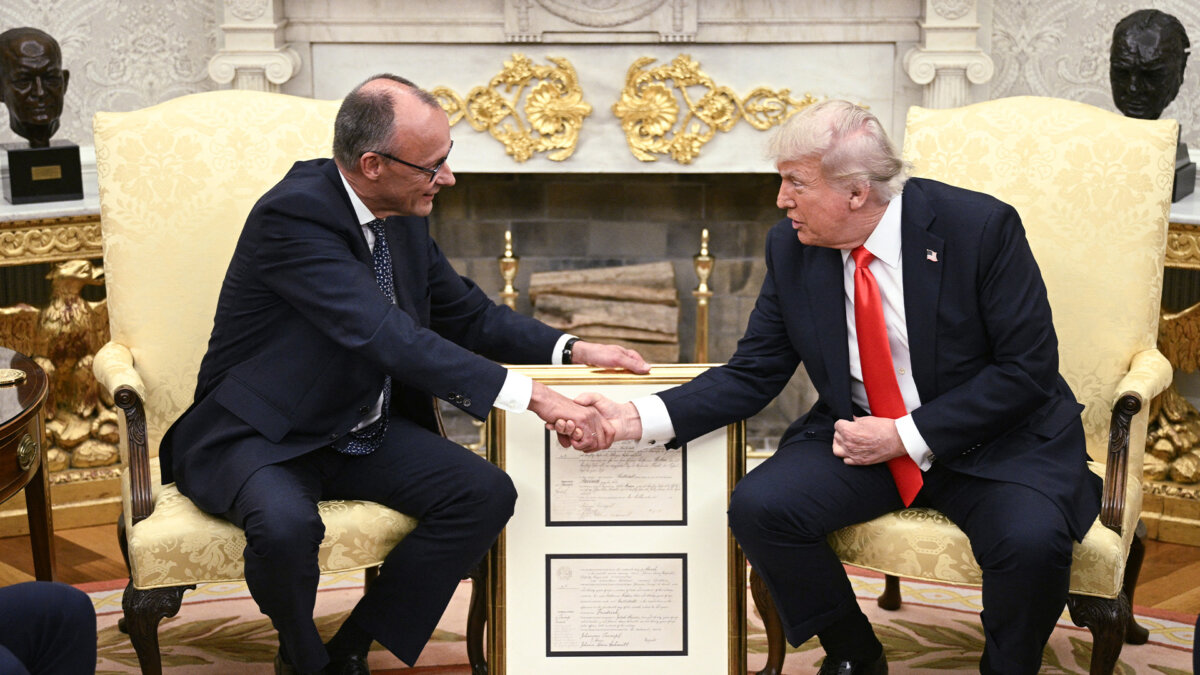
WASHINGTON—U.S. President Donald Trump hosted German Chancellor Friedrich Merz at the White House on June 5 to discuss a wide range of pressing issues, including the war in Ukraine.
Merz expressed confidence in Trump’s ability to help resolve the ongoing conflict and urged the U.S. president to toughen his stance on the Kremlin.
“We all are looking for measures and for instruments to bring this terrible war to an end,” Merz told Trump during their meeting in the Oval Office.
Referencing the upcoming D-Day anniversary on June 6, Merz praised the United States’ historical role in ending the war in Europe and liberating his country from Nazi dictatorship.
“We know what we owe you,” he said, noting that the United States is again “in a very strong position” to help end the current conflict in Europe.
“Let’s talk about what we can do jointly,” he said.
Merz said the European Union (EU) has backed Ukraine and applied pressure to Moscow, noting that it is now “looking for more pressure on Russia.”
Trump warned that if Russia and Ukraine do not reach a peace deal, he will take a “very tough” approach.
“And it could be on both countries, to be honest,” he said.
He also suggested that Russia and Ukraine may not be quite ready for peace.
“You see two young children fighting like crazy,” Trump said. “They hate each other, and they’re fighting in a park, and you try [to] pull them apart. They don’t want to be pulled sometimes; you’re better off letting them fight for a while.”
For months, Trump has been pressing both Russia and Ukraine to end the fighting and negotiate a permanent peace.
On June 4, Trump said he had a lengthy phone call with Russian President Vladimir Putin.
“It was a good conversation, but not a conversation that will lead to immediate Peace,” Trump wrote in a post on Truth Social. “President Putin did say, and very strongly, that he will have to respond to the recent attack on the airfields.”
Ukraine launched a large-scale drone attack targeting Russian bases over the weekend. The White House said Trump had not been informed about the attack in advance.
On June 2, German spokesperson Stefan Kornelius told reporters that Merz would “do everything” during his White House meeting to urge Trump to support a fair cease-fire and further sanctions on Russia.
Trump: ‘He’s Difficult’
This was the chancellor’s first visit to Washington since his election victory in May.
During their meeting, Trump called Merz “a very good man to deal with,” but also joked that “he’s difficult.”
Merz earlier voiced criticism of Trump’s tense Oval Office meeting with Ukrainian President Volodymyr Zelenskyy in March.
The chancellor also described Vice President JD Vance’s remarks at the Munich Security Conference as “overreach.” During his speech, Vance accused European leaders of undermining democracy in Europe.
The Trump administration has also criticized the German domestic intelligence service’s classification of the Alternative for Germany Party as a right-wing extremist party. Alternative for Germany came second in the February election with 20.8 percent of the vote.
In his first TV interview as chancellor, Merz said the Trump administration should “leave German domestic politics alone.”
Still, Merz aimed to find common ground with Trump on several key issues, including the war in Ukraine, trade tensions, and NATO defense spending.
In a recent interview with German public broadcaster WDR, Merz shared insights into his recent phone call with Trump.
“It’s always important not to talk for too long, but to keep it short and also let him talk,” Merz said, revealing his approach to dealing with the U.S. president.
“You have to adapt your approach and work with him. At the same time, we mustn’t make ourselves smaller than we are. We are not supplicants.”
Echoing a gesture once made by former Chancellor Angela Merkel, Merz invited Trump to visit Kallstadt, the German village where Trump’s grandfather, Friedrich Trump, was born.
During the meeting, Merz presented Trump with his grandfather’s original birth certificate.
Trade Tensions
Another key topic at the June 5 meeting was trade, including ongoing negotiations aimed at avoiding steep U.S. tariffs before the July deadline.
Currently, the EU is subject to U.S. tariffs of 10 percent on most goods.
Trump recently announced a 50 percent tariff on the EU that was set to take effect on June 1. However, following a phone call with European Commission President Ursula von der Leyen, he agreed to extend the deadline to July 9.
Germany is the biggest economy in the EU, and hence a high universal tariff is expected to have a big impact on the country’s manufacturing and export sectors.
More concerning for Germans are tariffs on specific sectors, such as automobiles, steel, semiconductors, aircraft, and pharmaceuticals. Trump imposed 25 percent tariffs on automobiles and recently raised steel and aluminum levies from 25 percent to 50 percent.
While the trade topic ranked high on Merz’s agenda, he did not have a mandate from the EU to negotiate directly with Trump.
On June 4, Maros Sefcovic, EU trade commissioner, met with U.S. Trade Representative Jamieson Greer in Paris. While Sefcovic described the meeting as constructive, he raised concerns about the recent doubling of U.S. metals tariffs.
Defense Spending
Trump has long argued that other countries, including Germany, must pay their fair share for the NATO alliance. Since returning to the White House in January, he has intensified pressure on member states to meet higher defense spending targets.
During a NATO foreign ministers’ summit in Turkey in May, German Minister of Foreign Affairs Johann Wadephul voiced support for Trump’s position, calling for a substantial increase in defense spending by NATO members.
Wadephul proposed that each country allocate 5 percent of its gross domestic product, an increase from the current target of a minimum of 2 percent per year.
He also supported the idea that member countries could spend 3.5 percent of gross domestic product on defense if an additional 1.5 percent were invested in military-related infrastructure. The idea was first floated by NATO Secretary General Mark Rutte.
 Friends Read Free
Copy
Facebook
Tweet
Friends Read Free
Copy
Facebook
Tweet