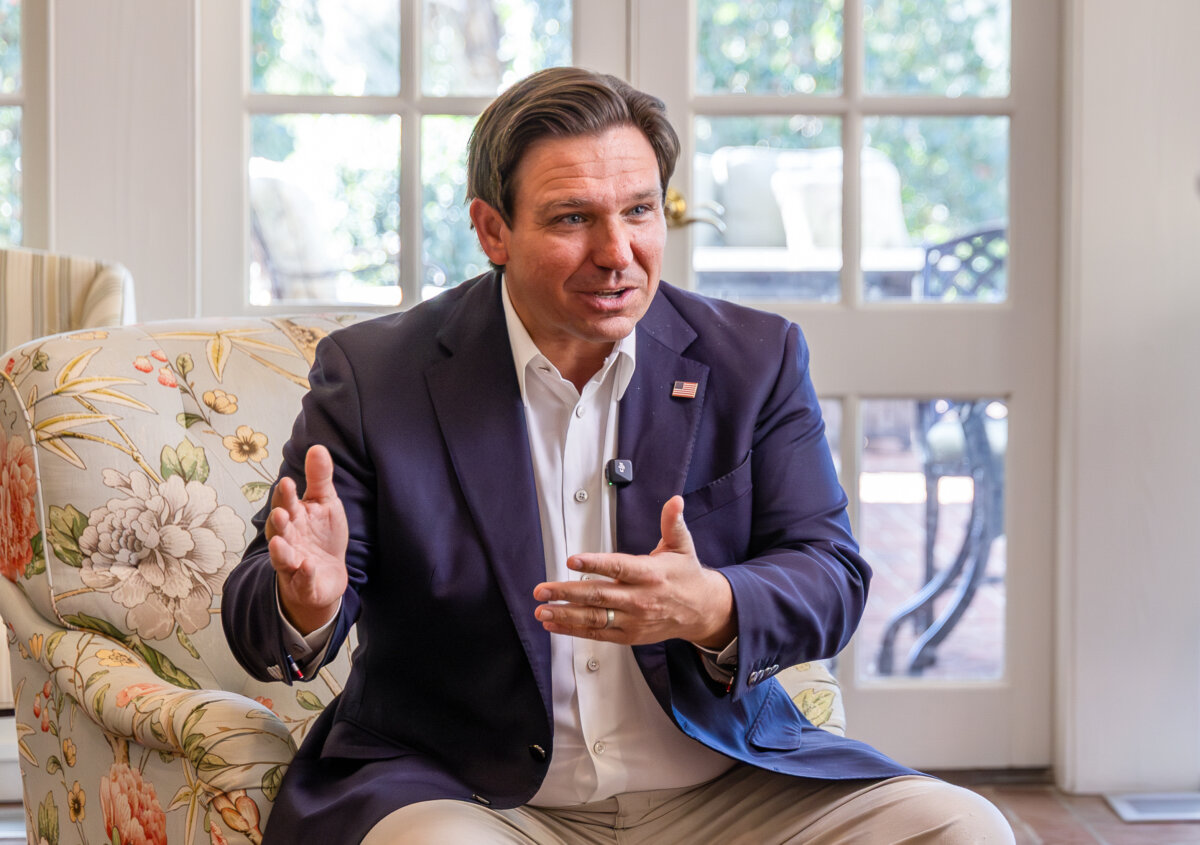


Florida lawmakers reconvened in Tallahassee on June 1 for a special legislative session centered on Gov. Ron DeSantis’s proposed property‑tax relief package.
The governor is advancing a constitutional amendment under his “Save Our Homes from Excessive Property Taxes” proposal, aiming to deliver sweeping property‑tax relief to Florida homeowners and establish a pathway toward full elimination.
Supporters say the initiative can rein in local government growth and protect homeowners, while critics argue it will cost cities millions of dollars in lost revenue, affecting core services.
Here is what to know about the governor’s plan.
Inside the Governor’s Proposal
At the center of the governor’s plan is a $250,000 homestead exemption, from the current $50,000. It would also be paired with a mandate for lawmakers to craft a timeline to eventually eliminate homestead property taxes altogether by lifting the exemption to $500,000.
Local businesses would also see relief as the legislation limits future property tax assessments.
DeSantis aims to mandate that local governments rely on remaining property taxes mainly for core public services, including education and schools, infrastructure, natural resources, and public safety.
Additionally, it creates a trust fund to provide grants to local governments to sustain core services.
Individuals who establish Florida residency after Jan. 1, 2027, must reside in the state for five years before becoming eligible for the expanded homestead exemption.
“Florida homeowners need relief. Now is the time to stand up for taxpayers, enact a historic reform, and save the home of every Floridian,” DeSantis said in a May 27 statement.
Because DeSantis’s proposal is structured as a constitutional amendment, Senate Joint Resolution 2-F must first clear the legislature with a 60 percent vote.
It must then secure 60 percent voter approval on the November 2026 ballot.
While DeSantis hopes for bipartisan support, Florida Democratic lawmakers have expressed their opposition.
Florida House Democratic Leader Fentrice Driskell said eliminating property taxes would have “devastating consequences” for county budgets.
“We’re open to solutions that create affordability but not at the expense of working families, our small businesses and local governments who rely on property taxes to repair roads, provide public safety through law enforcement and police departments, and fire to maintain beautiful parks and support our schools and so much more,” she said.
Meanwhile, the proposal was welcomed by state Sen. Ben Albritton, a Republican, and he urged his colleagues to act quickly.
“All Senators are encouraged to watch this meeting and to be prepared for the Floor on Tuesday and, if necessary, Wednesday,” Albritton wrote in a memorandum on May 27.
Property Tax Rates
Effective property tax rates vary across the Sunshine State, with the average coming in at 0.76 percent.
Places like Monroe County and Walton County will maintain rates of 0.52 percent and 0.53 percent, respectively.
Conversely, St. Lucie County and Broward County have rates of 1 percent and 0.94 percent, respectively.
There are also plenty of mid-range counties, such as Orange County (0.78 percent), Sarasota County (0.76 percent), and Hillsborough County (0.84 percent).
Floridians can pay a median annual property tax bill ranging from $1,400 to nearly $5,000.
Florida’s property tax rate is higher than those of its regional neighbors in the Southeast, such as Alabama (0.38 percent), Mississippi (0.72 percent), South Carolina (0.48 percent), and Louisiana (0.55 percent). Georgia’s average property tax rate is 0.77 percent.
Over the past year, more than a dozen states, such as Colorado, Georgia, Nebraska, and Texas, have been considering property-tax relief or reductions, according to the Tax Foundation.
Crunching Dollars and Cents
It is estimated that property tax collections have nearly doubled over the past seven years, rising from $32 billion to $60 billion. They are also projected to reach $83 billion by 2032.
Under this plan, the governor projects that 60 percent of homestead residential owners would see their property taxes eliminated. It would then climb to about 92 percent.
Various analyses indicate that homeowners would potentially save thousands of dollars per year.
At the same time, officials warn that local governments would be forced to tighten their budgets because they would lose millions of dollars annually.
The Florida Association of Counties, which represents all 67 Florida counties, estimates the property tax proposal would generate a $6.3 billion fiscal loss by 2028.
“We know this is a tax shift; they’re framing it as a tax cut,” Jeff Scala, the group’s deputy director of public policy for the organization, said during a June 1 call. “This proposal makes Florida more unaffordable.”

While the plan establishes a trust fund, experts say localities will likely need to raise taxes elsewhere or increase fees.
Schools could face the largest financial impact, with the Florida Policy Institute estimating about $5 billion a year in lost funding. It will eventually exceed $8.5 billion if lawmakers eliminate property taxes altogether by fiscal year 2030-2031.
“If the resolution passes, it would adversely impact counties, school districts, municipalities, and special districts like Children’s Services Councils and Hospital Districts,” the organization stated. “To offset the revenue loss, localities would have to increase taxes and fees and/or make budget cuts, effectively leading to a cost shift as Floridians either pay more for or lose vital public services.”
The Henry George Principle
Nineteenth-century economist Henry George wrote in his 1879 book “Progress and Poverty” that land, rather than capital or labor, should be taxed. He stated that the land’s value derives from the community and that a land value tax could support public services without adversely affecting economic productivity.
Over the decades, economists of various persuasions have sympathized with the Henry George principle.
“The least bad tax is the property tax on the unimproved value of land,” economist Milton Friedman said at an event in February 1978.
The Tax Foundation argues that the wide array of property tax reform proposals can distort real estate markets and undermine housing affordability.
However, the think tank also says changes can be made, such as limiting rate hikes, preventing unlegislated tax increases, and keeping property tax burdens in check.
“A better path forward would focus on sound tax policy solutions like narrowly tailored circuit breakers to help ensure that low-income families are not priced out of their homes and well-designed property tax levy limits that provide homeowners with much-needed relief from soaring property tax bills without the harms associated with other policy responses,” the economists wrote in a recent paper.
Jacki Thrapp contributed to this report.
 Friends Read Free
Copy
Facebook
Tweet
Friends Read Free
Copy
Facebook
Tweet