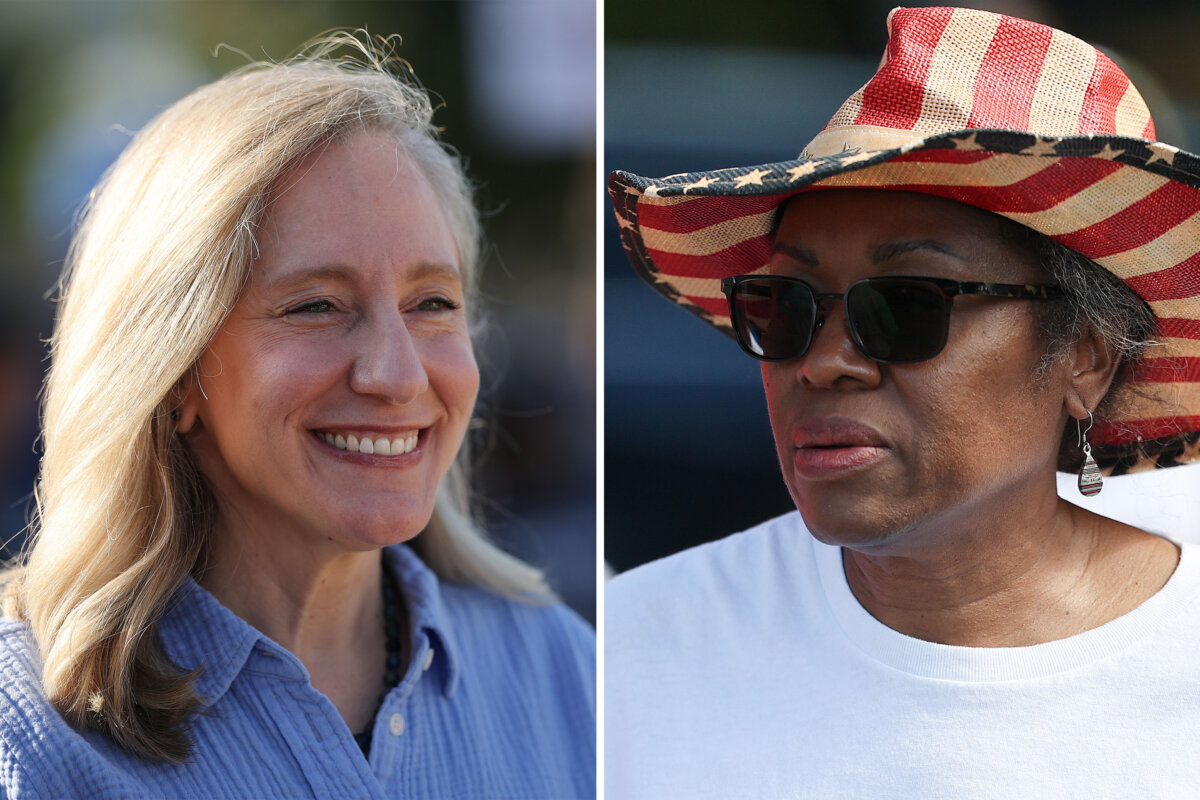
In the final weeks of the Virginia governor’s race, the two candidates have zeroed in on differing issues.
Abigail Spanberger, the Democratic candidate and frontrunner, has focused on the federal government shutdown that’s impacting many federal workers in the state.
The former congresswoman and CIA employee is currently polling at 52 percent and is 10 percentage points ahead of her rival, Lt. Gov. Winsome Earle-Sears, the Republican nominee.
Earle-Sears has taken to emphasizing education and transgender matters to consolidate GOP voters and appeal, from a different angle, to Spanberger’s target: the vote-rich suburbs of Washington, D.C., in Northern Virginia that have become the keys to success in the Commonwealth.
Earle-Sears has struggled in the polls since joining the race. Statewide, since 2010, Virginia has been a poor ground for Republicans due to the swelling of Washington, D.C., suburbs with progressive voters, such as urban professionals and federal workers. The incumbent Gov. Glenn Youngkin’s (R-Va.) 2021 victory was a blip amid two consecutive Democratic gubernatorial terms, two longtime Democratic U.S. senators, and both houses of the state Legislature being in Democrats’ control.
In this environment, Earle-Sears is learning from Youngkin, whose 2021 campaign prioritized critical race theory and parental rights in education. Spanberger, meanwhile, has pivoted her campaign to focus on the ongoing federal government shutdown, as well as her economic plan.
Spanberger Spotlights Shutdown
Spanberger, like most Democrats, has blamed President Donald Trump and Republicans for the shutdown, which has been ongoing since Oct. 1.
Congressional Democrats have refused to support a GOP short-term plan to fund the government at the existing level before the shutdown, as they are seeking the inclusion of health measures, including an extension to pandemic-era Obamacare subsidies that are due to expire at the end of the year.
Northern Virginia, which borders Washington, is home to many federal workers and contractors. It is the fastest-growing area of the state, and has a high number of foreign-born citizens and new immigrants, whose share of the region has risen to 28 percent over the last 25 years.
Before the shutdown, federal workers had also borne the effects of the Trump administration’s efforts to reduce the size of the federal bureaucracy and cut spending.
“Most federal workers, already traumatized by layoffs and mass resignations under political pressure from the president’s Department of Government Efficiency will either work without immediate pay in jobs deemed essential or stay home under unpaid furlough until the government reopens,” wrote Spanberger in a press release emailed to The Epoch Times. “The idea that the president would use the shutdown to escalate the attacks on the federal workforce even further is an egregious attack on Virginians.”
Trump and Republicans have attributed the shutdown to Democrats’ rejection of the GOP-backed stopgap bill, saying that it was inappropriate to negotiate health care funding in exchange for keeping the government open. Trump has also signaled mass layoffs during the shutdown, and the White House has said that furloughed federal workers won’t get back pay when the shutdown ends.
Experts say the impact of the administration’s shrinking federal workforce is driving up support for Spanberger.
“The government reductions-in-force have really impacted people that live here in Northern Virginia. Those are Virginia voters,” said Timothy Parrish, a Republican political strategist and former chairman of the Prince William County Republican Committee, to The Epoch Times.
Because the shutdown is happening during the Trump administration, the president and Republicans are likely going to be blamed, Parrish said.
Larry J. Sabato’s Crystal Ball, a political tracking unit of the Center for Politics at the University of Virginia, wrote: “Spanberger has been working to nationalize the race by linking Earle-Sears to the Trump administration. One Spanberger ad that has been running for about a month depicts Earle-Sears as unsympathetic to thousands of federal workers that have lost their jobs under Trump.”
Before the shutdown, however, Spanberger was spending the majority of her time discussing her plan to address Virginia’s economy, which is the highest polling issue of concern across the state. Her plan calls for apprenticeships for school students, a paid family and medical leave program, and raising the minimum wage to $15 an hour.
“She’s always been a very formidable candidate to run against. She is someone who is very focused, and she sticks to her messaging,” said Parrish. “[It’s a] complex, very substantive … economic plan.”
Schools for Sears
Winsome Earle-Sears has been emphasizing issues of progressive social ideologies in public schools, which have yielded fruits for Republicans in elections past. Youngkin’s campaign in 2021 emphasized the removal of “critical race theory” from Virginia’s schools, based on the allegation that it had been employed in Loudoun County, a wealthy community outside Washington, D.C.
“Winsome Earle-Sears has surged in recent weeks by highlighting how Democrats’ woke ideology is harming Virginia schoolchildren, especially those in the wealthy blue counties right outside of Washington, D.C.,” wrote her campaign on its website, describing her current approach to the race.
“Moderate parents in costly Washington suburbs might tolerate some wokeism, but not at the expense of their children and the education they pay for so dearly with their property taxes and high home prices. … If Earle-Sears keeps pressing the issue of ideology-over-education, she can win the governor’s mansion,” the campaign added.
Earle-Sears’s focus on those issues has not increased her position in the polls, while some experts opine that it will help her consolidate voters better.
“With Earle-Sears now raising the salience of red meat social issues … Republicans may have more reason to rally around their ticket,” wrote Sabato’s Crystal Ball.
Parrish, however, believes that these issues need to be communicated better.
“She’s got to have one very clear message, and she’s got to drive that home over the next 31 days, and it’s got to be succinct, and it’s got to be profound,” he said. “In 2021, Gov. Youngkin had a mantra … ‘If you hire me, I’m going to make the Commonwealth of Virginia the very best place in America to live, work, and raise a family.’ He said that mantra everywhere he went.”
“You don’t see a single policy point that you can always point back to in the Earle-Sears campaign, like you did in ’21 with the Youngkin campaign,” Parrish added. Messaging, it appears, is the chief contrast between Spanberger and her opponent.
Other commentators say the approach is not going to work for Earle-Sears.
“Spanberger is up 13 percent on handling trans issue. It is top of mind for only 3 percent of voters,” opined Sam Shirazi, host of the Federal Fallout podcast and a commentator on Virginia politics.
Beyond the issue of schools and transgenderism, Earle-Sears also wants to repeal the state’s tax on cars.
“Virginians are sick of the yearly stick-up just for owning a car. The car tax is legalized robbery—and I’m going to end it,” she wrote on X. Virginia tax law treats cars as “personal property” and subjects them to property taxes similar to real estate, which has been largely unpopular in the state.
The winner of the race will become the first woman governor of Virginia in the state’s 249-year history. The general election will be held on Nov. 4.
 Friends Read Free
Copy
Facebook
Tweet
Friends Read Free
Copy
Facebook
Tweet