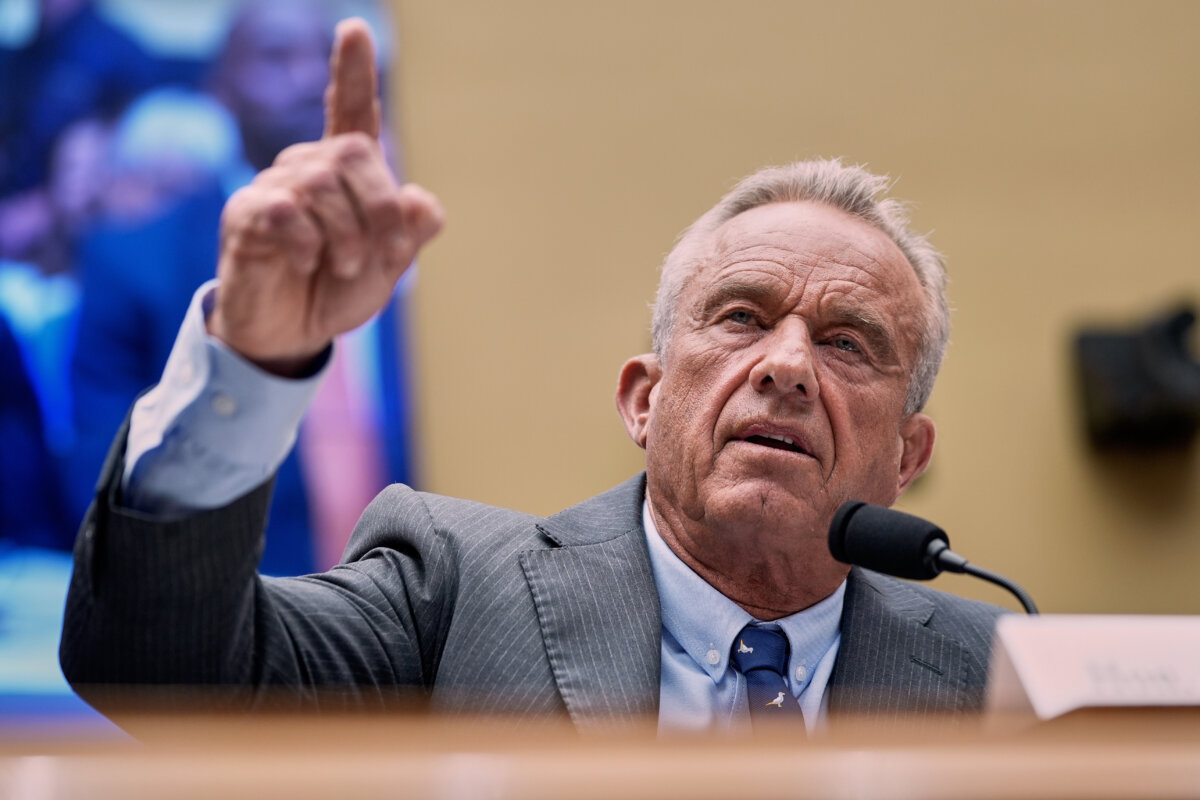

Health Secretary Robert F. Kennedy Jr. announced on Aug. 5 that 22 mRNA vaccine development contracts are being canceled and redirected “because the data show these vaccines fail to protect effectively against upper respiratory infections like COVID and flu.”
The mRNA development activities are spearheaded by the Biomedical Advanced Research and Development Authority (BARDA), which is managed by Global Health Investment Corporation.
The Department of Health and Human Services (HHS) contracts for the 22 projects are worth nearly $500 million, according to its Aug. 5 statement.
The decision “follows a comprehensive review of mRNA-related investments initiated during the COVID-19 public health emergency,” according to the announcement.
“We reviewed the science, listened to the experts, and acted,” Kennedy said in a statement. “We’re shifting that funding toward safer, broader vaccine platforms that remain effective even as viruses mutate.”
As part of the wind-down, BARDA’s award to Moderna/UTMB for an mRNA-based H5N1 vaccine will be canceled, HHS stated. Contracts with Emory University and Tiba Biotech will also be terminated. Pre-award solicitations from Pfizer, Sanofi Pasteur, CSL Seqirus, Gritstone, and others, as part of BARDA’s Rapid Response Partnership Vehicle and VITAL Hub, will be canceled or rejected.
There will be a “de-scoping of mRNA-related work” in three existing contracts and a restructuring of collaborations with the Department of Defense, impacting nucleic acid-based vaccine projects with AAHI, AstraZeneca, and HDT Bio, according to the HHS statement.
Some final-stage contracts will be permitted to continue, but no new mRNA-based projects will be initiated, according to HHS.
“Let me be absolutely clear: HHS supports safe, effective vaccines for every American who wants them,” Kennedy said. “That’s why we’re moving beyond the limitations of mRNA and investing in better solutions.”
Some infectious disease experts criticized the decision, expressing confidence in the safety of mRNA technology used in vaccines. They credited its development with slowing the COVID-19 pandemic and said future pandemics will be harder to stop without its presence.
Rick Bright, an immunologist who served as director of BARDA from 2016 to 2020, wrote in an X post on Aug. 5: “BARDA invested in mRNA technology precisely because it could deliver safe, scalable vaccines in record time, a capability proven during COVID. By dismantling that platform, we’re crippling our front-line defense, just ahead of unknown biological threats.”
Health care policy analyst Chris Meekins, a former deputy assistant secretary for HHS, where he focused on preparing for and responding to public health emergencies, said that the decision to end the investment in mRNA technology “creates a national security vulnerability.”
“These tools serve as a deterrent to prevent other nations from using certain biological agents,” Meekins wrote on X on Aug. 5. “The speed of the technology to create new biodefense capabilities is a national security asset.”
Kennedy’s announcement signals a broader shift in federal vaccine development priorities, according to HHS.
BARDA will focus on platforms with stronger safety records and transparent clinical and manufacturing data practices moving forward, the agency stated.
“Technologies that were funded during the emergency phase but failed to meet current scientific standards will be phased out in favor of evidence-based, ethically grounded solutions–like whole-virus vaccines and novel platforms,” the HHS statement reads.
Since taking office, Kennedy has implemented multiple changes regarding vaccines.
The Food and Drug Administration in late May said it planned to limit access to future COVID-19 vaccines to people 65 and older and individuals with underlying health conditions.
The agency also announced it would permit vaccine manufacturers to coordinate in-depth studies to assess the efficacy and safety of COVID-19 vaccines in children and younger, healthy adults.
In recent months, HHS also dismissed all 17 members of the Centers for Disease Control and Prevention vaccine advisory panel, ended the CDC’s COVID-19 vaccine recommendations for pregnant women and healthy children, and ordered the removal of mercury from influenza vaccines.
On Aug. 1, Kennedy announced the repeal of a federal policy that rewarded hospitals for reporting staff vaccination rates.
Created under the Centers for Medicare & Medicaid Services inpatient payment rule in August 2021, the policy linked hospital reimbursement to staff vaccination reporting.
The Associated Press contributed to this report.
 Friends Read Free
Copy
Facebook
Tweet
Friends Read Free
Copy
Facebook
Tweet