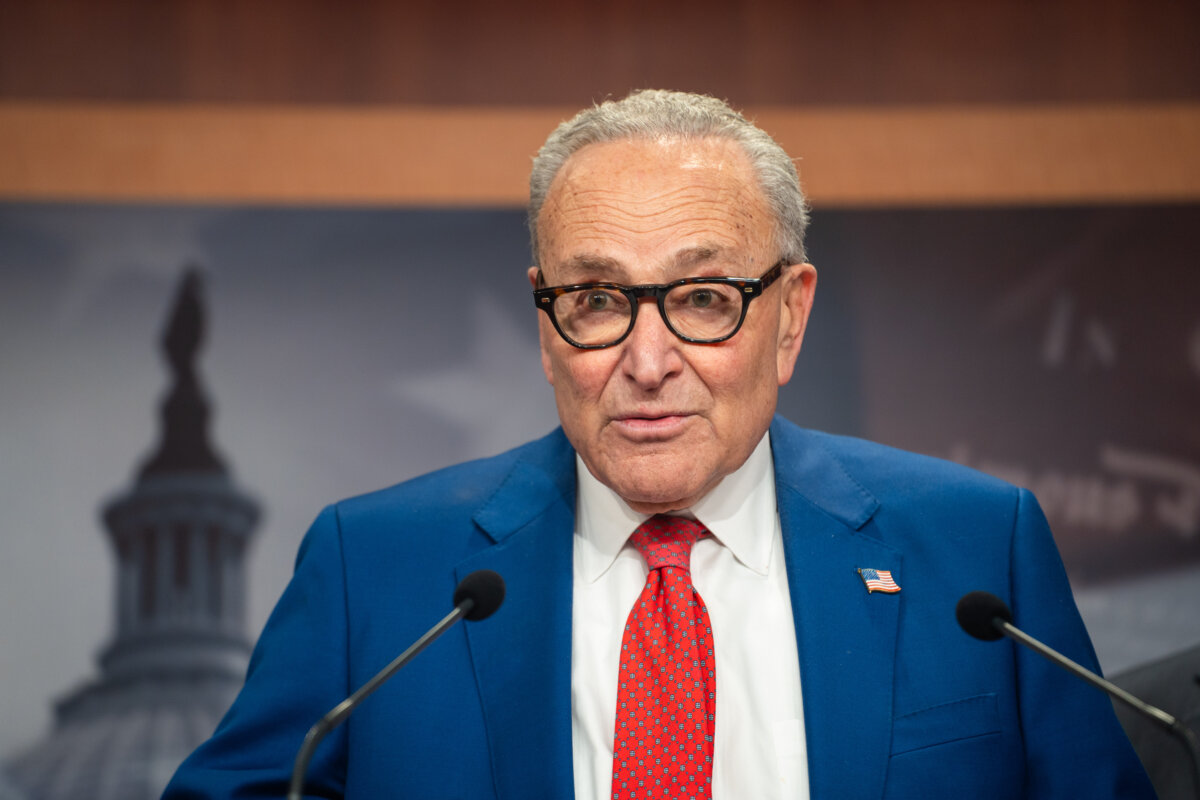

House and Senate Democrats said on Feb. 4 that they were united in their approach to funding the Department of Homeland Security (DHS) and Immigration and Customs Enforcement (ICE) as a two-week window begins for both parties to strike a deal on DHS funding and immigration enforcement policy.
The calls for reform come less than a day after President Donald Trump signed a bill on Feb. 3 ending a four-day partial government shutdown and extending DHS funding until Feb. 13.
The package fully funds five departments of the federal government through the end of the fiscal year while giving lawmakers less than two weeks to negotiate DHS funding.
The House passed the Senate-passed package, with most House Democrats, including House Democratic leadership, voting against it. A group of 21 Democrats voted for the bill, which Senate Democratic leaders had negotiated with the White House without the participation of House Democrats.
Asked at a press conference on Feb. 4 why he was not included in earlier negotiations between top Senate Democrats and the White House for the bill, House Minority Leader Hakeem Jeffries (D-N.Y.) deferred the question but said that House and Senate Democrats were at present united in “reining in” ICE.
“The House and Senate are completely and totally on the same page in terms of Democrats as we outlined,” Jeffries said. “Leader Schumer and I had a close, positive conversation yesterday about the path forward. We’ve remained in close contact over the last several days, as we will continue to do. And what you see here is a representation of the entirety of the House Democratic Caucus and the Senate Democratic Caucus united in reining in an agency, ICE, that’s out of control.”
Senate Minority Leader Chuck Schumer (D-N.Y.) said some of the biggest sticking points going forward with funding the DHS are ending “roving patrols” and limiting when agents can cover their faces with masks during enforcement actions.
“This is turning America inside out in a way we haven’t seen in a very long time,” Schumer said at the press conference alongside Jeffries and other Democratic leaders.
Jeffries said that ICE and other agencies should operate “like every other law enforcement agency in the country.”
He said Democrats want requirements that include “mandatory body cameras” and “judicial warrants.”
“The Fourth Amendment is not an inconvenience,” Jeffries said. “It is a requirement embedded in our Constitution that everyone should follow.”
DHS Secretary Kristi Noem announced the day prior that all federal officers in the field in Minneapolis will have body cameras moving forward, saying body cameras would be deployed nationwide as funding for them becomes available.
“We will rapidly acquire and deploy body cameras to DHS law enforcement across the country,” she said.
Jeffries also said that ICE should not be able to detain and deport American citizens, “which we know is taking place right now.”
Schumer said that Democrats agree on “three broad categories” of demands. First, he said, agents should not be able to “just stop anybody on the street” and detain people without explanation. He said there are places agents should not be able to go, including churches, synagogues, schools, and election places.
“There should be no racial profiling,” he said.
Second, Schumer said that Democrats want “outside independent oversight,” a right to sue, and “a right to go to court.”
Third, he said that Democrats oppose what he called “secret police” tactics and want agents to be identifiable.
“We need cameras,” Schumer said, saying that rules for their use need to be specific. Schumer called for “no masks except in extraordinary and unusual circumstances.”
Sen. Patty Murray (D-Wash.), the top Democrat on the Senate Committee on Appropriations, said Democrats will not support full-year DHS funding without changes.
“We are going to have accountability at DHS, or there will not be Democratic votes to fund a lawless agency,” she said.
Murray said that if Republicans refuse Democratic demands, “they are forcing a Republican shutdown of DHS.” She noted that Democrats “strongly support the mission of FEMA and the Coast Guard” but said that the public is demanding “guardrails” to “rein in ICE and border patrol.”
Republicans have expressed some support for the Democratic proposals, but there is heavy opposition to having immigration officers obtain judicial warrants instead of administrative warrants.
Sen. Ron Johnson (R-Wis.) said on Feb. 1 during an appearance on CNN’s “State of the Union” that he does not have a problem with requiring federal agents to wear body cameras. However, he said he opposes restricting DHS officers from entering homes unless they obtain warrants.
“We have millions of cases,“ he said. ”So demanding judicial warrants is their sneaky way of basically neutering our ability to enforce any immigration laws.”
Speaker Mike Johnson (R-La.) said on Feb. 2 that Republicans would “never” go along “with adding an entirely new layer of judicial warrants.”
“It is unimplementable,” he said. “It cannot be done, and it should not be done. It’s not necessary.”
Many, including Johnson, also oppose requiring federal agents to remove masks, arguing that it would be a possible safety threat.
Schumer said Democrats were ready to negotiate with anyone from the White House to Senate Majority Leader John Thune (R-S.D.). He noted that Thune had designated Sen. Katie Britt (R-Ala.) to negotiate but said Democrats also need the White House, Senate Republicans, and House Republicans involved.
“If they’re not serious, and they don’t put in real reform, they shouldn’t expect our votes, plain and simple,” Schumer said.
He said Democrats would submit a plan in the coming days and await the GOP’s response.
Zachary Stieber and Joseph Lord contributed to this report.
 Friends Read Free
Copy
Facebook
Tweet
Friends Read Free
Copy
Facebook
Tweet