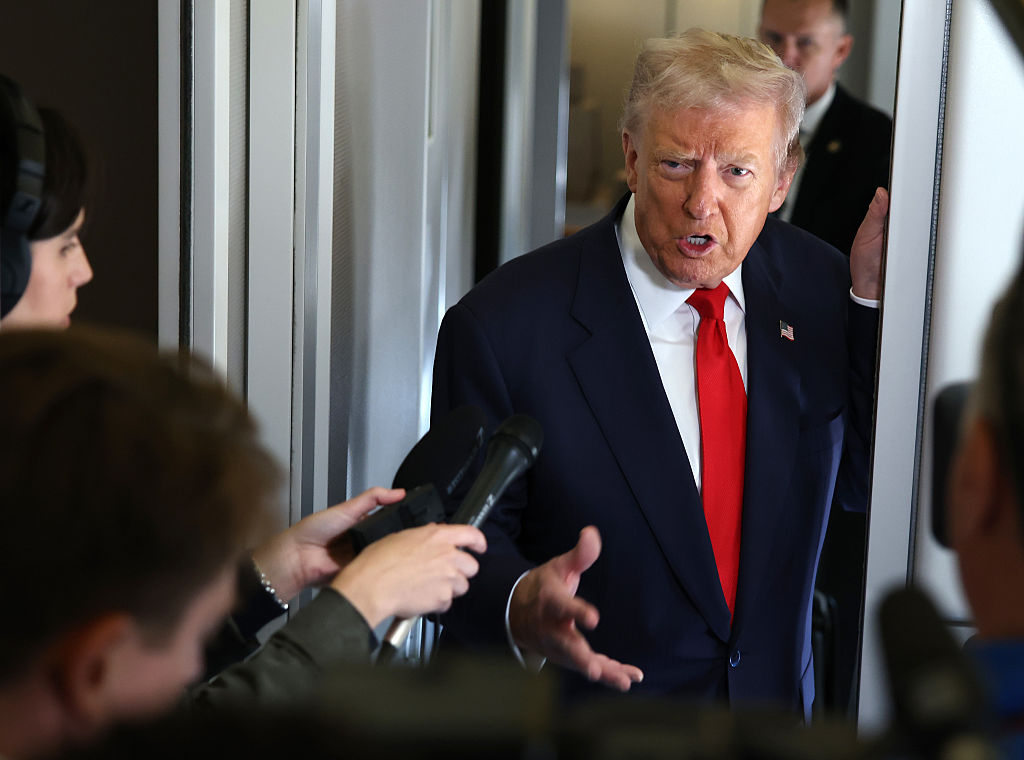
Since being reelected, President Donald Trump has moved at lightning speed to implement more than 200 executive orders, redefining U.S. policy on immigration, energy, race, education, crime, freedom of speech, and religion.
When it comes to the culture wars, according to conservatives, Trump has not only regained ground, but also opened new fronts, presenting issues such as the environment and immigration as matters of commonsense values. Whether those gains will hold is an open question.
Trump has been adept at using online media to circumvent established newspapers and networks to control narratives on cultural issues, according to Jonathan Choe, an independent journalist and senior fellow with the Discovery Institute.
“Trump, at the end of the day, is a businessman and a showman,” Choe told The Epoch Times. “He understands media. He’s understood it for decades, and he knows how to quickly pivot to new media.
“The Trump White House, in my opinion, that entire media team, has done a spectacular job of understanding the shifts in culture, but also in the media.”
That does not necessarily translate to lasting gains.
Darryl Hart, history professor at Hillsdale College, told The Epoch Times, “I don’t think he is changing many minds, certainly not on the other side.”
“The polarization is really strong,” he said.
This view is supported by recent polling data that suggest that Americans remain sharply divided on cultural issues.
Regarding gender issues, an AP-NORC Center for Public Affairs Research survey in May found that while only 41 percent of respondents approved of Trump’s performance in general, 52 percent supported his policies on transgender issues, which include barring transgender-identifying boys from girls sports and private spaces. Responses were split according to party; 90 percent of Republicans supported Trump’s policies, and 81 percent of Democrats opposed them.
This raises the issue of how enduring some of Trump’s policies might be if Democrats retake the White House at the end of his term. Election wins for Democrats on Nov. 5 in Virginia, New Jersey, and New York City, as well as a popular vote in California to redistrict the state’s electoral map, show that the opposing side remains a powerful force in the United States.
Opening New Fronts
All the same, conservative analysts said some parts of Trump’s cultural agenda will likely endure. According to them, Trump has opened up new fronts in the culture wars on topics such as Antifa, climate change, and immigration.
“President Trump has taken something that the majority of Americans did not even realize was an issue, and now today the majority of Americans think we should deport people who have entered the country illegally,” Jenny Beth Martin, cofounder of Tea Party Patriots, which advocates for civil liberties and smaller government, told The Epoch Times.
Still, a June survey of 5,044 U.S. adults by Pew Research Center found that the public is split over this issue; 50 percent approved of the use of state and local law enforcement in deportation efforts, and 49 percent did not.
On climate change, Trump has tried to move the country away from the narrative of existential crisis and pending global catastrophe to one of Americans having affordable and abundant energy.
Prominent figures in the climate change debate such as Bill Gates and Ted Nordhaus have softened their more alarmist stances, seemingly coming around to Trump’s point of view. Gates has said climate change “will not lead to humanity’s demise,” and Nordhaus has written that he no longer believes “this hyperbole.”
Trump has also shone a spotlight on political violence from hardcore leftist groups such as Antifa, a far-left extremist group that originated under the Soviet Union and functioned as the violent wing of Germany’s Communist Party to target political rivals. Trump designated Antifa as a domestic terrorist organization in an executive order.
“Because Trump put that label on Antifa, it’s now part of the national conversation,” Choe, who is based in Seattle, told The Epoch Times. “Before, when I was covering Antifa during the early days of the [Black Lives Matter] riots in 2020, when they were going around trashing Seattle in ninja outfits, local media wouldn’t even use the word ‘Antifa.'”
“What the Trump White House has done from a messaging standpoint—waging an information war on the left-wing corporate media—they’ve done so brilliantly, in my opinion,” he said.
Wading Into the Battles
Other conservatives lauded Trump’s willingness to take the culture wars seriously and wade in where others have feared to go.
“He was willing to call out radical gender ideology on the campaign trail and make it a centerpiece of the campaign,” Ryan Bangert, special counsel to the president at Alliance Defending Freedom, a conservative legal group, told The Epoch Times.
Effectively, he said, this left Democrats in a position of defending transgender-identifying men competing in women’s sports and having access to women’s bathrooms, showers, and changing rooms, as well as gender-related medical procedures on children and school teachers supporting students’ gender transitions without parents’ knowledge or consent.
Tiffany Justice, a fellow at the Heritage Foundation and cofounder of conservative parents’ group Moms for Liberty, said Trump listened to parents who said they were being marginalized while progressive race and gender ideology was being taught to their children in schools.
“Early on, with Moms for Liberty, I was very frustrated, because I would say that we’re in the middle of a cultural revolution and there were people, politicians and others, who would wave it off and make light of the culture war,” Justice told The Epoch Times.
“In order to win a culture war, you have to be willing to engage in the culture, and President Trump has unabashedly done so.”
Winning in the Courts
Another reason why Trump’s actions may endure is the fact that his administration has gone beyond executive orders to advocating, often successfully, before the courts, Bangert said.
Trump appointed three sitting Supreme Court justices and nominated approximately 240 district and appellate judges during his first and second terms. His Justice Department has also been active this year in supporting conservative causes that come before the courts, which can help such cases reach the Supreme Court.
“If you look at the advocacy before the U.S. Supreme Court, that’s something that won’t be undone by an election,” Bangert said.
Although the court does not always agree with the administration’s point of view, he said, it always takes the views of the solicitor general very seriously.
“Oftentimes you’ll see a much higher grant rate [for Supreme Court review] when the solicitor general takes a very active interest in the case,” Bangert said.
The higher courts are often siding with conservative constitutional liberties cases involving freedom of religion, freedom of speech, and the right to bear arms, according to him.
“Freedom of religion is something that the U.S. Supreme Court has been exceptionally protective of over the past several years,” Bangert said. “Parental rights is something that is an emerging area.”
The recent Supreme Court decision in Mahmoud v. Taylor, for example, ruled that a Maryland public school district that sought to teach children progressive views on sex and gender over parents’ objections and with no option to opt out of those sessions was “an unconstitutional burden on [families’] religious exercise.”
Numerous Supreme Court decisions, most notably West Virginia v. Environmental Protection Agency (EPA) and Loper Bright Enterprises v. Raimondo, have been handed down that limit the ability of federal agencies to dictate a climate agenda to private industry, which have supported Trump’s deregulatory agenda regarding energy.
These decisions aligned with the recent decision by the EPA under Trump to rescind its “endangerment finding” regarding whether carbon dioxide was a harmful pollutant requiring regulation under the Clean Air Act.
Bringing the Extremes to Light
Another successful tactic of the Trump administration, according to conservative analysts, has been to shed light on what the more extreme progressives have been doing behind the scenes, forcing his political opponents to defend what they had previously advanced without debate or pushback.
“There has been this awakening to what government has been doing,” Hart said. “That kind of knowledge and awareness could have a more lasting effect [than executive orders].”
One such issue was the revelation that the U.S. Agency for International Development had spent millions of dollars in support of transgenderism and other progressive causes, many of which have been canceled by the Trump administration.
Much more has come to light regarding corporate and government programs advancing diversity, equity, and inclusion initiatives and the environmental, social, and governance movement, from which many corporations are now stepping back.
“Much of what was going on was under the radar, so for [the left] to go right back to what they were doing is, I think, probably going to be more difficult,” Hart said.
Regardless of how much of Trump’s agenda ultimately sticks, the president has a uniquely large footprint in America’s culture wars, according to Hart.
“I’ve never seen anyone have the kind of grip, both for good and ill, on the American political psyche that Donald Trump has,” Hart said. “The only person to whom I could liken it would be [President Franklin D. Roosevelt].”
 Friends Read Free
Copy
Facebook
Tweet
Friends Read Free
Copy
Facebook
Tweet