
The United States has ample critical mineral deposits, and its mining industry is spearheading innovative technologies designed to decouple the nation from dependence on China for the processed metals and materials domestic manufacturers need.
But without an education system that emphasizes hard sciences, especially geology, that won’t happen, experts told the House Natural Resources Committee’s Oversight and Investigations Subcommittee during a Dec. 3 hearing.
“Congress can enact every permitting reform, every critical minerals bill on the docket, but without the workforce to execute them, we won’t be restoring our leadership in mining,” Rep. Burgess Owens (R-Utah) said. “If America wants to win … that starts with a mining workforce strong enough to secure our supply chains.”
Owens’s proposed Mining Schools Act, which boosts funding for geologist and mining engineer programs at high schools and colleges, is among 14 mining and mineral development bills awaiting adoption in the House.
Such investment is needed, according to Walter Copan, Colorado School of Mines vice president for research and technology transfer. He said there are only 14 universities in the United States with dedicated mining and mineral engineering programs, down from 25 in 1982.
Subcommittee Chair Rep. Paul Gosar (R-Ariz.) said that “1,449 students graduated from U.S. university mining schools [in 2015], but only 590 students graduated from these schools in 2023.”
Meanwhile, China has at least 38 mineral-processing schools and 44 university mining engineering programs. Beijing’s Central South University itself annually produces 1,000 undergraduates and 500 graduate-degree geologists and engineers, according to a Center for Strategic & International Studies analysis.
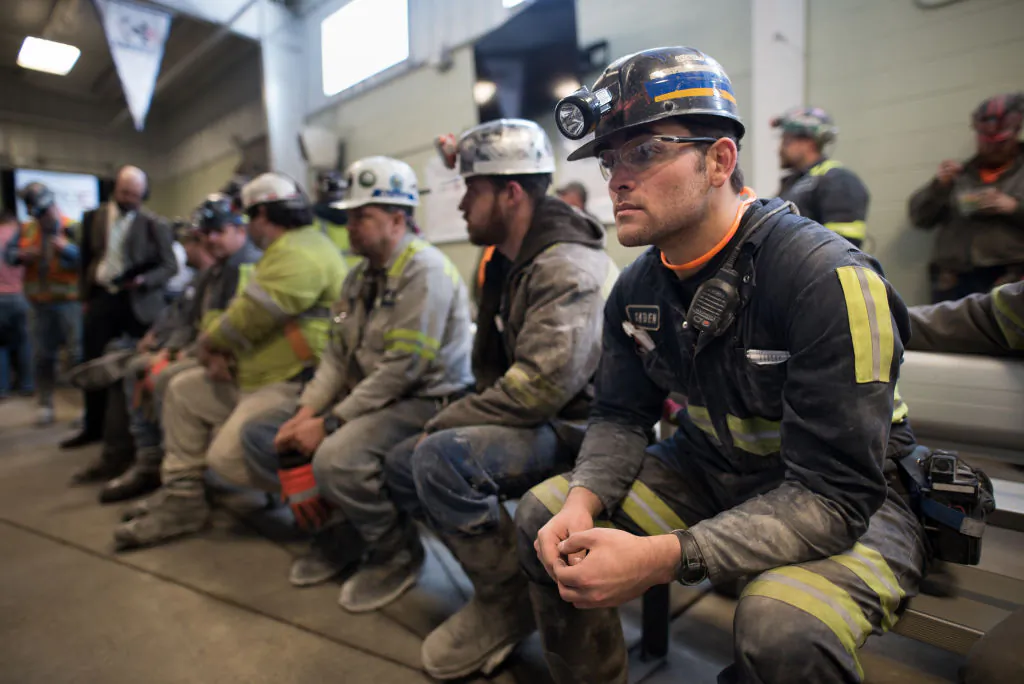
Committee Chair Rep. Bruce Westerman (R-Ark.) said in addition to fewer people entering the mining industry, “an estimated 220,000 workers are expected to retire from the current mining workforce by 2029.”
Although automation, artificial intelligence (AI) cloud computing, and robotics can compensate for retirements, young workers with a range of trade and technology skills are needed, he said.
“In short, there is a vocation for everyone in the mining industry today,” he said.
Hard Rock AI
AI advancements, innovations in extraction—including sifting critical minerals and rare earths from existing or closed mines—and using American-pioneered oil/gas drilling expertise are among technologies and processes being deployed to identify viable critical mineral deposits and de-risk investment, panelists told the subcommittee.
Terra AI Head of Growth Daniel Donahue said his San Francisco-based firm is “building an AI” to accelerate “exploration by nearly half, and reduce inherent geologic risk that makes mining difficult to invest in.”
His “small office in Silicon Valley” is manned by geologists from Shell, Schlumberger (a multinational oilfield company), NASA, and Colorado School of Mines, along with AI engineers from Meta, Google, and Stanford, he said.
“A geologist like me would produce one model over several weeks or months. We can produce thousands in just minutes,” he added.
Data is “the new oil,” Donahue said.
“[If mining AI is] adopted to scale, we can change the process and ‘win’ the hundreds of mines that will define our future,” he said.
Momentum Technologies CEO Mahesh Konduru said his company’s demonstration plant has developed extraction technology that dramatically improves “recovery rates for both light and heavy rare earth elements” from “waste rock”—or tailings—and processes them into metals and materials.
The Texas-based innovator is developing a modular plant that can be co-located at mines to process ore into metals on site, he said.
“We want to take China out of the equation, and this is where our technology comes into play,” Konduru said. “No company outside China has yet produced a full range of separated rare earths at volume, especially the heavy rare earths needed in high-performance magnets.”
SLB New Energy Head of Mining Nicholas Lugansky said his Houston-headquartered corporation, founded in 1878 in France, pioneered technologies that fostered 20th-century advancements in oil and gas exploration and production.
“We see tremendous opportunities to accelerate U.S. mining capabilities by transferring and adopting proven oil and gas technologies to the mining sector,” he said. “These technologies are not speculative—they are real, and we can bring them.”
Reform, Deregulation
Permitting reform, trimming regulations, and capping litigation timelines are among the needed legislative remedies, witnesses said, calling for swift adoption of the proposed Mining Regulatory Clarity Act, Critical Mineral Dominance Act, and Bipartisan SPEED Act and expressing support for President Donald Trump’s March executive order streamlining approvals for critical mineral projects.
“In the United States, it takes an average of 29 years to build a new mine from the first stage of exploration to production,” Westerman said. “We are second only … to Zambia. We chuckle about that, but that’s unacceptable. This is the United States of America. We should be able to develop a mine in less than 29 years.”
As the primary sponsor of the SPEED Act, which revises what he called the “abused” 1969 National Environmental Policy Act, he said regulatory reform is “the other half of this puzzle” to “bring much-needed domestically produced minerals into the supply chain.”
Rep. Maxine Dexter (D-Ore.) said among laws that should be revised is the Mining Law of 1872, “which passed in the Civil War era,” and does little to advance new technologies.
“You want to speed up the permitting process and fund it, [but] when [Republicans] chronically underfund permitting offices, fire staff, and sideline science, you guarantee more conflict, more litigation, and more delays,” she said.
When Democrats held House and Senate majorities in 2021–2023, Congress “invested $1 billion in permitting capacity and modern tools under the Biden administration, timelines got over 20 percent shorter, even as environmental health protections remained in place,” Dexter said.
Donahue, Konduru, and Lugansky said innovations their companies are developing in AI, robotics, and advanced processing are actually designed to sidestep permitting and regulatory “bottlenecks.”
Co-locating modular, transportable processing plants on mining sites eliminates the “complexity of transporting feedstock, the need for a permit to deal with that,” Konduru said.
“You can start operating it, and then you can incrementally add more capacity as you need,” he said.
With familiar oil and gas drilling technologies, project timelines can be reduced “by three to five times,” Lugansky said, calling for legislative assurances “that regulators provide equal access to water, land, and mineral resources to all players, and take appropriate action if some actors try to monopolize these resources.”
Correction: A previous version of this article misstated the state that Rep. Maxine Dexter (D-Ore.) represents. The Epoch Times regrets the error.
 Friends Read Free
Copy
Facebook
Tweet
Friends Read Free
Copy
Facebook
Tweet