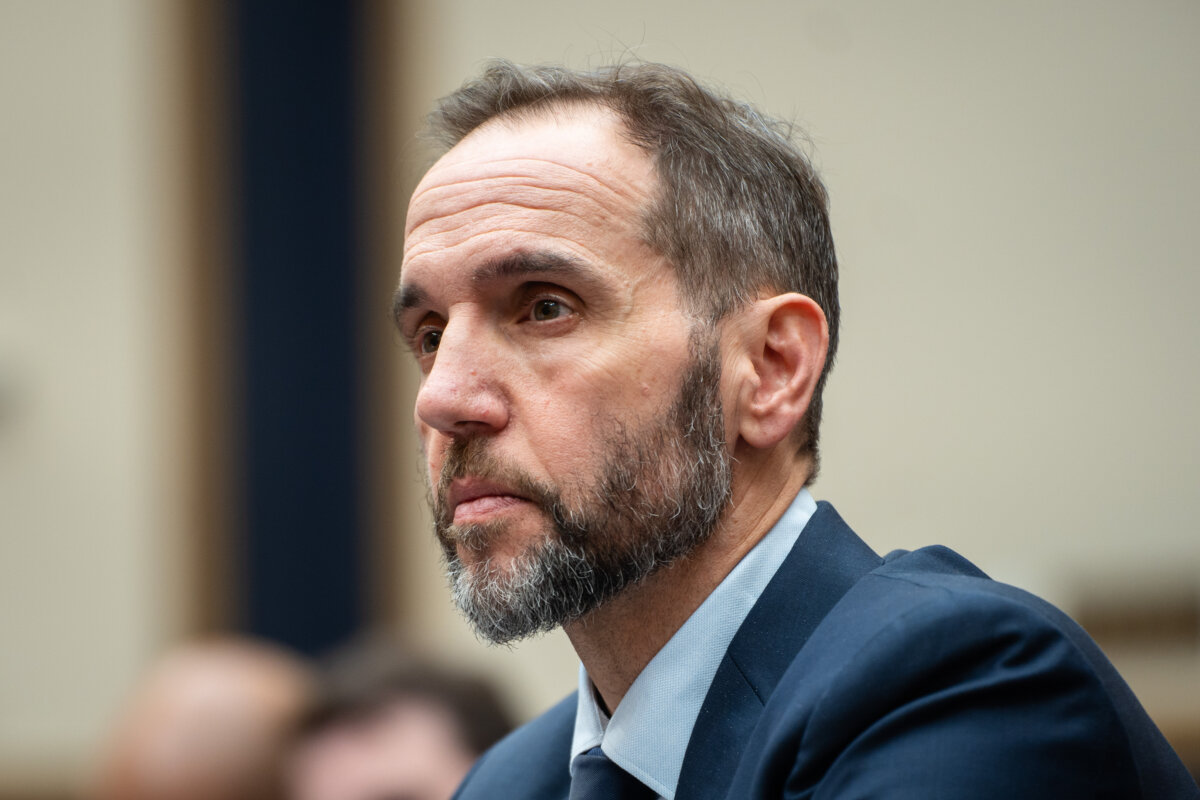

Former special counsel Jack Smith testified on Sept. 29 that GOP lawmakers’ cellphone data obtained during an investigation that led to charges against President Donald Trump was “centrally relevant.”
The probe into an alleged conspiracy by Trump to overturn the results of the 2020 presidential election, codenamed Arctic Frost, was initially launched by the FBI and was later assigned to Smith as a special counsel investigation. Smith repeatedly told the Senate Judiciary Committee during a hearing on Tuesday that obtaining the phone records of multiple Republican lawmakers was an important part of the federal investigation.
In his final report, Smith wrote that toll records, which he said only showed the identities of callers and recipients and the duration of calls, provided evidence that Trump attempted to contact two senators and directed a co-conspirator to contact members of Congress and have them delay the certification of the 2020 election.
While Trump was charged by a grand jury following Smith’s investigation, the charges were ultimately dropped after he won the 2024 presidential election.
As part of the investigation, Smith obtained phone call records of multiple Republican senators, including Ron Johnson (R-Wis.), Marsha Blackburn (R-Tenn.), Lindsey Graham (R-S.C.), Bill Hagerty (R-Tenn.), Josh Hawley (R-Mo.), Cynthia Lummis (R-Wyo.), Dan Sullivan (R-Alaska), and Tommy Tuberville (R-Ala.). Rep. Mike Kelly’s (R-Pa.) phone records were also obtained during the investigation.
In addition to receiving the phone records, Smith obtained nondisclosure orders from District of Columbia federal District Court Chief Judge James Boasberg, preventing lawmakers from knowing that their phone records were being investigated.
The former special counsel told the committee that before requesting toll records for members of Congress from third-party telephone companies, his team consulted with the Justice Department’s Public Integrity Section. Smith maintained that the phone records were “materially relevant” to the investigation.
Asked why the records were relevant, Smith said the toll records corroborated evidence that “President Donald Trump and his co-conspirators were seeking to exploit the violence on January 6 in furtherance of their criminal scheme” by attempting to further delay the certification of the 2020 election.
“It was an important part of our investigation, and it was centrally relevant to the issue of criminal intent to seek to further delay the proceedings in violation of the law,” Smith told the committee. “Given what had happened that afternoon [on] January 6, in my view, added to the powerful evidence we had of Donald Trump’s guilt, and the participation of his co-conspirators in his criminal scheme at his behest.”
Smith told Durbin that his team did not conduct any wiretaps of members of Congress but that the non-content phone records were needed due to “incomplete” White House switchboard call records.
“We didn’t have all the records, and so that was another important point to corroborate,” he said. “For example, evidence of an email where someone says the president is trying to reach out to these people, but then to find the actual records of the actual call.”
Smith later clarified that his team’s nondisclosure orders were not based on the suggestion that congressional members would “commit acts of obstruction” but on “a real concern that Donald Trump and his associates would do that because they had done it.”
During Tuesday’s hearing, Sen. John Kennedy (R-La.) suggested that Smith’s actions violated the Constitution’s Speech or Debate Clause. The clause guarantees legal protections for lawmakers and ensures the separation of powers.
During his opening statements before the Senate Judiciary Committee on Tuesday, Smith maintained that his investigation showed Trump “engaged in a criminal scheme to overturn the results and prevent the lawful transfer of power.”
Smith also told the committee that he stood by his previous testimony before the House of Representatives, during which he defended his decision to prosecute Trump in both the election case and a separate case alleging that Trump illegally retained classified documents after leaving office.
 Friends Read Free
Copy
Facebook
Tweet
Friends Read Free
Copy
Facebook
Tweet