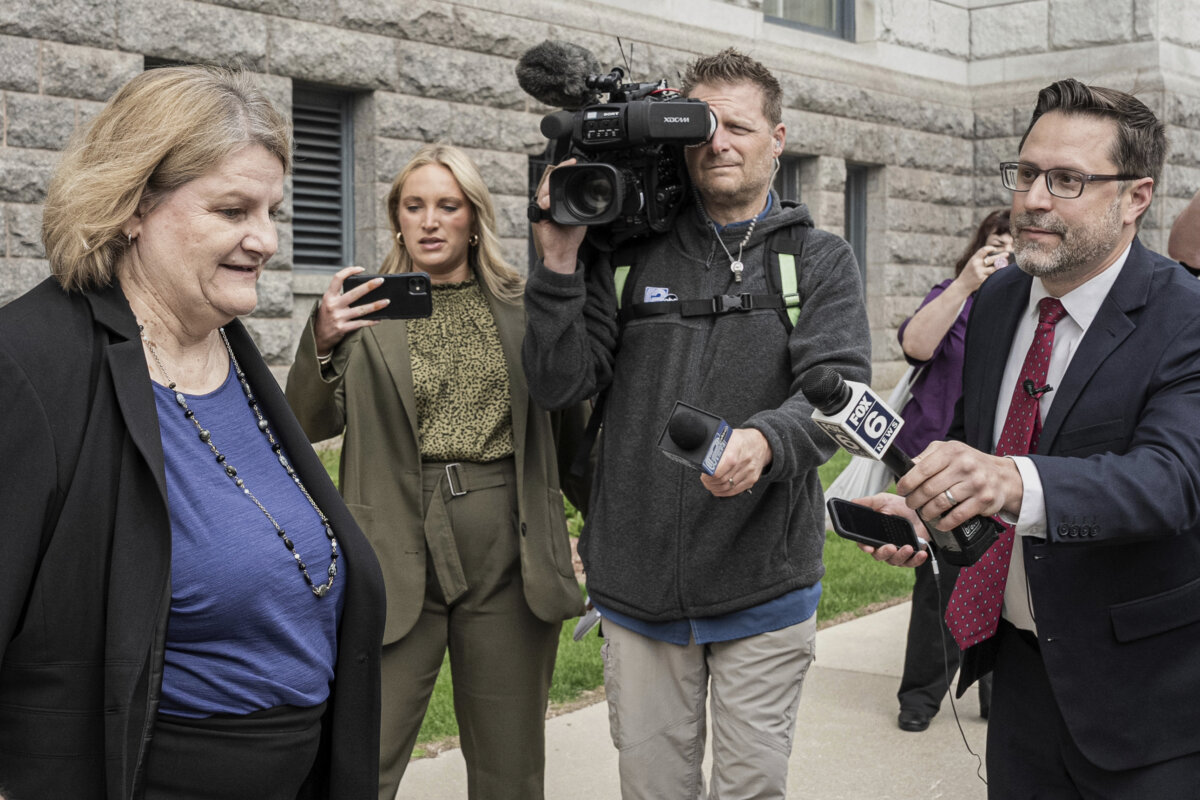

A federal judge in Wisconsin has turned down Milwaukee County Judge Hannah Dugan’s bid to dismiss her case, clearing the way for a trial on charges that she obstructed immigration officers who came to her courtroom to make an arrest.
In an opinion issued on Aug. 26, District Judge Lynn Adelman of the U.S. District Court for the Eastern District of Wisconsin rejected Dugan’s argument that her conduct was protected under the doctrine of judicial immunity, which generally shields jurists from being sued for actions taken in their official capacity.
“There is no basis for granting immunity simply because some of the allegations in the indictment describe conduct that could be considered ‘part of the judge’s job,'” Adelman wrote in the 27-page opinion. “The same is true in the bribery prosecutions, concededly valid, where the judges were prosecuted for performing official acts intertwined with bribery.”
Adelman also dismissed the defense’s attempt to link the case to the Supreme Court’s ruling last summer that President Donald Trump is at least presumptively immune from criminal prosecution for official acts.
That decision, Adelman wrote, was meant to safeguard the independence and effective functioning of the executive branch and to make sure that the president can carry out constitutional duties without undue caution—concerns that are unique to the presidency and “do not arise when one of the nation’s many judges is subject to prosecution.”
The federal judge further rejected Dugan’s argument that her arrest and prosecution violated the separation between state and federal powers under the U.S. Constitution.
Still, Adelman acknowledged that Dugan did raise “some very real concerns” about judicial immunity. For instance, he pointed to a hypothetical question of whether a state judge could be prosecuted for thwarting a planned federal immigration arrest by ordering an illegal immigrant into custody to answer for state charges.
Federal prosecutors responded to this question by saying judges with common sense would not violate the criminal law if they “are in good faith carrying out their required duties.” However, Adelman called the response “unsatisfying.”
Dugan’s attorneys said they were disappointed by the ruling but remain confident in her defense.
“We look forward to the trial which will show Judge Dugan did nothing wrong and simply treated this case like any other in front of her courtroom,” the legal team said in a statement.
Dugan, 66, was arrested by the FBI on April 25 for allegedly helping conceal Eduardo Flores-Ruiz, an illegal immigrant from Mexico. FBI director Kash Patel said at the time that evidence indicates that Dugan “intentionally misdirected” federal immigration agents away from Flores-Ruiz, who was to be arrested in her courthouse.
According to an FBI affidavit, Immigration and Customs Enforcement agents arrived at the courthouse on April 18 with an administrative warrant for Flores-Ruiz, who was scheduled to appear before Dugan that day on misdemeanor domestic violence charges. When informed of the agents’ presence, Dugan reportedly became “visibly upset” and insisted that the arrest team needed a judge-signed warrant.
The affidavit alleges that after sending Immigration and Customs Enforcement agents to speak with the county’s chief judge, Dugan led Flores-Ruiz and his attorney out of her courtroom through a backdoor typically used by jurors. After the man left the courthouse, immigration officers chased him on foot and arrested him at a nearby intersection.
In May, a federal grand jury indicted Dugan on one felony count of obstructing or impeding a proceeding and one misdemeanor count of concealing an individual to prevent discovery and arrest. She has pleaded not guilty to both charges.
Dugan has been suspended from the bench with pay by order of the Wisconsin Supreme Court.
A hearing in Dugan’s case is scheduled for Sept. 3. It is unclear whether the defense will appeal Adelman’s decision at the hearing. Such an appeal would go to the Seventh Circuit Court of Appeals and potentially delay the trial until 2026.
 Friends Read Free
Copy
Facebook
Tweet
Friends Read Free
Copy
Facebook
Tweet