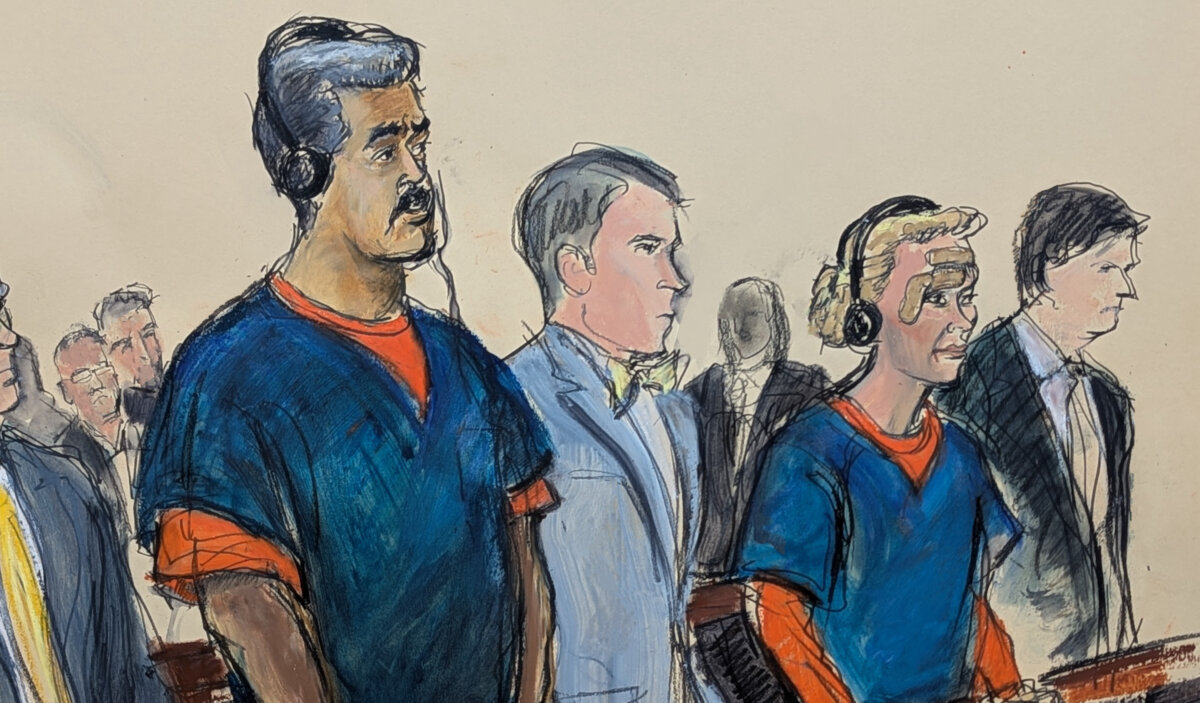

A federal judge on Thursday denied former Venezuelan leader Nicolás Maduro’s wife’s request to leave jail for home confinement while she awaits trial on charges that include conspiring to import cocaine and torture.
U.S. District Judge Alvin K. Hellerstein, in the Southern District of New York, wrote that Cilia Adela Flores de Maduro’s motion “is denied with the ability to renew the motion should further medical need arise.”
The order, signed on Oct. 8, says she may renew it “if her medical conditions worsen, or other reasons so suggest.”
Flores, 69, filed the application on Sept. 9.
She had asked to wait for trial at a residence under home detention, with court-approved visitors, video surveillance, a single landline under a consensual wiretap, random searches, location monitoring, surrender of her passport and identification documents, a third-party custodian, and regular reporting to U.S. Pretrial Services.
She also offered 24-hour armed surveillance, approved by the court and paid for by the defense.
Hellerstein found Flores “presents both a serious flight risk and a danger to the community.”
The charges, he wrote, carry a mandatory minimum of 50 years and a maximum of life, producing “a high incentive to flee.” She is not a U.S. citizen. Her only tie to the district, the judge wrote, is her incarcerated husband.
The danger to the community stems from alleged relationships with “drug lords” and the new torture allegations, he said.
He said that finding rests on clear and convincing evidence.
The private guards did not save the motion.
Hellerstein cited a Second Circuit ruling that “the Bail Reform Act does not permit a two-tiered bail system in which defendants of lesser means are detained pending trial while wealthy defendants are released to self-funded private jails.”
Her lawyers pointed to her heart. She has a mitral valve prolapse, a history of rheumatic valve disease, asthma, chest pressure, palpitations, and shortness of breath, the defense filing told the court.
Since detention, she has lost more than 25 pounds and two molars.
An April 23 stress test led doctors to recommend cardiac catheterization, which she has not undergone. She argued that the Metropolitan Detention Center could not support recovery from a later procedure.
Hellerstein did not brush the concern aside.
“I do not doubt the seriousness of Ms. Flores’s concerns about her health,” he wrote, but said he still found no current medical need that would warrant release, because the diagnostic procedure has not been done.
The Fourth Superseding Indictment charged Flores with cocaine importation conspiracy and with possession of, and conspiracy to possess, machine guns and destructive devices.
A grand jury returned a Fifth Superseding Indictment on Oct. 6, adding conspiracy to commit torture and narcoterrorism conspiracy.
Prosecutors unsealed that indictment Oct. 8.
It charges Maduro and Flores with torturing political opponents and Americans.
According to the indictment, the two “created and maintained a violent system of repression.”
Between 1999 and 2025, thousands of Venezuelans were harassed, threatened, arrested, prosecuted, assaulted, tortured, or killed by Maduro and other regime officials, the indictment says.
Both have pleaded not guilty. Their trial is set for June 1, 2027.
U.S. forces captured Maduro and Flores in Caracas in the early morning of Jan. 3 and brought them to New York.
Attorney General Pam Bondi said that day that Maduro “has been charged with narco-terrorism conspiracy, cocaine importation conspiracy, possession of machine guns and destructive devices, and conspiracy to possess machine guns and destructive devices against the United States.”
At the arraignment, Maduro said he is “a decent man” and called his capture a “kidnapping,” making him a “prisoner of war.”
 Friends Read Free
Copy
Facebook
Tweet
Friends Read Free
Copy
Facebook
Tweet