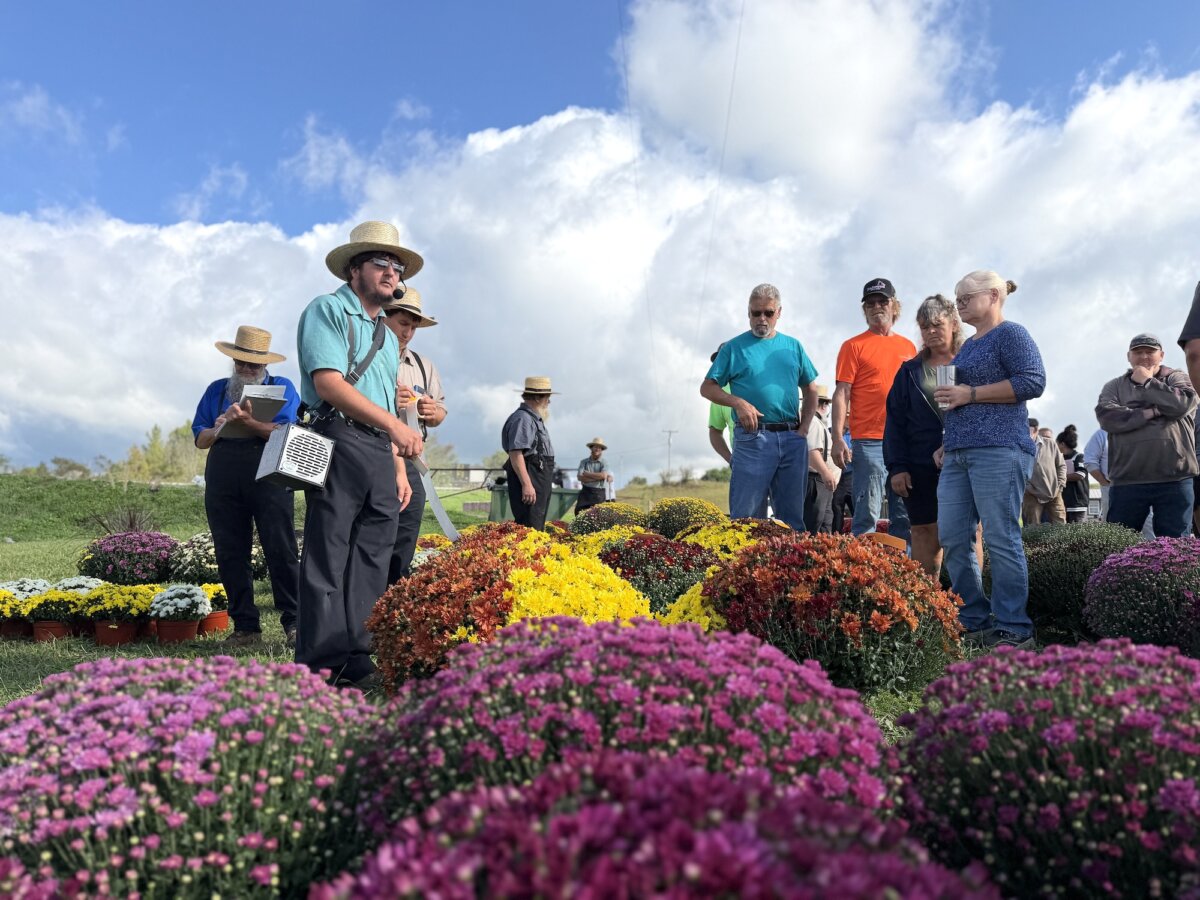
FORT PLAIN, N.Y.—Three days a week, Amish farmers gather at a regional produce auction in the village of Fort Plain, bringing fresh vegetables, fruit, and flowers to market.
Some come by horse-drawn wagon along narrow country backroads, others by bicycle, kick scooter, and pickup truck.
For now, it is another Wednesday at the auction in Fort Plain, New York—Amish country. But away from the auction floor, a legal battle over New York’s school vaccination mandate is testing the boundaries of religious freedom and state authority.
The dispute is prompting some Amish families to consider whether to stay in New York or pull up stakes and leave, the plaintiffs’ attorneys say.
“It’s not like they’re making a choice—New York is making a choice,” said Hiram Sasser, an attorney with First Liberty Institute representing a group of Amish parents in the case.
“New York is making the choice that they no longer welcome the Amish.”
One Amish man at the auction, who asked to remain anonymous, said he wonders what lies ahead.
“I don’t know what’s going to happen,” he told The Epoch Times. “I don’t know if people are going to leave, but I doubt it.
“I know there’s a lot of people that are not going to take the vaccines. I think we’ll go to jail before we do that.”
In 2022, the department fined three Amish community schools in the Mohawk Valley for violating public health law: Dygert Road School near Canajoharie, Pleasant View School in Heuvelton, and Shady Lane School in Clymer.
The schools face a combined $118,000 in penalties under New York’s school vaccination requirement.
The requirement applies to public, private, and religious schools. Medical exemptions are allowed when a child has a condition that prevents vaccination.
“Immunization is one of the most important things a parent or guardian can do to protect their child’s health,” the department said.
Sasser said the dispute is about religious freedom and the right of the Amish to make their own health decisions. The conflict has placed an intensely private religious community in the middle of a public legal battle.
Most Amish men and women approached for this story declined to comment. Those who did either were unaware of the vaccine controversy or did not want to discuss it too deeply.
An Amish man browsing books at a sidewalk sale in Fort Plain said he was “not particularly fond” of vaccines.
At a Fort Plain store, an Amish woman said some people in her community are more accepting of vaccines than members of other Amish groups.
“We don’t mind [vaccines],” she said. “I’m OK with not having them.”
She had never considered leaving New York over the dispute and doesn’t know others who have.
“You don’t really know other people’s feelings,” she said.
Her comments show that Amish families do not all share the same views. That variation is also reflected in their vaccination rates, which remain well below those of the general population, according to the Centers for Disease Control and Prevention (CDC).
On Sept. 9, Anabaptist World reported that two unvaccinated Amish infants in Lancaster County, Pennsylvania, died in August after contracting measles. They were the nation’s first measles-associated deaths this year.
“The county was the center of a rapid measles outbreak, with 45 percent of the state’s cases in early September. Its large population of Amish and conservative Mennonites has a low rate of vaccination,” the news site added.
The Pennsylvania Department of Health confirmed two additional measles-associated deaths on Sept. 15 in Jefferson and Mifflin counties, and a fifth death statewide on Sept. 30 in Lancaster County.
“My thoughts are with the two families who lost loved ones to this highly-contagious virus, as Pennsylvania faces the worst measles outbreak in more than three decades,” state Secretary of Health Dr. Debra Bogen said in a statement.
“We remain committed to working with our partners across Pennsylvania to stem this outbreak and prevent more deaths. That means ensuring people have the facts about measles and access to the MMR vaccine–which kept measles outbreaks at bay for decades.”
Measles can cause serious short- and long-term complications, including pneumonia and brain swelling, the department said. It added that nearly 20 percent of people diagnosed with measles are hospitalized, and historical data show that measles-associated deaths, though rare, occur in one to three cases per 1,000.
The virus spreads when an infected person breathes, coughs, or sneezes. It can remain infectious in the air and on surfaces for up to two hours after the infected person leaves the area.
In Lancaster County, which hosts the nation’s largest Amish community, 90.5 percent of kindergarteners had received the measles, mumps, and rubella (MMR) vaccine, state health data show.
Among Amish kindergarteners, the rate was estimated at about 25 percent.
In 2019, New York eliminated the religious exemption for school vaccinations after a measles outbreak involving 1,000 cases exposed gaps in vaccination coverage.
The CDC reported 48 measles outbreaks in the United States last year, with 90 of the 2,289 confirmed cases linked to outbreaks. The agency reported three deaths from measles nationwide for all of 2025.
This year, 3,471 measles cases have been reported, with 39 outbreaks.
On Aug. 10, President Donald Trump signed an executive order cutting the childhood vaccines recommended for all children from 18 diseases to 11, including measles, polio, and chickenpox.
The order also calls for separate shots and three medical visits.
The next day, New York State Health Commissioner Dr. James McDonald said the order does not change New York’s immunization requirements.
“To be clear: no new research was presented. Vaccines are the best protection for our children and under Governor Kathy Hochul, New York has the strongest public health standards in the country,” McDonald said in a statement.
“With measles cases on the rise across the country, now is not the time to confuse the public. The MMR vaccine has been protecting children for over 55 years. Splitting it into three visits offers no clinical advantage and requires children to have more shots and parents to have more office visits while providing no additional medical benefit.
“Here in New York, we will continue to be guided by the science.”
The New York Department of Health told The Epoch Times that its responsibility is to protect public health, safeguard New Yorkers and their families, and enforce the law fairly and equitably.
“While we cannot comment on pending litigation, the department is committed to eliminating serious illness and unnecessary deaths caused by vaccine preventable diseases,” it said.
“The department continues to provide community outreach and education on the safety of immunizations.”
Staying Healthy
John Rhinehardt, an auction bidder from the Caroga Lake area, marveled at the Amish work ethic and their commitment to growing healthy produce.
“They eat so healthy because it’s fresh food,” Rhinehardt told The Epoch Times. “There’s some of them here that are 65, 70 years old” and going strong, he said.
Rhinehardt said many Amish prefer natural health remedies and reject what they consider artificial treatments, including vaccines.
He said he isn’t against vaccines but believes getting them is largely a personal choice.
In 2025, the Amish vaccine case against New York state reached the U.S. Supreme Court, which sent it back to the Second Circuit for reconsideration.
That year, Alabama Attorney General Steve Marshall led a coalition of 21 states in a Supreme Court brief backing the Amish families on religious-freedom grounds.
“Parental rights really took the spotlight in 2020, when parents woke up to what some schools were teaching their kids. But the hostility of some states is reflected not just in the curriculum, but their general refusal to accommodate religion,” Marshall said in a statement.
“New York’s attack on the Amish for their religious beliefs about vaccines is disturbing and has no place in American law.”
On June 30, the Second Circuit upheld New York’s school vaccination requirement, rejecting the Amish parents’ constitutional challenge.
Sasser said no Amish families have announced plans to leave the state as they appeal the case back to the Supreme Court.
“They’ve basically said it’s like they’ve been called to follow what God has told them about what they’re supposed to do on this issue,” Sasser told The Epoch Times.
In an unrelated case, the Supreme Court on Sept. 8 rejected a New York mother’s religious challenge to a vaccine mandate for her son to attend kindergarten.
Justices Samuel Alito and Neil Gorsuch said they would have granted her emergency application but did not explain why.
‘No Light Decision’
In Miller v. McDonald, the Amish parents argue that New York’s vaccination law conflicts with their faith and provides no religious exemption or other accommodation.
Sasser said the families view the case as a religious-freedom dispute, not simply a disagreement over medical policy.
“The Amish don’t make light decisions,” Sasser said. “They put a lot of prayer into this situation. As they detailed in their statements in the case, this is very important to them. They have to follow what God has called them to do.”
Sasser said New York’s more than 26,000 Amish ultimately face a choice between complying with state law and following their religious beliefs.
“If they follow what New York says, they won’t be able to follow what they believe God has told them to do. The problem is that if you don’t do what New York says, they are going to fine you and seize your farm,” he said.
Moving would mean leaving behind land, neighbors, and a community that has taken decades to build, Sasser said.
The Young Center at Elizabethtown College said the Amish have clashed with the government over military service, education, Social Security, healthcare, and zoning.
Other disputes have involved child labor, photo identification, and slow-moving-vehicle signs.
The center said the Amish generally prefer to avoid government programs and political involvement but often cooperate with local officials.
The vaccination dispute fits into that longer history of Amish communities negotiating their relationship with the government.
‘Load Your Wagons’
Four states—California, Connecticut, Maine, and New York—do not allow nonmedical exemptions for school vaccination requirements.
Sasser said some New York Amish families may have no choice but to consider moving to states that permit religious exemptions.
“I guess they’d have to load their wagons—like literally load their wagons and go somewhere else,” Sasser said.
The possibility of Amish families leaving has drawn attention from people outside the community.
Mike Bauer, who was getting a haircut at a barbershop in Fort Plain, said the Amish bring business to the area and contribute to the local workforce.
“I always say, ‘Thank God for the Amish.’ They give a lot of business. They’re workers. They don’t bother anybody, you know,” Bauer said.
A Fort Plain business owner who asked to remain anonymous said vaccinations can prevent childhood illnesses such as measles.
He worried that unvaccinated Amish could spread the disease to the “English,” a term Amish use for non-Amish people regardless of ethnic background.
Jason Sanders, a motel manager who lives in Ames, about 10 miles from Fort Plain, said New York would lose part of its cultural identity without Amish farms and businesses.
Living near Amish settlements brings a sense of calm and safety, he said.
“I haven’t locked my house in 20 years. It’s a wonderful life out here. It really is,” Sanders told The Epoch Times.
The possibility of Amish families leaving over vaccinations makes it a local as well as religious issue, Sanders said, though he does not consider himself an “anti-vaxxer.”
Population Growth
The Young Center says the Amish are among the nation’s fastest-growing populations, doubling in size nearly every 20 years.
In June 2025, nearly 411,000 Amish lived in 33 states and three Canadian provinces, with 61 percent settled in Ohio, Indiana, and Pennsylvania, the center reported.
The Amish have roots in North America dating to the 1700s and now live in hundreds of settlements. Their communities have grown even as others have disappeared.
More than 270 settlements have vanished since the 1730s because of high land costs, outside development, and school-law conflicts, according to the Young Center.
There are 64 Amish settlements in New York, according to Amish America. The largest, in Heuvelton, has about 3,200 residents and was established in 1975 in Lawrence County.
New settlements have developed as families seek affordable farmland and room to maintain their way of life.
Liberty Test
Sasser said New York should protect the Amish’s constitutional rights rather than force families to choose between state mandates and religious beliefs.
He said the case could become a “litmus test” of how much religious freedom Americans can expect when religious beliefs conflict with government requirements.
“If the Amish just shrugged and said, ‘Oh, never mind,’ there wouldn’t be any Amish,” Sasser said.
“The Amish just want to be left alone. They don’t want to be involved in a court case. They don’t want to be having this discussion. They don’t want any news coverage. They don’t want any of this.”
Home Grown
In Fort Plain, it was another late summer morning at the produce auction. Another day in the life of the Amish in the Mohawk Valley.
Men in beards, straw hats, button-down shirts, and black pants held up by suspenders walked through the building, inspecting produce stacked in large cardboard boxes on wooden pallets.
An auctioneer lifted a plump green Brussels sprout, one of the finest looking this side of the Mohawk Valley. He raised it high for bidders to see, his voice rattling off numbers in lyrical, rapid-fire succession from a portable speaker strapped around his waist.
Once a lot was sold, young boys in similar dress loaded boxes onto waiting trucks and cars.
The auction moved quickly. Bids rose, lots sold, and fresh kale, tomatoes, and summer squash changed hands.
But the Amish presence in the Mohawk Valley extends far beyond the auction floor.
To residents such as Sanders, they are neighbors, customers, workers, and friends.
“They’re the best people when you need a hand. I would hate to see people like that have to go,” Sanders said.
 Friends Read Free
Copy
Facebook
Tweet
Friends Read Free
Copy
Facebook
Tweet