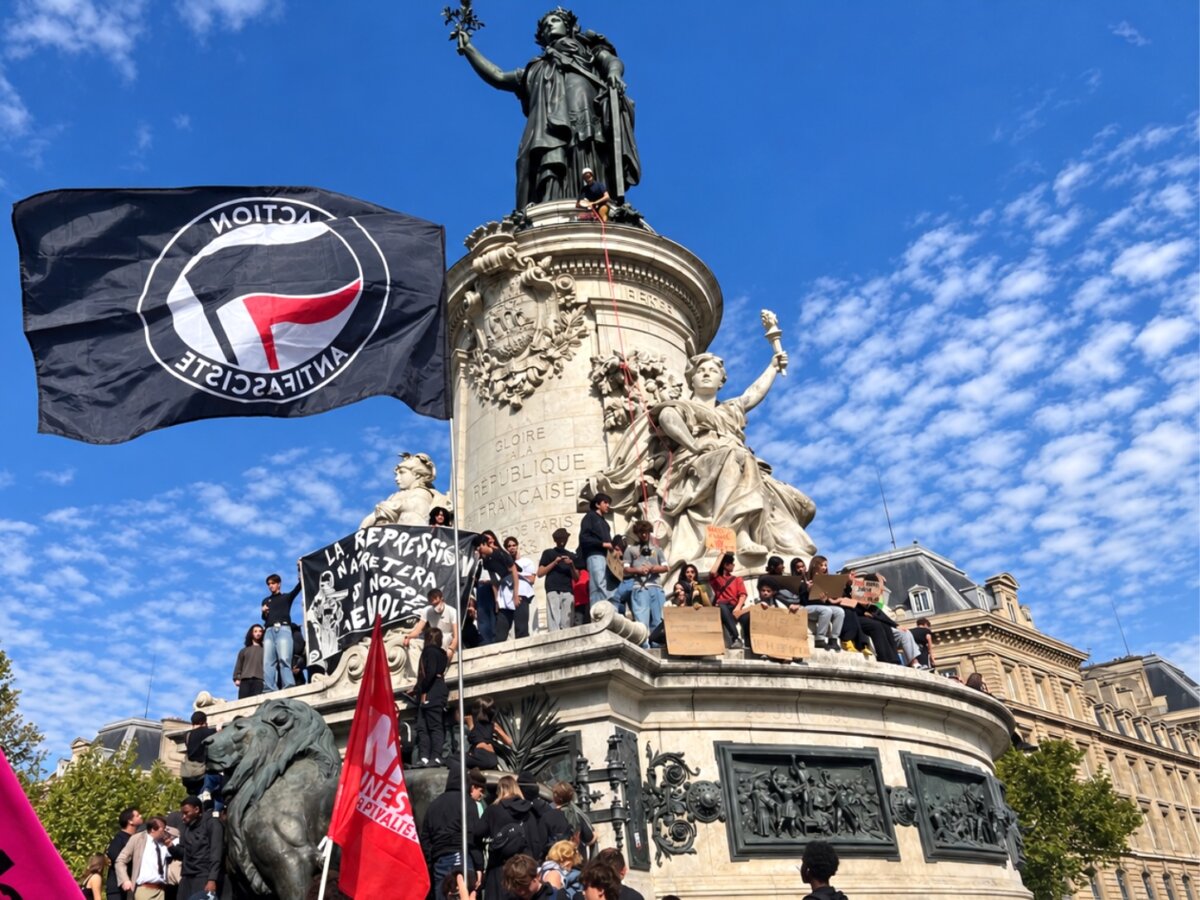

PARIS—“Down with the state, the cops, and the fascists,” protesters chanted at Paris’s Place de la République on Oct. 6, as the latest march in France’s far-left high school protest movement prepared to set off.
“Everybody hates the police” and “To arms!” rang out across the square. Other chants included “Free Palestine,” “We are all children of Gaza,” “Marine in prison,” referring to National Rally figure Marine Le Pen, and “Mélenchon for president,” referring to founder of the far-left France Unbowed (LFI) party Jean-Luc Mélenchon.
Demonstrators also repeatedly chanted the Italian anti-fascist slogan “Siamo tutti antifascisti,” or “We are all antifascists.”
The crowd brought together not just high school and university students, but far-left activists, trade unionists, and older demonstrators. Many young people of North African and sub-Saharan African descent, as well as women wearing Islamic headscarves, also took part in the protest.
Mélenchon walked near the front of the march alongside party coordinator Manuel Bompard. Socialist Party leader Olivier Faure also joined the demonstration.
Before the march began, Bally Bagayoko, the LFI mayor of Saint-Denis, a suburb north of Paris, was greeted by young demonstrators chanting “Bally for president.” He encouraged them to vote for LFI.
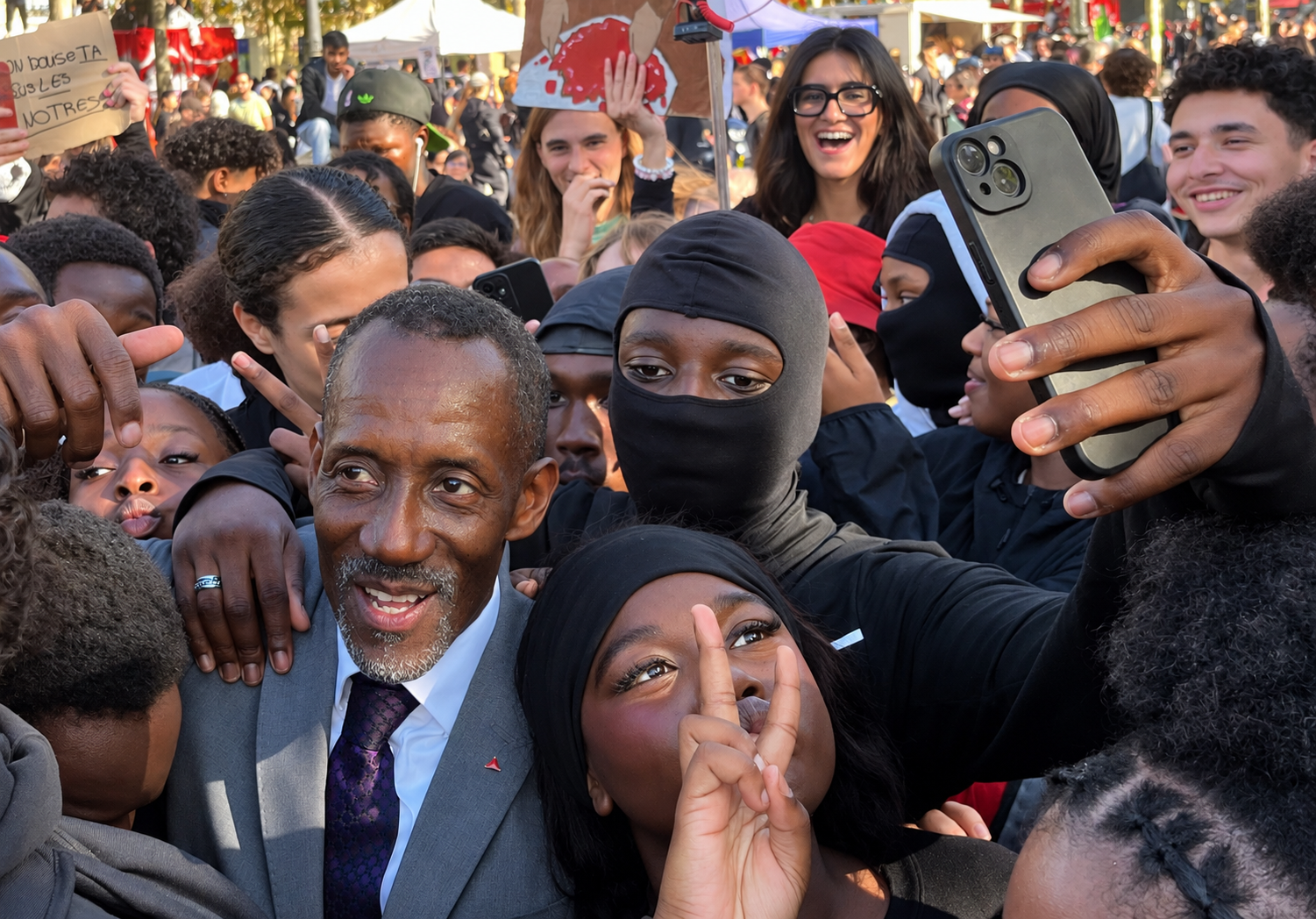 Saint-Denis LFI Mayor Bally Bagayoko, wearing a gray suit and purple tie, is surrounded by high school protesters posing for photos at Place de la Nation in Paris, France, on Oct. 6, 2026. (Etienne Fauchaire/The Epoch Times)
For some of the students, their concerns about education were intertwined with broader political grievances.
Moussa, a 17-year-old high school student, said he had come to denounce what he called “France’s systemic racism and the racial selection against black high school students” seeking admission to higher education.
Mohamed, also 17, said he was protesting what he described as “France’s systemic Islamophobia against Muslims, who are forbidden from respecting their religious convictions by wearing Islamic dress.”
Arthur, an 18-year-old student, said he wanted “more resources for education and less money for Israel.” Leïla, a 20-year-old law student, said France should devote “more money to education than to the army.” She said she was also marching “to keep up the pressure on Israel and support the Palestinians.”
By the time the procession reached Place de la Nation, its final destination, confrontations with police had turned violent. Protesters threw stones, glass bottles, and mortar-style fireworks toward police as anti-police chants, insults, and jeers were shouted. Police officers responded with tear gas.
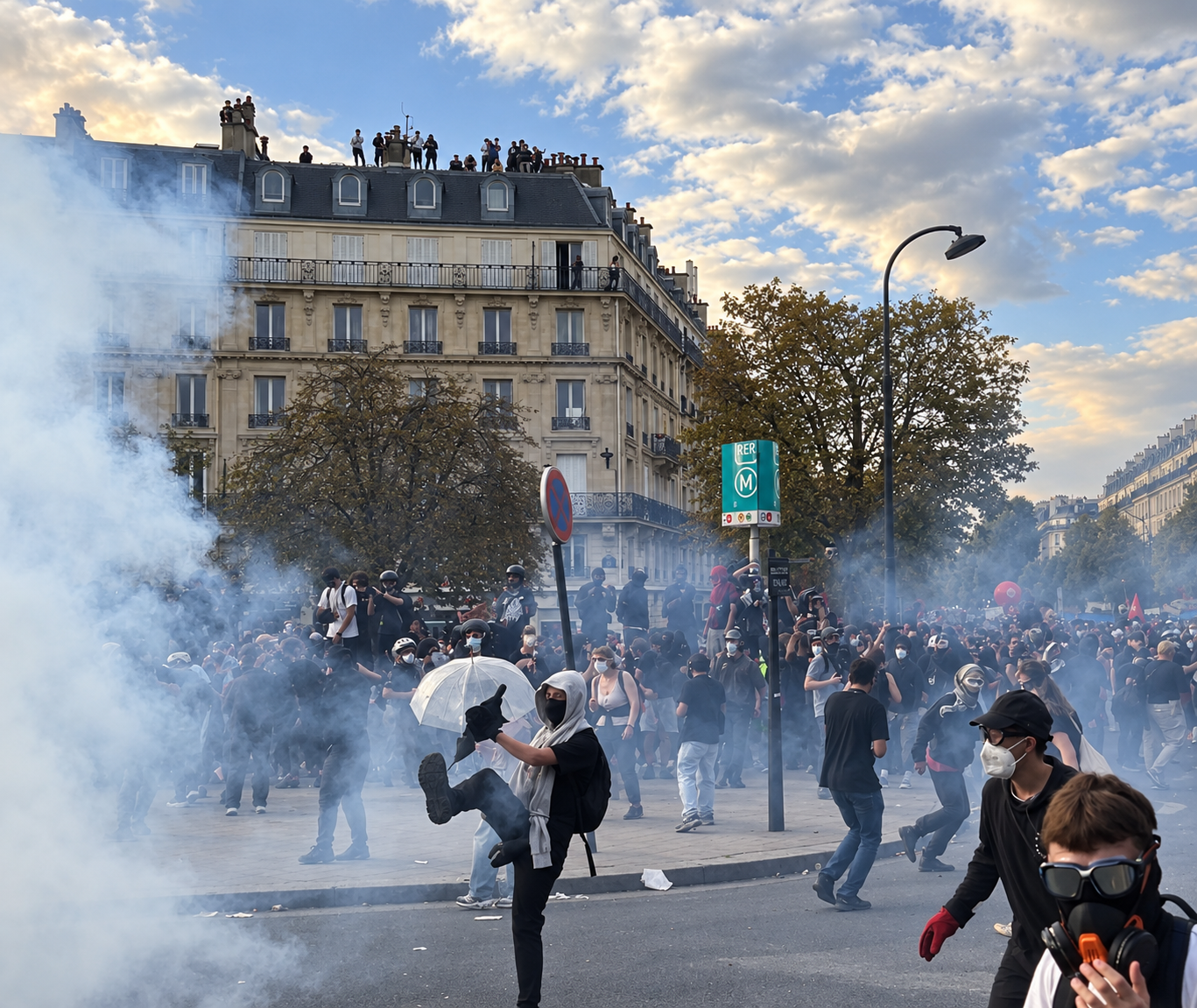 Tear gas drifts across Place de la Nation at the end of a Paris high school march from Place de la République on Oct. 6, 2026. (Etienne Fauchaire/The Epoch Times)
Nearly 500 Arrests Nationwide
The Paris march was one of many protests held in roughly 30 cities on Oct. 6, the third national day of action in a movement that began in mid-September with complaints over teacher shortages, deteriorating school buildings, and long school hours.
The two earlier national days were built around school blockades: on Sept. 29 the Education Ministry counted 338 high schools disrupted and 45 fully blocked, with 440 arrests, and on Oct. 1 (“acte II”) more than 1,020 of France’s roughly 3,700 high schools were affected, including 222 blockades, while police logged about 900 actions and nearly 1,950 arrests.
For Tuesday’s city marches, the Interior Ministry put nationwide turnout at 256,000, including 56,000 in Paris, while organizers claimed 450,000 participants.
Police arrested 488 people across France, while 43 officers were injured, according to the ministry. About 900 of the country’s 3,700 high schools suspended some or all classes, the Education Ministry said.
Violence was not confined to the capital. Clashes were also reported in Strasbourg, Rennes, Toulouse, and Châteauroux in central France, where police officers came under attack, according to the French daily newspaper Le Figaro.
The Interior Ministry has recorded 6,547 arrests since Sept. 28, while the prime minister’s office says at least 715 police officers and 215 students have been injured.
The movement has also produced controversial messages that have been circulating among students.
Prosecutors in Orléans, south of Paris, opened a preliminary investigation into the alleged glorification of terrorism after a video showed students singing a rap song during an Oct. 1 blockade of the Lycée François-Villon in nearby Beaugency, Le Figaro reported.
The lyrics reference Mohamed Merah, the Islamist terrorist who murdered three soldiers and four people, including three children, at a Jewish school in southwestern France in 2012. They also reference the 2015 Bataclan attack in Paris, Salah Abdeslam, who was convicted for his role in the coordinated attacks that night, and Adolf Hitler, leader of the National Socialist German Workers’ (Nazi) Party.
Similarly, on Oct. 5, National Rally lawmaker Mathieu Valet announced he had referred the matter to the public prosecutor’s office after a student at Honoré-de-Balzac High School in Mitry-Mory, appearing to point toward a group of police officers, shouted to an enraged crowd, “There are only 10 of them. In the name of Allah, let’s kill them!”
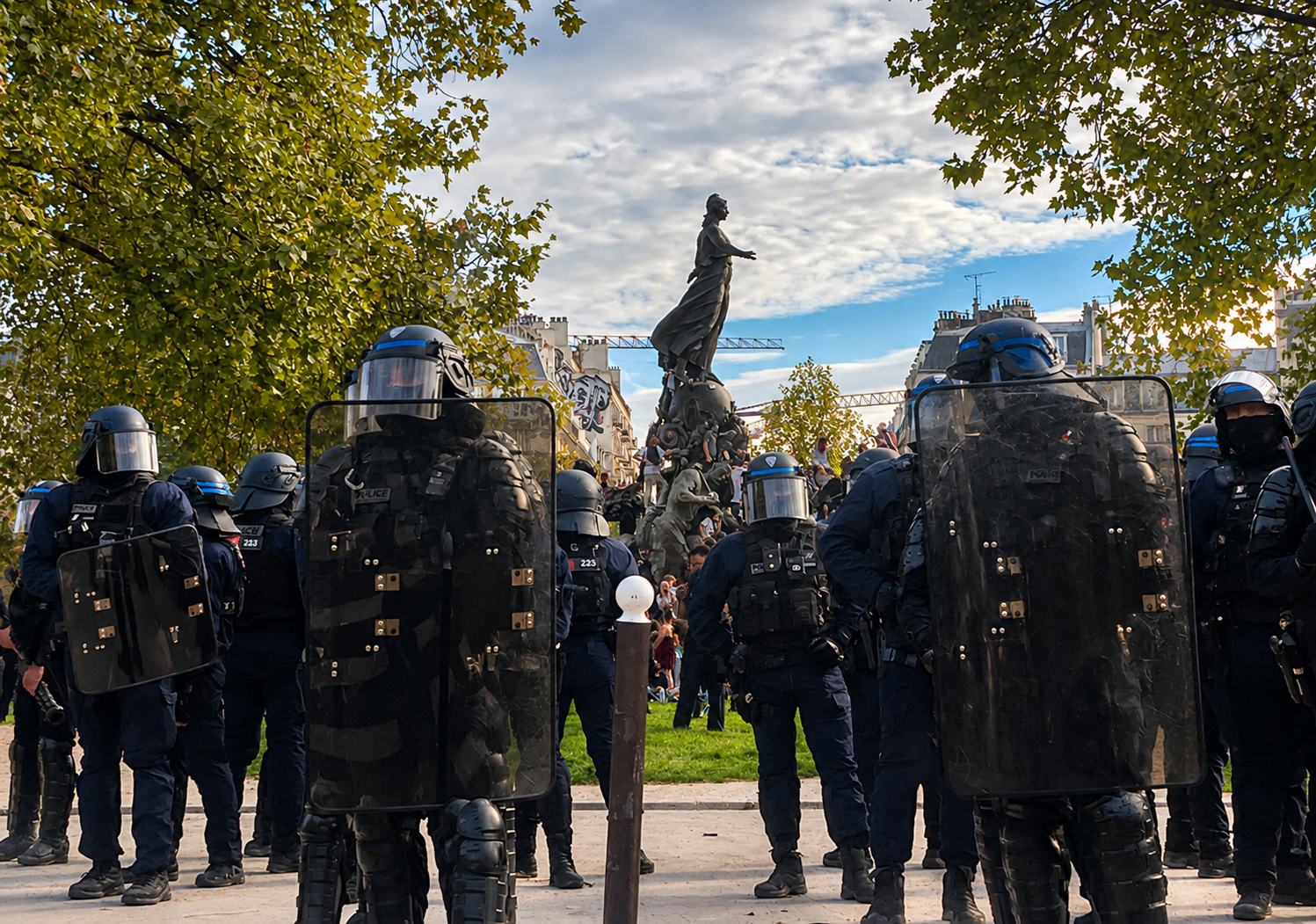 Riot police wearing helmets and body armor form a shield line at Place de la Nation during high school protests in Paris on Oct. 6, 2026. (Etienne Fauchaire/The Epoch Times)
‘High School in Name Only’
The political forces supporting the movement are a source of controversy.
The prime minister’s office said on Oct. 1 that French intelligence services viewed the blockades as a “maneuver organized by LFI and its ultra-left proxies.” Speaking before the National Assembly five days later, French prime minister Sébastien Lecornu accused the party of seeking to sow chaos and of making violence part of its political project.
LFI has rejected the accusations. Bompard accused the government of “sinking into conspiracy theories.”
Baptiste Gili, national delegate of UNI, a right-wing student union opposed to the blockades, told The Epoch Times that describing the movement simply as a “high school” protest is “misleading.”
“These are ‘high school protests’ in name only: The vast majority of high school and university students are focused on studying,” Gili said. “Some of the protesters’ demands may be legitimate and entirely understandable, but above all, they serve as a pretext for far-left rioting and violence.”
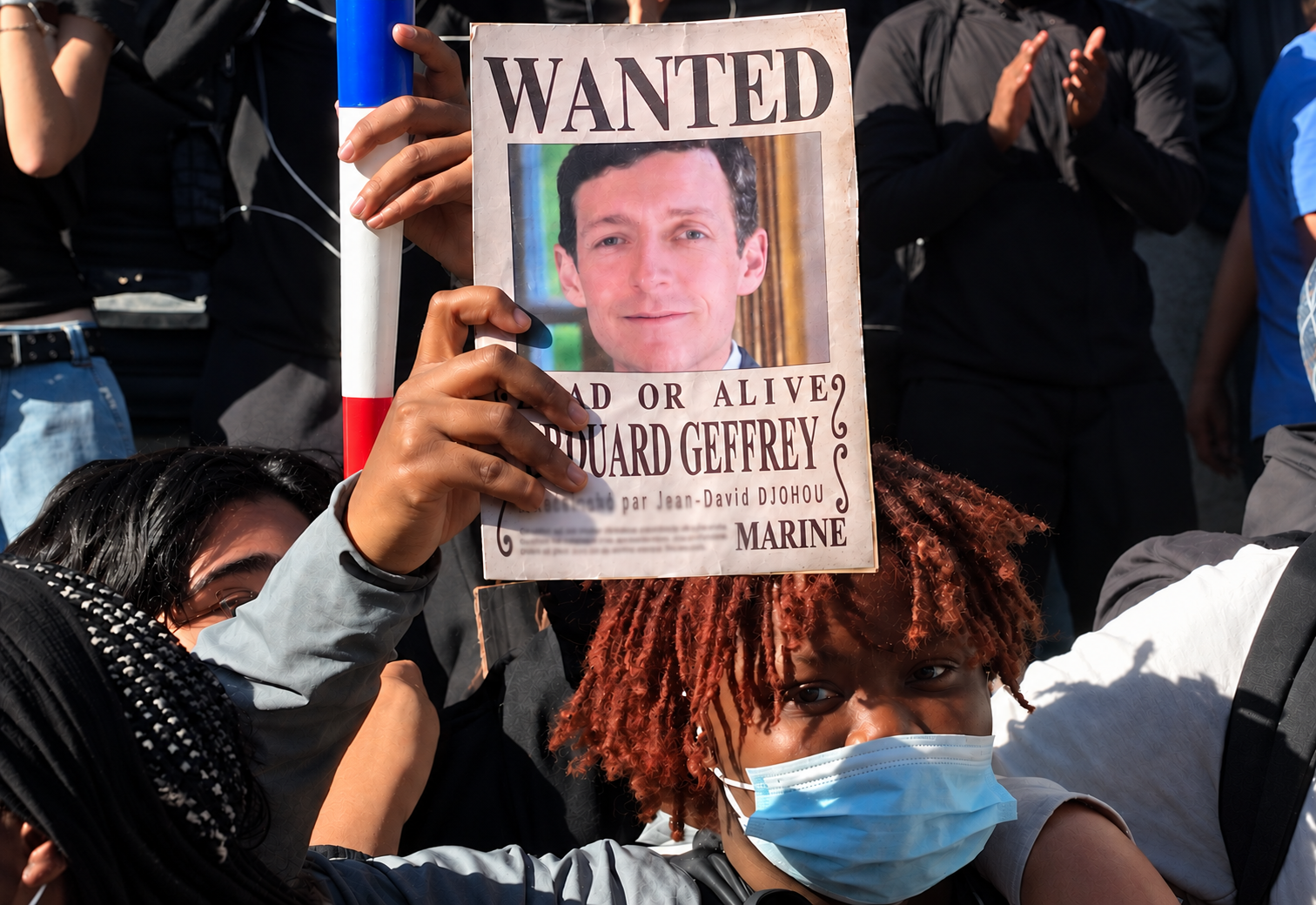 A protester holds a “Wanted: Dead or Alive” poster depicting French Education Minister Édouard Geffray during a high school protest at Place de la République in Paris on Oct. 6, 2026. (Etienne Fauchaire/The Epoch Times)
Gili also placed part of the responsibility for the unrest on President Emmanuel Macron’s government.
“First, the government agreed to meet with these left-wing student unions as though they genuinely represented students while refusing to meet with UNI,” he said. “Second, in doing so, it legitimizes the far-left idea that resorting to violence is a way to get what you want.”
Trump Weighs In
The unrest has also drawn reaction from abroad.
U.S. President Donald Trump weighed in on Oct. 6, describing what was unfolding in France as “nothing less than out-of-control mass migration.”
Writing on Truth Social, Trump said the unrest was not fundamentally about schools but about what he characterized as an attempt by Islam to take over a once-great country.
“What’s happening in France is nothing less than out of control mass migration. This isn’t about schools, this is about Islam wanting to take over a once great Country!” Trump said.
Questions have emerged over links between organizations involved in the French protests and Islamist groups.
The Union Syndicale Lycéenne (USL), one of the left-wing organizations calling for the protests, co-founded a collective in 2025 alongside Étudiants Musulmans de France (EMF), the conservative French magazine Le Point reported. A French government report published in May 2025 described EMF as the student arm of the French branch of the Muslim Brotherhood.
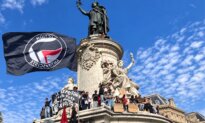
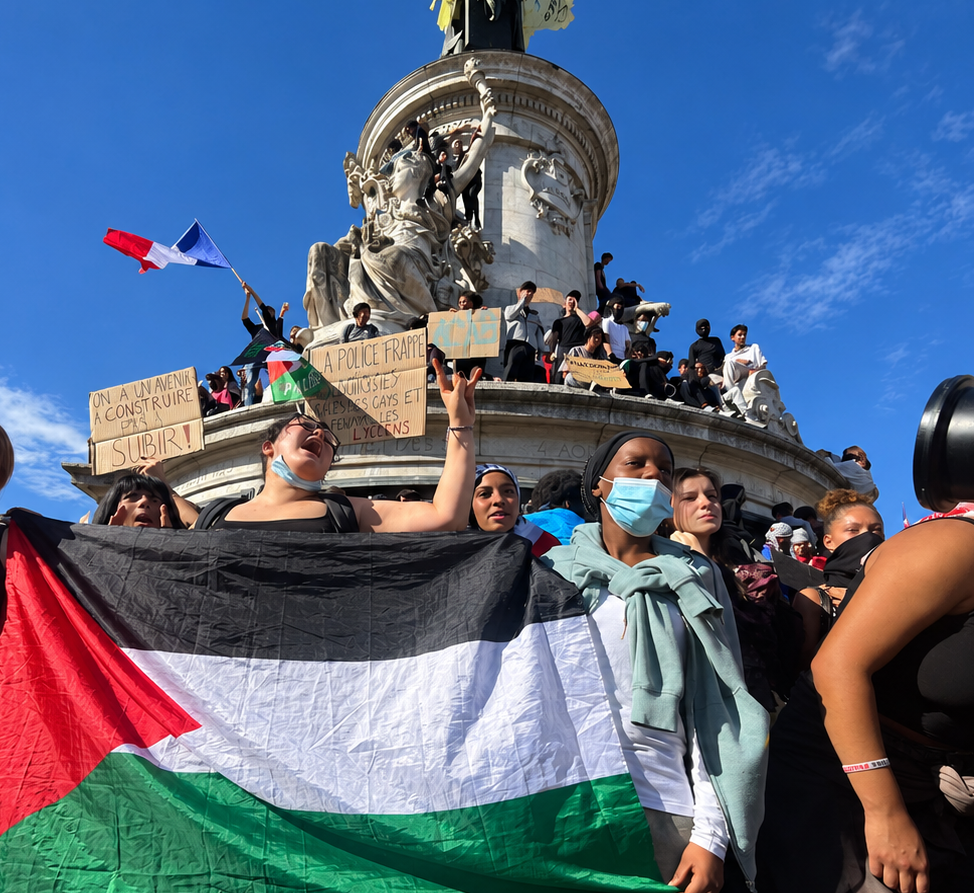 Protesters hold a Palestinian flag as they gather on the Monument to the Republic during the high school protest at Place de la République in Paris on Oct. 6, 2026. (Etienne Fauchaire/The Epoch Times)
Student organizations have called for the blockades to continue on Oct. 7 and another nationwide protest on Oct. 8.
 Friends Read Free
Copy
Facebook
Tweet
Friends Read Free
Copy
Facebook
Tweet