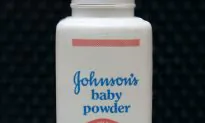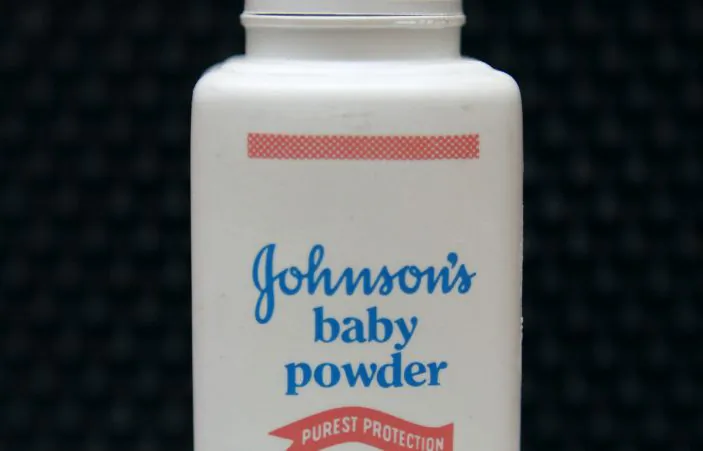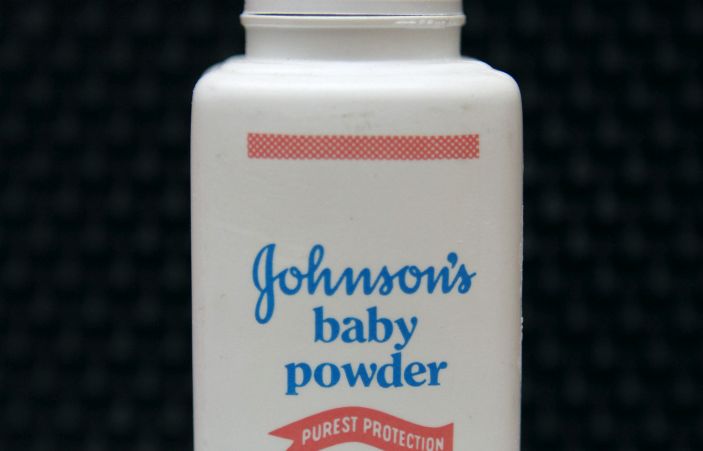

A Los Angeles jury found on June 5 that Johnson & Johnson was not negligent when selling its talc-based baby powder and other cosmetic talc products.
The lawsuit had alleged that Johnson & Johnson’s talc-based baby powder caused ovarian cancer. The claims were brought by the families of three women who alleged the women’s ovarian cancer was linked to the talc in the company’s product, as the talc was at risk of containing asbestos.
“Talc litigation is a plaintiff-lawyer driven fake tort, premised on junk science,” Johnson & Johnson vice president of litigation Erik Haas said.
Ari Friedman, a lawyer representing one of the plaintiffs, said the verdict is disappointing.
The case involving the families of Mary Owens, Bonnie Tienken, and Geneva Williams—who each died of ovarian cancer and used Johnson’s baby powder—is seen as a bellwether trial for the thousands of claims remaining to be heard.
More than 67,000 plaintiffs have sued the company over allegations linking the company’s talc products to ovarian cancer. The company maintains its talc products are safe and asbestos-free, and argues it has a strong position, with 16 of the 17 ovarian cancer cases tried over the last 11 years being successfully overturned.
The June 5 verdict now adds to this record.
Thousands more have sued the company after developing mesothelioma—a rare form of cancer impacting the lining that covers the outer surface of some of the body’s organs, usually linked to inhaling or ingesting asbestos fibers. Ninety-five percent of those cases have been settled in private and the company has issued clauses that the settlements should not be seen as an admission of wrongdoing.
Johnson & Johnson has won some of the cases outright, including a trial in Oklahoma involving mesothelioma claims last week, while juries in other cases have awarded large settlements for plaintiffs.
The company has appealed in all cases and has got many of them reduced or overturned. Numerous appeals are ongoing.
Resolving Mass Claims
Since 2021, J&J has attempted to resolve the mass tort claims by setting up a new subsidiary with liability and declaring bankruptcy. As part of the bankruptcy resolution, the company offered an $8.9 billion trust fund to pay out all claims that its talc products caused cancer.
Courts decided this was an abuse of the bankruptcy system as the new subsidiary would not be in genuine financial distress, being backed by parent company Johnson & Johnson, in what would be an attempt to shield it from liability.
Johnson & Johnson had argued that this mass approach would have been better for claimants, as the tens of thousands of cases remaining could take another 3,000 years to hear. It was forced to continue to fight the claims in the regular court system under its own name.
The concerns first emerged in the 1950s–1970s, but major litigation did not appear until the late 1990s. The first known mesothelioma lawsuit was not filed until 1997 by Darlene Coker, but it was dropped due to insufficient evidence.
The first major ovarian cancer lawsuit was not filed until 2009 by Deane Berg. In 2013, Berg became the first to win a liability verdict linking talc to ovarian cancer but received no damages.
The concerns became more public after Reuters published an article in December that Johnson & Johnson said misrepresented its baby powder product and the science about talc, and “misled its readers by printing inaccurate statements, withholding crucial information that otherwise undermines its thesis.”
After the report, the Food and Drug Administration started testing 50 cosmetic products for asbestos, including Johnson’s baby powder. It reported less than a year later, in October 2019, that its independent testing had found asbestos in one lot of the product.
“The FDA is advising consumers not to use this specific lot of the product,” it said at the time, noting that another lot had tested negative for asbestos.
Declining demand led Johnson & Johnson to make the commercial decision to phase out talc from its baby powder, which has been talc-free since 2020 in the United States and Canada, and 2023 in the remaining countries.
Johnson’s baby product range, including its new corn starch-based baby powder, is now under a company called Kenvue.
Reuters contributed to this article.
 Friends Read Free
Copy
Facebook
Tweet
Friends Read Free
Copy
Facebook
Tweet