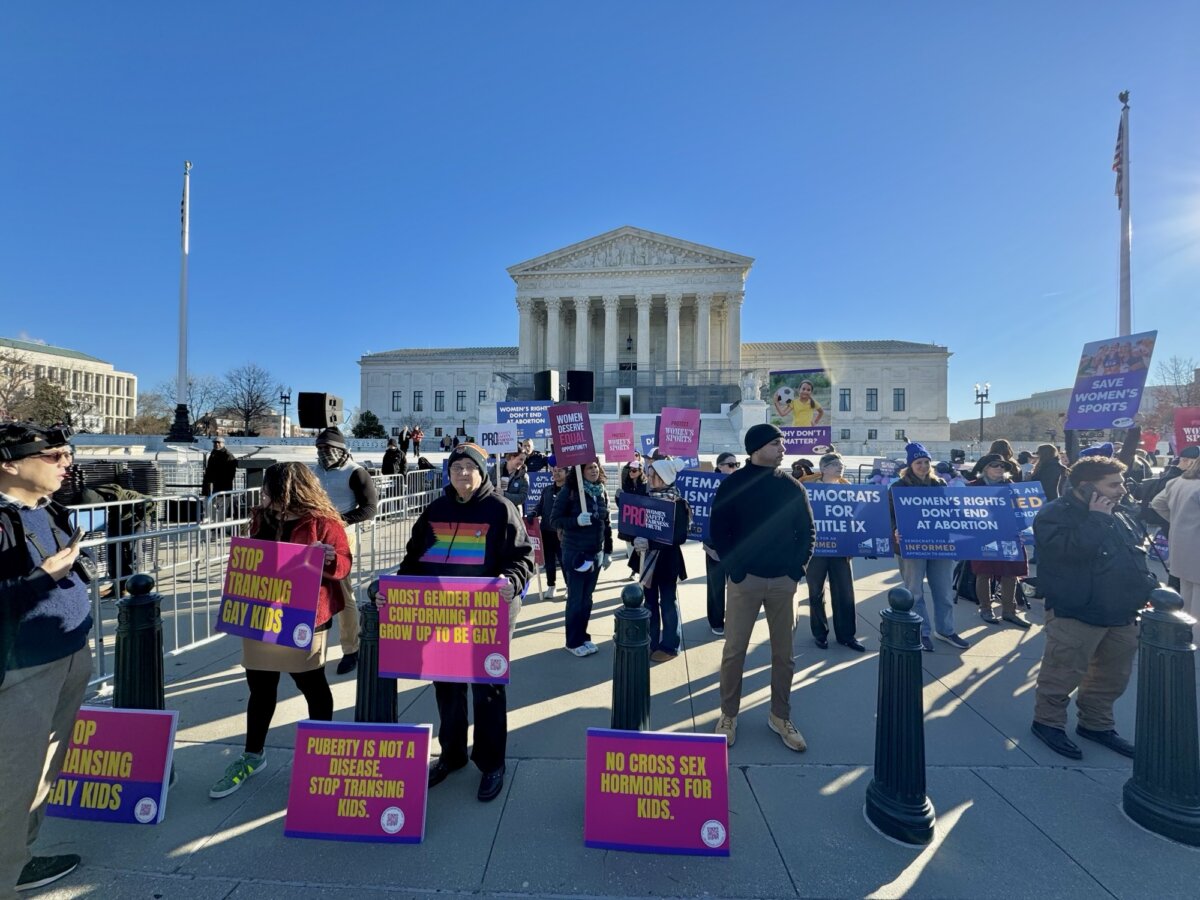

Three justices of the Supreme Court of the United States on Jan. 13 pressed advocates in two cases regarding transgender student participation in sports to define “sex” for the purposes of constitutional law.
“What is that definition, for equal protection purposes? What does it mean to be a boy or a girl, or a man or a woman?” asked Associate Justice Samuel A. Alito Jr. during the first round of oral arguments in the case of Little v. Hecox. In that case, Idaho’s law H.B. 500—which bans transgender individuals from participating in women’s sporting events—is being challenged by Lindsay Hecox, a transgender student at Boise State University who attempted to join the women’s track and cross-country teams.
“We do not have a definition for the court,” replied Hecox’s advocate, Kathleen R. Hartnett of Cooley LLP. Hartnett, however, argued that her side was not challenging the definition of “woman” in H.B. 500, but merely the way Idaho has applied it to his case.
“The way it applies, in practice, is to exclude birth sex males categorically from women’s teams, and that there’s a subset of those birth sex males where it doesn’t make sense to do so,” Hartnett argued.
Alito continued to press the question.
“Well, how can a court determine whether there is discrimination on the basis of sex if we don’t know what sex means, for equal protection purposes?” he said, referring to the Equal Protection Clause of the 14th Amendment to the U.S. Constitution, which requires states to ensure persons “the equal protection of the laws.”
“I think, here, we just know that,” responded Hartnett regarding the definition of sex. “Lindsay qualifies as a birth sex male and she’s being excluded categorically from the women’s teams as the statute,” she noted.
Alito then asked Hartnett if a self-identified woman could be defined as a woman.
“The person says, ‘I sincerely believe I am a woman. I am, in fact, a woman.’ Is that person not a woman?” he posed.
Hartnett responded that she would “respect their self-identity in addressing the person,” though she argued that self-identity was not at issue.
The same question, seeking the definition of “sex” and a “woman,” was repeated by Chief Justice John G. Roberts Jr. and Associate Justice Brett M. Kavanaugh during oral arguments in the next case, West Virginia v. B.P.J., where the parents of Becky Pepper-Jackson, a high school student in West Virginia, are challenging a state law that bans transgender students’s participation in school sports.
“You don’t think we should have an operating definition of ‘sex’ in Title IX?” asked Roberts to Pepper-Jackson’s counsel, Joshua Block of the American Civil Liberties Union (ACLU), who then analogized sex to race.
Block responded: “I don’t think Congress adopted a definition of race in Title VI [of the Civil Rights Act of 1964] in order to prohibit discrimination on the basis of race. I think we’re not trying to police the accuracy of the terminology.”
Kavanaugh questioned Block on whether states could adopt different definitions of the term “sex” when setting laws regarding women’s sports.
“Do you think sex and Title IX can reasonably be interpreted to allow different states to take different understandings of that in their sports leagues?” he asked.
“I don’t think the purpose of Title IX is to have an accurate definition of sex,” Block argued. “I think the purpose is to make sure that sex isn’t being used to discriminate by denying opportunities, just as I don’t think we need to define race in order to enforce Title VI.”
Oral arguments in both cases, held back-to-back, lasted three hours. The court is expected to deliver its opinion during the present term.
 Friends Read Free
Copy
Facebook
Tweet
Friends Read Free
Copy
Facebook
Tweet