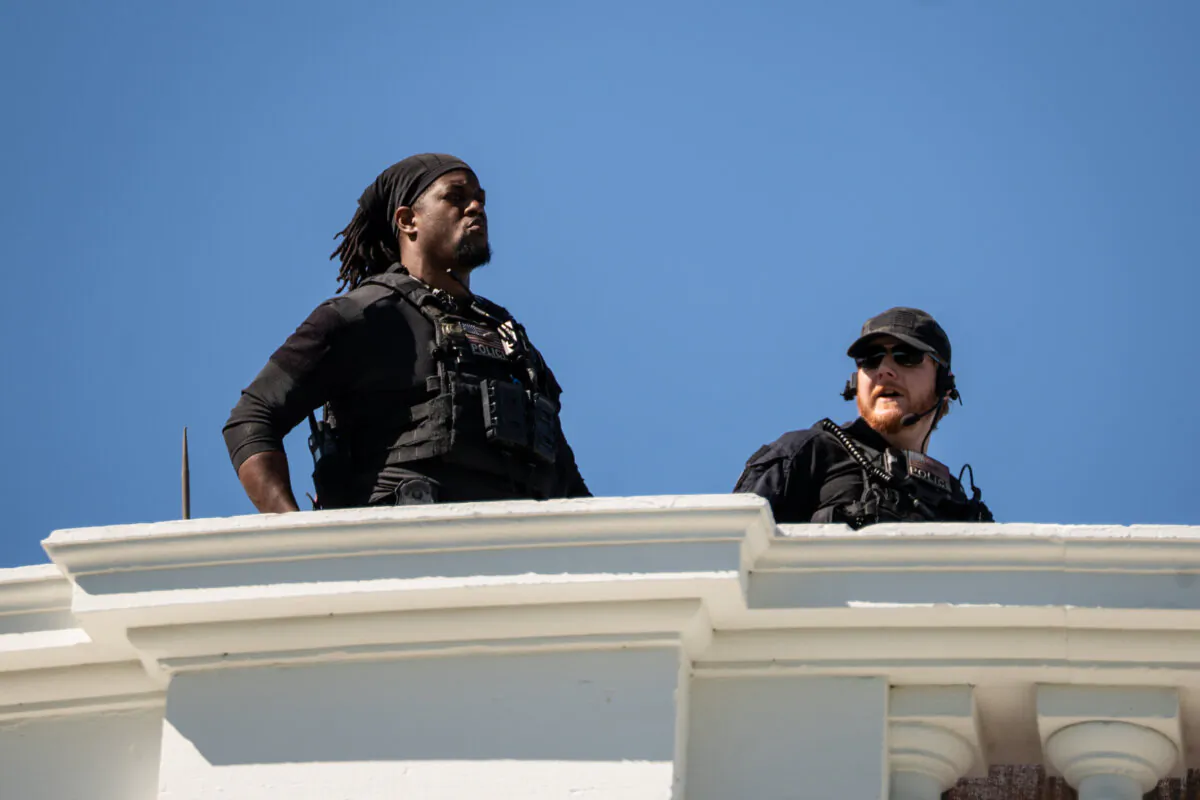

President Donald Trump revoked former Vice President Kamala Harris’s Secret Service protection on Aug. 28, a White House official told The Epoch Times.
“You are hereby authorized to discontinue any security-related procedures previously authorized by Executive Memorandum, beyond those required by law, for the following individual, effective September 1, 2025: Former Vice President Kamala D. Harris,” stated Trump’s letter to Homeland Security Secretary Kristi Noem, according to CNN.
Harris’s senior adviser, Kirsten Allen, said in a statement to media outlets, “The Vice President is grateful to the United States Secret Service for their professionalism, dedication, and unwavering commitment to safety.”
Here is what to know about the Secret Service.
What Is the Secret Service?
The Secret Service has had a long history. It did not begin with protecting individuals. Rather, it was an operation that combated counterfeiting.
It was founded through an executive order signed by President Abraham Lincoln on April 14, 1865—the day he was assassinated. It would become the first investigative agency in U.S. history. It was housed in the Treasury Department until 2003, when it was moved over to the Department of Homeland Security.
It was not until after President William McKinley was assassinated in 1901 that the Secret Service began to protect the sitting president.
Today the Secret Service has more than 8,000 employees, including special agents, across 15o offices in the United States and abroad, according to its website. It has a $3.2 billion budget for the 2025 fiscal year.
Who Gets Protection and for How Long?
The president, vice president, their immediate family members, and major presidential and vice presidential candidates and their spouses get Secret Service protection, but the timeline of their protection depends on the individual and his or her own circumstances. The president-elect and vice president-elect also get protection from the Secret Service.
The Secret Service also protects visiting heads of state, other distinguished guests, and events of national significance.
The president gets Secret Service protection for life, though that was not always the case. In 1965, a new law initially gave lifetime protection to former presidents. But between 1997 and 2013, post-presidential protection details lasted 10 years because of another law change. A new law in 2013 then reinstated the protection for life.
The vice president gets protection for six months after being out of office. For Harris, that meant her protection ended on July 21. However, according to The Associated Press, citing a source familiar with the matter, President Joe Biden signed a measure to extend her protection for another year shortly before he left office.
Past Scrutiny
The Secret Service has not been without controversy. It failed to prevent the assassination of President John F. Kennedy in 1963. His brother, Robert F. Kennedy, while running for president in 1968, was also killed, but the Secret Service was not required to protect presidential candidates at that time.
In April 2012, some Secret Service personnel were sent home from Cartagena, Colombia—where then-President Barack Obama was visiting for the Summit of the Americas—for alleged heavy drinking and solicitation of prostitutes.
In 2024, the Secret Service came under fire over its protection of Trump, who was the subject of two assassination attempts.
Regarding the second attempt, Cheatle’s successor, Ronald Rowe, who was serving in an acting capacity, said increased assets such as drones, counterassault teams, countersnipers, and countersurveillance agents were effective, allowing for quick action by an agent who noticed a rifle sticking through a fence at Trump International Golf Club in West Palm Beach, Florida.
In October 2024, Biden signed a bill into law giving presidential-level Secret Service protection to presidential candidates. It was unanimously passed by both houses of Congress.
 Friends Read Free
Copy
Facebook
Tweet
Friends Read Free
Copy
Facebook
Tweet