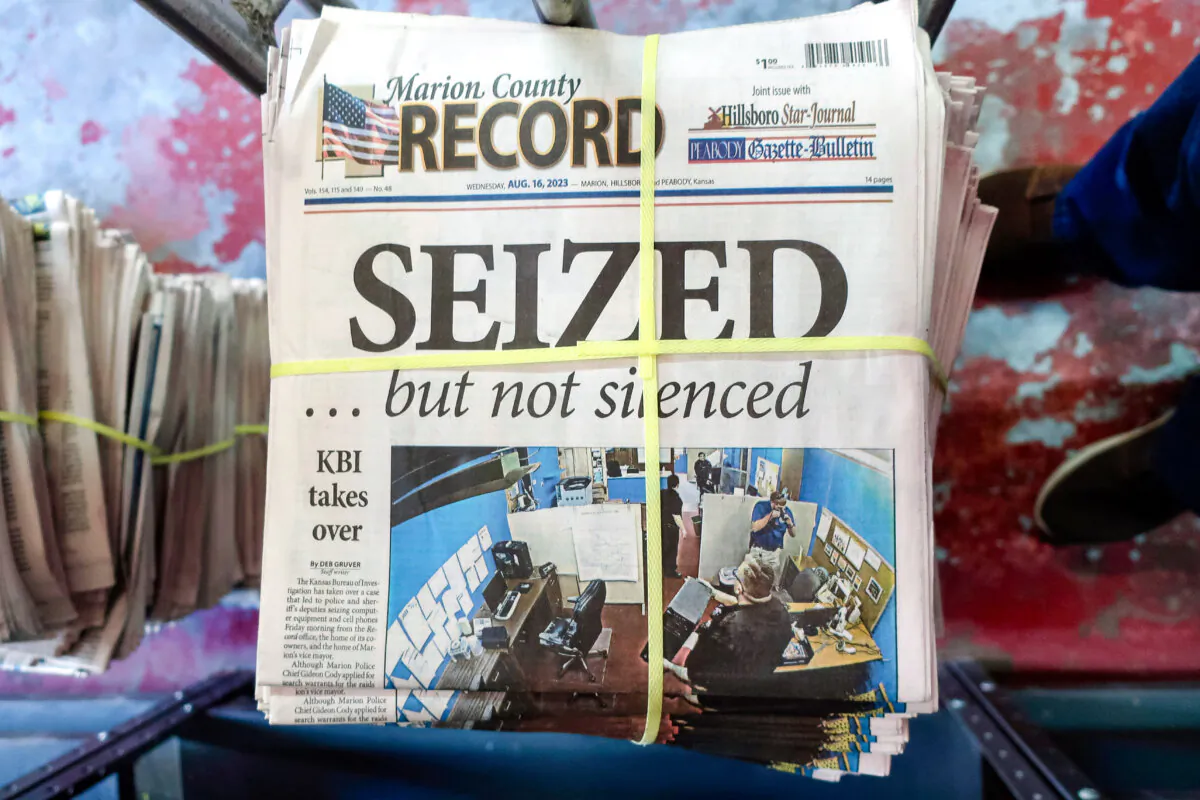

Marion County, located in central Kansas, will pay a total of $3 million to settle federal lawsuits stemming from the 2023 police raid of a family-owned, small-town newspaper.
The settlement, approved on Monday by the county’s board of commissioners, resolves allegations against the county for its role in the raid on the Marion County Record, a weekly paper serving a prairie town of about 1,900 residents. As part of the agreement, the county will issue an apology and “concede that wrongdoing likely occurred” during the searches, according to the Record.
“The admission of wrongdoing is the most important part,” said Eric Meyer, owner and editor of the Record. “In our democracy, the press is a watchdog against abuse. If the watchdog itself is the target of abuse, and all it does is roll over, democracy suffers.”
On Aug. 11, 2023, then-Marion Police Chief Gideon Cody led officers in a raid on the Record’s newsroom and Meyer’s home, seizing computers and cell phones belonging to Meyer and his reporters.
Police also searched the home of Meyer’s 98-year-old mother, Joan Meyer, the paper’s co-owner, who was seen on surveillance video scolding officers as they conducted the search. She died the following day from a heart attack allegedly brought on by the stress of the raid.
A search warrant, signed by a county judge, alleged that reporter Phyllis Zorn had committed identity theft by accessing public driving records of a local restaurant owner whose license had been suspended for drunk driving several years ago. After public backlash, the Marion County Attorney determined there was “insufficient evidence” to justify the raid.
Settlement Details
The raid has since spurred at least four federal lawsuits against Marion city and county governments, the Marion Police Department, and individual officials. Monday’s agreements give the county and the sheriff’s office immunity from any future legal action related to the raid.
As part of the settlement, the Marion County Sheriff’s Office issued a formal apology to Meyer and Ruth Herbel, a city council member whose home was also raided the same day.
“The Sheriff’s Office wishes to express its sincere regrets to Eric and Joan Meyer and Ruth and Ronald Herbel for its participation in the drafting and execution of the Marion Police Department’s search warrants on their homes and the Marion County Record,” the statement read.
“This likely would not have happened if established law had been reviewed and applied prior to the execution of the warrants,” it added.
While the county agreed to compensate Zorn and fellow Record reporter Deb Gruver, they were not included in the official apology.
The county will pay Meyer $1.5 million, Herbel $650,000, Zorn $600,000, and Gruver $250,000, according to the Record. Insurance will cover most of the payout, but the county must pay Meyer $50,000.
Earlier this year, Gruver separately settled with Cody for $235,000. Cody, who resigned amid the controversy, faces pending criminal charges.
Meyer said that Zorn has retired from the Record following the settlement.
State Investigators Clear Journalists of Wrongdoing
After the raid drew criticisms from news organizations and press freedom advocates across the nation, the Kansas Bureau of Investigation took over the case before handing it off to the Colorado Bureau of Investigation, which released a final report in August 2024.
The 124-page report found no criminal liability on the part of the Record’s journalists or editors. It also concluded that the entire kerfuffle stemmed from an initial misunderstanding by police officers about whether the Kansas government website Zorn accessed as part of her reporting was open to the public.
“It is not a crime under Kansas law for a law enforcement officer to conduct a poor investigation and reach erroneous conclusions,” the report said.
Still, the report stated that law enforcement should first exhaust less extreme measures when journalists themselves are suspected of a crime.
“Before a search warrant is sought for a press room, a law office, church, or the office of a mental health professional, inquisition subpoenas or other available forms of investigation should be utilized,” the report read. “Search warrants for law offices, press rooms and churches should be sought only in extraordinary circumstances and with extreme caution.”
 Friends Read Free
Copy
Facebook
Tweet
Friends Read Free
Copy
Facebook
Tweet