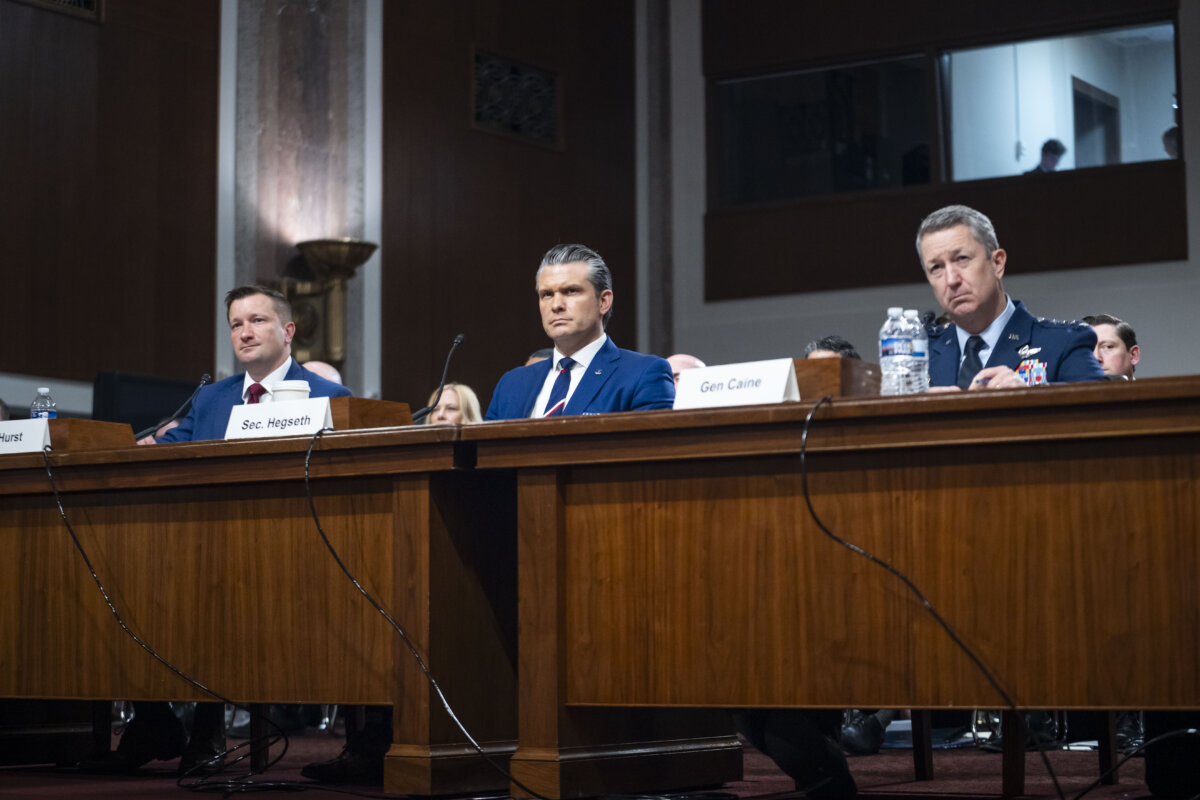

Secretary of War Pete Hegseth and Chairman of the Joint Chiefs of Staff Gen. Dan Caine faced numerous pointed questions about the Iran conflict in their first set of public hearings since the fighting began on Feb. 28.
Hegseth and Caine testified in back-to-back hearings before the House and Senate Armed Services committees on April 29 and April 30, as the Pentagon seeks congressional support for a record-setting $1.5 trillion in military and defense funding in fiscal 2027.
The first hearing, on the House side, lasted about six hours. The second day, in the Senate, lasted another three hours.
Across the two hearings, Democrats repeatedly engaged Hegseth in contentious exchanges. Republicans largely affirmed their support for the Trump administration for its handling of the Iran conflict and its military funding request.
Here are four takeaways from the two days of testimony.
Democrats Scrutinize Iran War
In his opening statement in both hearings, Hegseth said U.S. forces had achieved great successes in the campaign against Iran in just a matter of weeks. He went on to criticize lawmakers, primarily Democrats, for casting doubt on the recent combat operations in the Middle East.
“The biggest adversary we face, at this point, are the reckless, feckless, and defeatist words of congressional Democrats and some Republicans,” he said.
During their speaking opportunities on the first day, Reps. Patrick Ryan (D-N.Y.) and Chris Deluzio (D-Pa.) both raised questions about whether U.S. troops positioned at Port Shuaiba, Kuwait, had sufficient protection at the start of the conflict.
Six U.S. soldiers were killed and dozens more were injured when an Iranian drone struck the Kuwaiti port facility on March 1.
Several Democrats described the conflict as costly and unpopular at home, with Rep. John Garamendi (D-Calif.) describing it as a “quagmire.”
“This war of choice is a political and economic disaster at every level,” Garamendi said. “Despite the president’s promise to lower the cost of living, gas prices are up 40 percent, and inflation is soaring.”
Hegseth responded that Garamendi’s comment amounted to “handing propaganda to our enemies.”
“Shame on calling this a ‘quagmire’ two months in,” Hegseth said.
Democrats in both the House and Senate committees also raised questions about a strike on a girls’ school in Iran on the first day of the conflict. Hegseth said the strike is the subject of an ongoing military investigation.
Sen. Tammy Duckworth (D-Ill.), on the second day of the hearings, argued that while the Trump administration has touted the sinking of Iran’s fleet of traditional warships, it has understated the threat posed by the Iranian Islamic Revolutionary Guard Corps’ (IRGC) fleet of smaller attack speed boats.
“Iran has long invested in this second asymmetric navy, specifically to develop capabilities that would be difficult for conventional U.S. military forces to target,” Duckworth said.
Questions Surround Iran Funding Supplemental
Along with questioning the Trump administration’s overall messaging about the progress of the Iran conflict, Democrats also raised questions about the cost of the campaign.
On the first day of hearings, acting Pentagon comptroller Jules Hurst said Operation Epic Fury had cost the U.S. military about $25 billion in its first two months. Hurst said munitions accounted for most of those expenses, but said he also factored in operations and maintenance and replacement costs for damaged assets.
In the second day of hearings, Sen. Richard Blumenthal (D-Conn.) said that he believed the $25 billion figure to be “well below the actual cost” of the conflict and that he would request more details.
“I’m going to ask for a more accurate assessment,” Blumenthal said.
A spokesperson for the Pentagon comptroller’s office did not provide a more detailed breakdown of the costs of the Iran conflict when reached for comment by The Epoch Times.
In March, Hegseth acknowledged reports that the Trump administration was considering as much as $200 billion in supplemental funding to cover the costs of the Iran campaign and said the spending figure “could move.”
Although the Trump administration has since begun to articulate its $1.5 trillion military budget for 2027, it has yet to specify a separate funding request to specifically address the costs of the war.
Hurst said the administration would put forward its proposal once it has a full assessment of the cost of the conflict, which remains unresolved and has been on pause for the past three weeks as the parties have engaged in new negotiations.
Hegseth Defends $1.5 Trillion Budget Request
Rep. Adam Smith (D-Wash.), ranking Democrat member of the House Armed Services Committee, shared misgivings about the size of the requested military budget request for 2027, noting the national debt is nearing $40 trillion.
“The other thing worth worrying about is the Pentagon has not yet passed an audit,” Smith said in his opening remarks on the first day of hearings. “If we give them what is roughly a 50 [percent] to 60 percent increase, is that money going to be well spent? We have every reason to doubt that.”
Hegseth said that the 2027 budget request is meant to continue efforts to “reverse the four years of underinvestment and mismanagement of the Biden administration.”
Ahead of this week’s congressional hearings, Hegseth released a video statement in which he acknowledged past failures with the Pentagon’s financial accounting, which he called “nothing short of a disaster,” and said the military would implement reforms to pass an audit in 2028.
Among the priorities in this year’s budget request was a boost in shipbuilding to advance President Donald Trump’s “Golden Fleet” initiative. Trump launched the shipbuilding initiative in December 2025, with plans to launch a new class of battleship in his name, as well as a new frigate class.
Rep. Jared Golden (D-Maine) noted recent setbacks in other shipbuilding projects and raised concern that the budget request rushes the design of new classes of warship while underfunding proven ship designs, such as the Arleigh Burke-class guided missile destroyer.
“My sincere hope is that you, the Navy, and Congress, will pump the brakes on this battleship,” Golden said. “Take the time to get it right, whatever it is. And for now, focus on the workhorse you can depend on.”
Sen. Angus King (I-Maine) questioned the lack of Ukraine-related funding in the 2027 budget request.
Hegseth said the lack of funding directed at Ukraine reflects the Trump administration’s policy to shift the burden of the conflict onto Europe.
“We want Europe stepping up and shouldering the burden,” Hegseth said.
Sen. Tim Sheehy (R-Mont.), a Navy SEAL veteran, advocated for more funding for special operations forces. Hegseth said additional funding may be allocated through a supplemental funding request.
Army Chief’s Removal Draws Bipartisan Pushback
Lawmakers on both sides of the aisle praised the leadership of Gen. Randy George, who had served as the chief of staff of the Army until being asked to step down in early April.
“Secretary Hegseth, I respect you. I do want you to know I disagree with the firing of Gen. George,” Rep. Austin Scott (R-Ga.) said in the first day the hearings.
Scott credited George with reversing the Army’s worst recruiting slump of the post-Vietnam War era.
Sen. Joni Ernst (R-Iowa) likewise expressed disappointment over George’s removal, as well as the earlier removal of Gen. James Mingus, who had served as the vice chief of staff for the Army.
Asked by Rep. Derek Tran (D-Calif.) if he had conferred with Trump about the decision to remove George, Hegseth said, “I won’t relay what was discussed, but he was aware of the action that would be taken.”
Sen. Jack Reed (D-R.I.), ranking Democrat member of the Senate Armed Services Committee, was among several lawmakers to ask about the rationale for George’s removal.
Hegseth said that, out of respect to George and other officers who have been asked to step down, he would avoid specifying a reason for the decision. He went on to emphasize his focus on reshaping the culture of the military.
“It’s ultimately challenging to change the department, the culture of a department, with the same people who were a part of or in that department,” Hegseth said.
 Friends Read Free
Copy
Facebook
Tweet
Friends Read Free
Copy
Facebook
Tweet