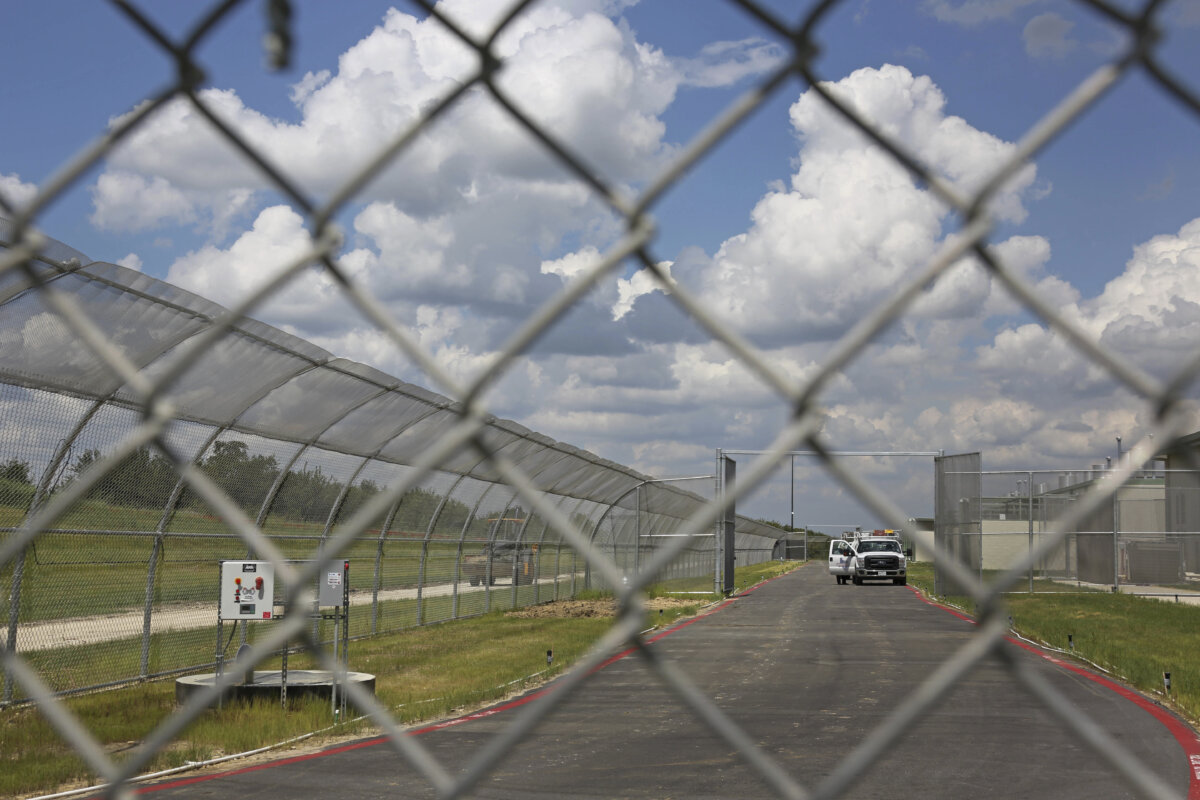

The defense and prosecution in a landmark Texas Antifa trial have made their closing arguments about a “noise protest” in 2025 outside a Texas immigration facility that ended with a shooting.
In the trial, now in its third week at the U.S. District Court for the Northern District of Texas in Fort Worth, the government alleges that an Antifa cell launched a coordinated attack against the Prairieland Immigration and Customs Enforcement facility housing illegal immigrants outside Dallas on July 4, 2025, which resulted in one officer being shot in the neck.
Members of Antifa, short for “anti-fascist,” have not faced terrorism-related charges until now, although they have been involved in organized protests across the country that have, at times, turned violent.
President Donald Trump signed an executive order on Sept. 22, 2025, designating the Antifa far-left extremist group as a domestic terrorist organization.
Attorneys for nine defendants in the case describe the Prairieland incident as a “noise protest,” during which they used fireworks to show solidarity with illegal immigrants inside. They argue that defendants never planned for an attack, suggesting that the shooting was a defensive measure.
The prosecution asked the jury to consider why protesters would appear at night at an immigration facility, dressed in black bloc, armed with AR-style rifles, and using a Faraday bag if their intent was peaceful.
“Why hide yourself?” Assistant U.S. Attorney Shawn Smith said. “Because you know you’re getting ready to do something illegal.”
Smith told the jury that the medical kits and firearms signaled the alleged Antifa cell’s intent to attack the facility and ambush officers.
Defense attorneys, who unexpectedly rested their case on March 10 without calling a single witness, said the government’s arguments against the defendants lacked substance.
“Some of you looked really surprised when the defense rested,” Cody Cofer, an attorney for defendant Cameron Arnold (also known as Autumn Hill), told the jury during closing arguments.
Cofer indicated that the defendants’ attorneys didn’t need to call defense witnesses because the government didn’t prove its case.
The case was scheduled to go to the jury after closing arguments on March 11.
Arnold, Zachary Evetts, Bradford Morris (also known as Meagan Morris), Maricela Rueda, and Benjamin Song face charges including attempted murder, discharging a firearm in a violent crime, conspiracy to use explosives, and material support to terrorists.
The prosecution alleges that Song ambushed law enforcement, firing 11 shots until his rifle jammed, wounding an Alvarado police lieutenant. The officer returned fire and recovered after hospital treatment.
If convicted, Arnold, Song, Evetts, Morris, and Rueda each face a minimum penalty of 10 years in federal prison and a maximum penalty of life, according to the U.S. Attorney’s Office.
Savanna Batten, Elizabeth Soto, and Ines Soto face fewer charges, including material support to terrorists and conspiracy to use explosives. Daniel Rolando Sánchez-Estrada is charged with document concealment and conspiracy.
All have pleaded not guilty.
The prosecution claims that the Antifa cell mapped the area to launch a “direct action” and provoke a disturbance with officers.
Counterterrorism expert Kyle Shideler, who testified for the government, said anarchists focus on direct action for political change, including violent acts such as bombings and prison breaks, to provoke an insurrection intended to spark a revolution.
Cooperating government witnesses testified that Song told some group members to bring rifles, because he was “not going to jail,” according to Smith.
“We know Song wanted to create a conflict,” Smith said.
Phillip Hayes, Song’s attorney, said during closing arguments that there was “no call for arms” until after the police lieutenant arrived at the scene and pulled his gun.
Witnesses described Song, the alleged shooter, as shouting, “Get to the rifles,” before gunfire erupted.
Hayes said no shots were fired until after the officer pointed a gun at the back of a fleeing comrade.
“What happened on July 4 was a tragedy, honestly,” Hayes said.
Smith told the jury that the group’s tactics were typical of how Antifa operates.
One hallmark of Antifa is operational security, including “hiding what they’re doing” by using encrypted messages and covering tracks after direct action, he said.
“That’s why understanding Antifa is important to the case,” Smith said. “They believe in a cause.”
He noted that investigators found a small notebook with X passwords for an “Antifa DFW” account, which was changed to the Emma Goldman Book Club.
Goldman, the book club’s namesake, was a Russian-born Jew and revolutionary. She advanced an anti-capitalist, anarchist ideology in the United States in the early 1900s until she was deported.
However, defense attorneys argued that Antifa is an ideology, not an operational group.
Cofer said former group members who testified had trouble identifying Antifa members unless prompted by the government.
 Friends Read Free
Copy
Facebook
Tweet
Friends Read Free
Copy
Facebook
Tweet