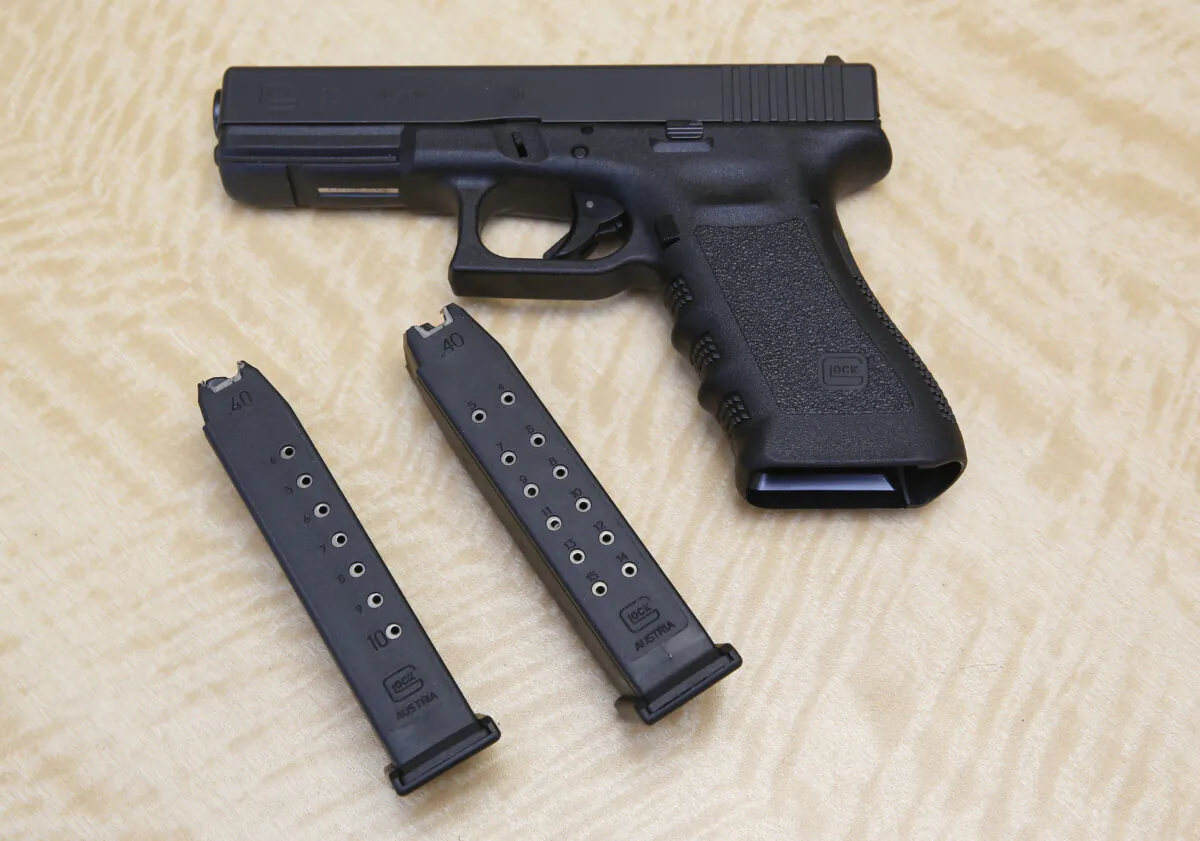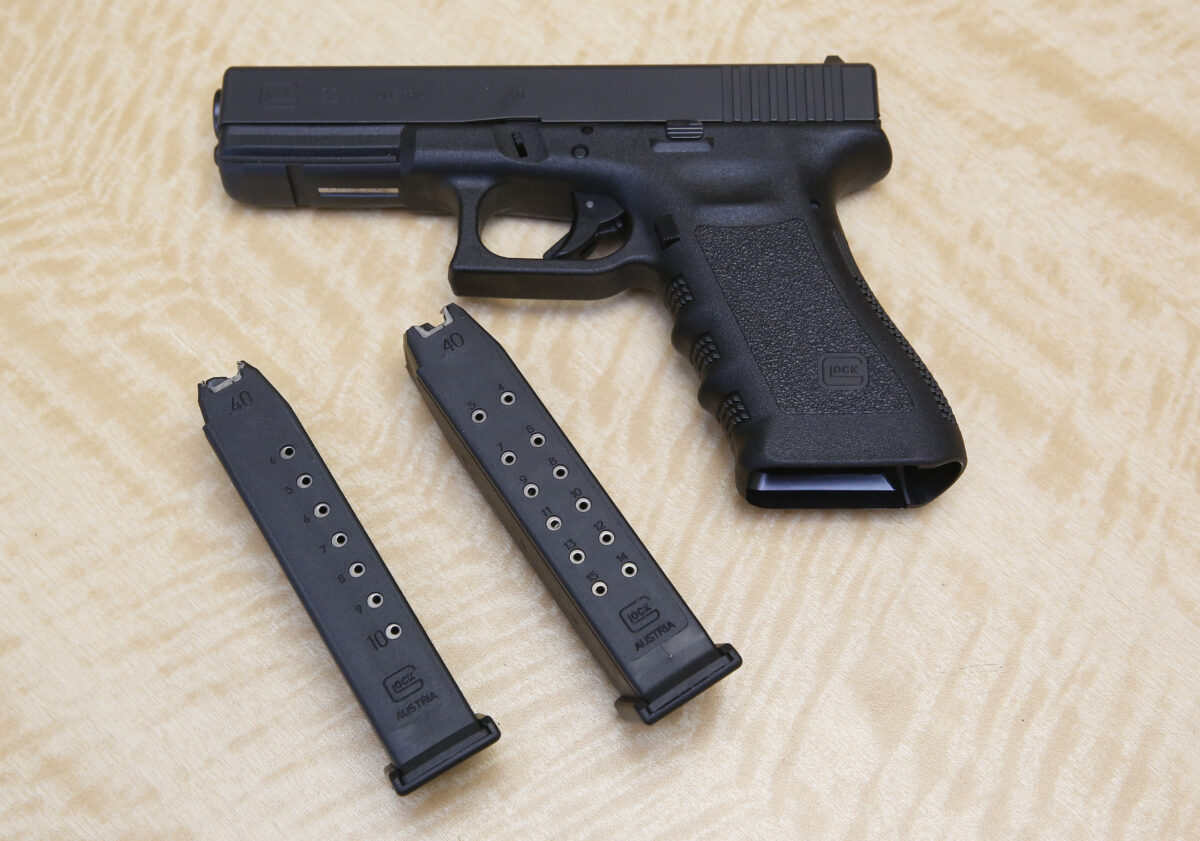

Maryland’s governor on May 26 signed legislation that bans selling, buying, and receiving many handguns, prompting groups such as the National Rifle Association to sue.
Gov. Wes Moore, a Democrat, signed Senate Bill 334, which bars people from manufacturing, selling, buying, receiving, or transferring guns defined as “machine gun convertible pistols.”
Pistols with cruciform trigger bars that can be “readily converted … into a machine gun” through the attachment of a “pistol convertor” fall under the definition, per the law.
The prohibition starts on Jan. 1, 2027.
Maryland Senate President Bill Ferguson, also a Democrat, told a briefing on May 26 ahead of Moore’s signing the bill that the converters are cheap devices that turn handguns into machine guns.
“They’ve turned up on well too many streets at crime scenes in Maryland,” he said. “Now it will be a serious crime to own these weapons because nobody on a street in Maryland needs a weapon of war built to fire at that pace.”
Pistol convertors are illegal under federal and state law.
Groups that favor restrictions on guns, including Moms Demand Action, celebrated the development.
“Convertible pistols not only leave families shattered, they put the law enforcement officers who protect us dangerously outgunned against an arsenal they were never meant to face,” Deb Lattimer, a volunteer with the Maryland chapter of Moms Demand Action, said in a statement. “Governor Moore’s signature today gives me hope that we are finally addressing the root of this crisis by holding manufacturers accountable.”
Only California has imposed a similar law.
Organizations that aim to protect Second Amendment rights said the prohibition covers nearly all Glock and Glock-style handguns.
“That is a handgun ban. The fact that the ban targets only one category of popular handguns does not make it constitutional,” the National Rifle Association (NRA) and the other organizations said in a lawsuit filed in federal court in Maryland later on May 26.
John Commerford, executive director of the NRA’s Institute for Legislative Action, said in a statement that the group would “exhaust every option available to ensure this law is struck down.”
Maryland Attorney General Anthony Brown said earlier in May that it was not clear how a court would rule on the matter because “pistol converters are an emerging technology that courts have not yet addressed in depth.”
Brown wrote to the governor that the bill “has a reasonable likelihood of withstanding Second Amendment scrutiny.”
“While there is a risk that a reviewing court could conclude that the bill violates the Second Amendment, a court could reasonably conclude that a pistol that can be readily altered to fire multiple rounds with a single trigger pull is poorly suited for lawful self‑defense,” he said. “Because of that unusually easy convertibility, the reviewing court could conclude the weapon would fall outside the Second Amendment’s core protections.”
 Friends Read Free
Copy
Facebook
Tweet
Friends Read Free
Copy
Facebook
Tweet