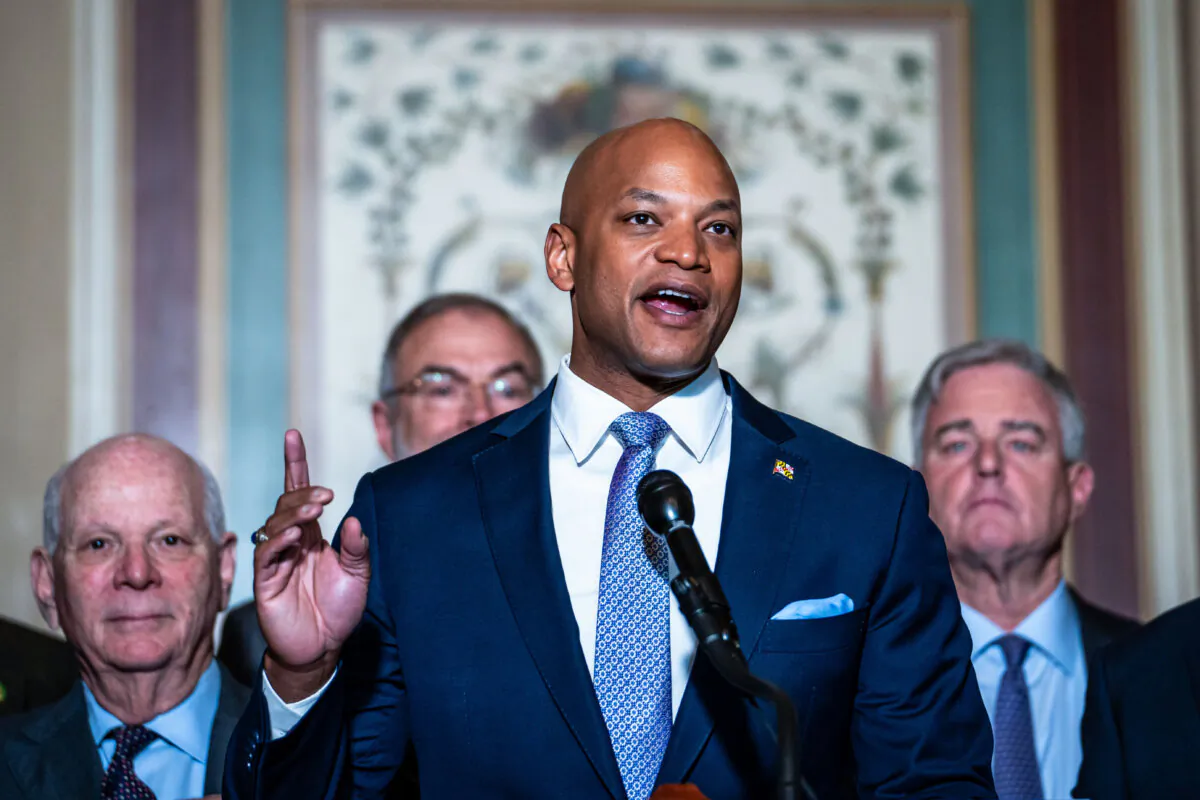

Maryland House Democrats moved House Bill 488 closer to final passage on Jan. 30, advancing a plan to redraw the state’s congressional map as Republicans warned that the push could set a new precedent for mid-decade redistricting.
The state bill had its second reading and now needs a third reading before being voted on in the House of Delegates, where Democrats are expected to approve it before sending it to the Maryland Senate. It could still face an uphill battle in the state Senate even though Maryland has a Democratic majority, because Senate Majority Leader Bill Ferguson has voiced opposition to any mid-decade redistricting.
The bill would implement a new congressional map recommended by a redistricting advisory commission created by Gov. Wes Moore, a Democrat, who has strongly supported their chosen map. Democrats currently hold seven of Maryland’s eight U.S. House seats, and the proposed map could eliminate the state’s lone Republican-held district, represented by Rep. Andy Harris.
The proposal would set new district lines for Maryland’s eight seats and includes a constitutional amendment framework tied to the plan. The bill’s synopsis says it would “alter districts for the election of Representatives in Congress for elections in 2026” and for elections held after that until a post-2030-census map takes effect.
As debate continued on Jan. 30 during the second reading of the bill, Democrats and Republicans repeatedly clashed over whether Maryland should redraw its map at all in the middle of the decade.
HB 488 was first introduced on Jan. 23 and advanced out of the House Rules and Executive Nominations Committee with amendments before reaching the floor, according to the bill’s legislative history.
Republicans offered amendments that would have blocked the mid-decade redraw or substituted a different map, but both failed. During debate, several Republican delegates argued that mid-decade redistricting was inherently improper.
Maryland Delegate Stuart Schmidt Jr. said in his argument for his failed amendment, which would have stricken the proposed map completely, that mid-decade redistricting in any state for political reasons was wrong.
“My representation has been a revolving door,” he said. “To have one’s representation change so frequently is the definition of a broken system. We’re here today because Texas started this. It’s wrong. California followed. Missouri, North Carolina, Ohio. It’s wrong. It’s wrong, wrong, wrong, that we’re here today, and Marylanders shouldn’t have to hear it. We shouldn’t have to be fighting because someone else is fighting.”
House Majority Leader David Moon, a Democrat, responded that he shared concerns about mid-decade redistricting but that the fix should be national.
Moon pointed to a bill in the U.S. Congress—H.R. 4889—that would ban mid-decade redistricting in all 50 states and void maps drawn this cycle. He said Republicans who oppose the practice should press congressional leaders to move that proposal, arguing that “the solution has to come from Congress.”
Moon rejected the idea that Maryland should limit itself while Republican-led states redraw maps to reshape the U.S. House.
A key feature of the bill is a statewide ballot question in November 2026 tied to whether the 2026 congressional plan could be used again in later cycles.
The bill directs that a constitutional amendment be submitted to voters at the November 2026 general election. The ballot language says the amendment would authorize the use of the map again for the 2028 and 2030 congressional elections until a new plan takes effect after the 2030 census.
 Friends Read Free
Copy
Facebook
Tweet
Friends Read Free
Copy
Facebook
Tweet