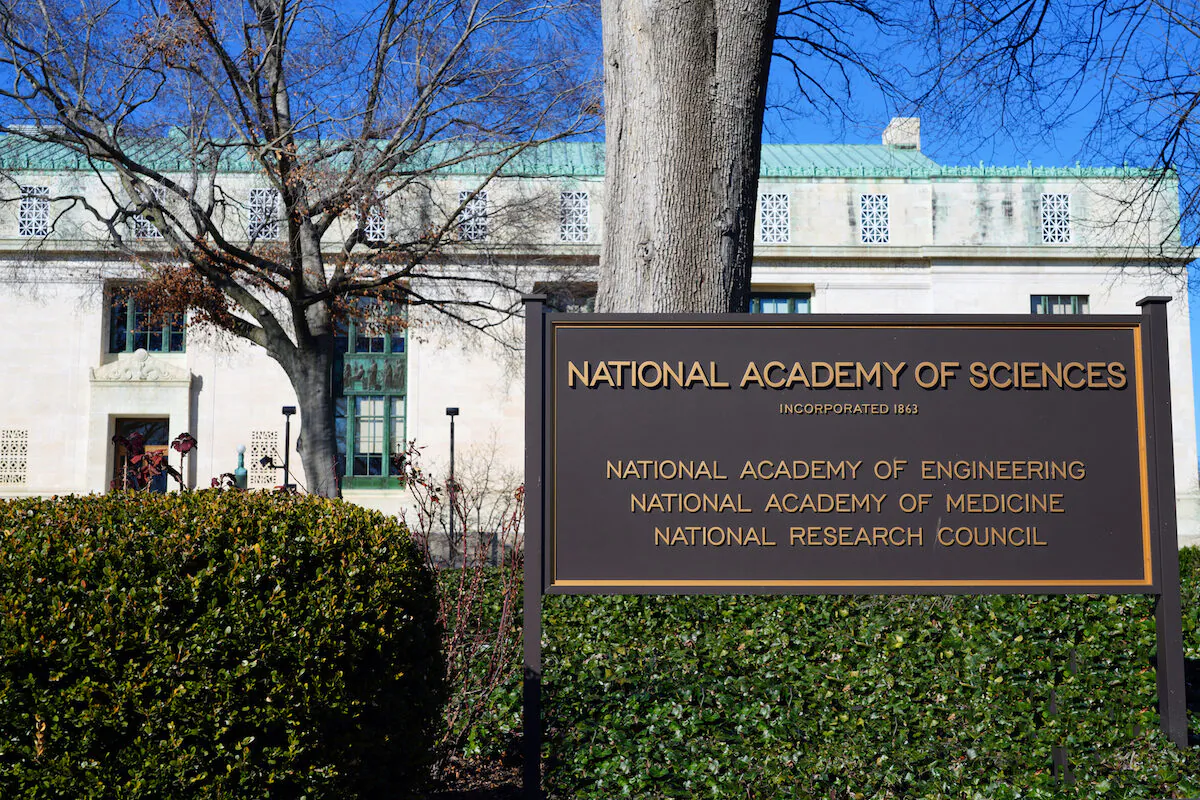

Facing accusations from conservatives that it may be attempting to bias judges in favor of climate lawsuits, the National Academy of Sciences (NAS) has removed from its website a chapter on climate science in its manual produced as a judicial reference for judges.
The fourth edition of the Reference Manual on Scientific Evidence for federal judges, which includes a chapter on climate science, was written by the NAS in partnership with the Federal Judicial Center.
“That chapter has received considerable scrutiny,” the NAS announced in a statement. “The NAS has determined that questions about the processes used to develop the chapter warrant an independent review, and the chapter will not appear on our website while that review is underway.”
Critics say the move vindicates the concerns they raised about the manual and the NAS’s contributions to it.
“After eight long months, the National Academies has finally acknowledged that the biased climate science chapter in its judicial reference manual deserves additional scrutiny,” Carrie Severino, president of the Judicial Crisis Network, told The Epoch Times via email.
“It took massive public backlash, [Supreme Court Justice Elena] Kagan distancing herself from the chapter, and the Federal Judicial Center removing the chapter, before the National Academies finally bowed to reality.”
Climate litigation involves cities, counties, and states suing energy companies for damages that they claim global warming has inflicted on their communities. One such lawsuit, in Multnomah County, Oregon, is seeking $50 billion from Exxon Mobil, Shell, Chevron, BP, ConocoPhillips, and others.
Attorneys who represent these municipalities have received funding from activist nonprofit organizations such as the Rockefeller Family Fund and the New Venture Fund.
The Federal Judicial Center’s reference manual was criticized by many conservatives, and by climate scientists who dissented from its conclusions, saying that it was biased.
“Federal judges rely on this manual to decide cases,” Jason Isaac, CEO of the American Energy Institute, told The Epoch Times via email. “When activists capture the process used to write it, they capture the courts themselves.”
Critics charged that statements by the NAS in the reference manual appeared to support plaintiffs’ claims in thousands of climate lawsuits currently moving through courts across the United States. The manual was provided to more than 3,000 judges and has been cited in more than 1,700 opinions.
Attorneys general from 27 states wrote to the Federal Judicial Center in January requesting that it remove the information on climate science from its manual.
The attorneys general alleged bias, among other issues, on the part of the authors, stating that the people who wrote the climate chapter have also advocated for climate lawsuits as a tool to fight global warming. Two of the authors coauthored a 2021 report on “The Law and Science of Climate Change Attribution,” which features a chapter called “How Might Judges and Litigants Utilize Attribution Science in the Courtroom?” that provides a framework for employing weather event attribution in lawsuits.
President Donald Trump criticized the NAS on Truth Social in July, stating that it had “published fraudulent, biased, and misleading Manuals on Climate Change.” Trump also threatened to defund the group, stating, “Taxpayers should not be funding Climate Fraud, and Judges should never have relied upon it.”
The manual was endorsed by Supreme Court Justice Elena Kagan, who wrote the foreword to it, but she later stated during congressional testimony that she hadn’t read the chapter on climate science.
Congressional Investigations
Meanwhile, Congress has launched investigations into how the manual was written, who wrote it, and whether outside parties—including persons affiliated with the law firms acting as plaintiffs attorneys in climate lawsuits—had contributed to the manual.
Reps. Jim Jordan (R-Ohio), chairman of the House Judiciary Committee, and Darrell Issa (R-Calif.), chairman of the Subcommittee on Courts, Intellectual Property, and the Internet, charged in a Jan. 14 letter to the Federal Judicial Center that it may have produced “biased programming” with the “underlying goal of predisposing federal judges in favor of plaintiffs who allege injuries from the manufacturing, marketing, use, or sale of fossil-fuel products.”
In the wake of these allegations, the Federal Judicial Center removed the chapter from the reference manual.
In addition to the manual, the NAS produced a separate report in July that lent support to “extreme event attribution,” the legal theory underpinning climate lawsuits, which claims that damage from extreme weather can be attributed to fossil fuel emissions, as plaintiffs assert.
“The scientific tools, observational datasets, and methods developed and used for [extreme event attribution] have advanced considerably over the past decade and increased the confidence in [extreme event attribution] results for some types of weather events,” the NAS stated regarding its report.
That report also provides a methodology for establishing a link between greenhouse gas emissions, changes in climate, extreme weather, physical impacts on communities, and societal and economic harm, and it stated that the NAS had the “highest confidence” when attributing damages from extreme heat, cold, and heavy rainfall.
The NAS stated that the chapter is now pending a review and that its procedures must follow “the highest standard of objectivity” and that “when questions arise whether that standard has been met, we have an obligation to examine them honestly and act on what we find.”
Critics say they await the outcome of that examination.
“If the NAS is serious about objectivity, it should review the entire Reference Manual, not just the chapter that drew the most heat,” Isaac said. “And the credibility of any independent review will depend entirely on how transparent the NAS is: who is conducting it, what it actually finds, and whether the results are made fully public.”
The NAS did not respond to requests for comment from The Epoch Times; however, a spokesperson from the organization said in a statement to media outlets that its mission was “to provide independent, objective scientific advice.”
 Friends Read Free
Copy
Facebook
Tweet
Friends Read Free
Copy
Facebook
Tweet