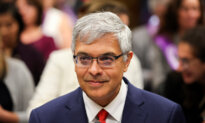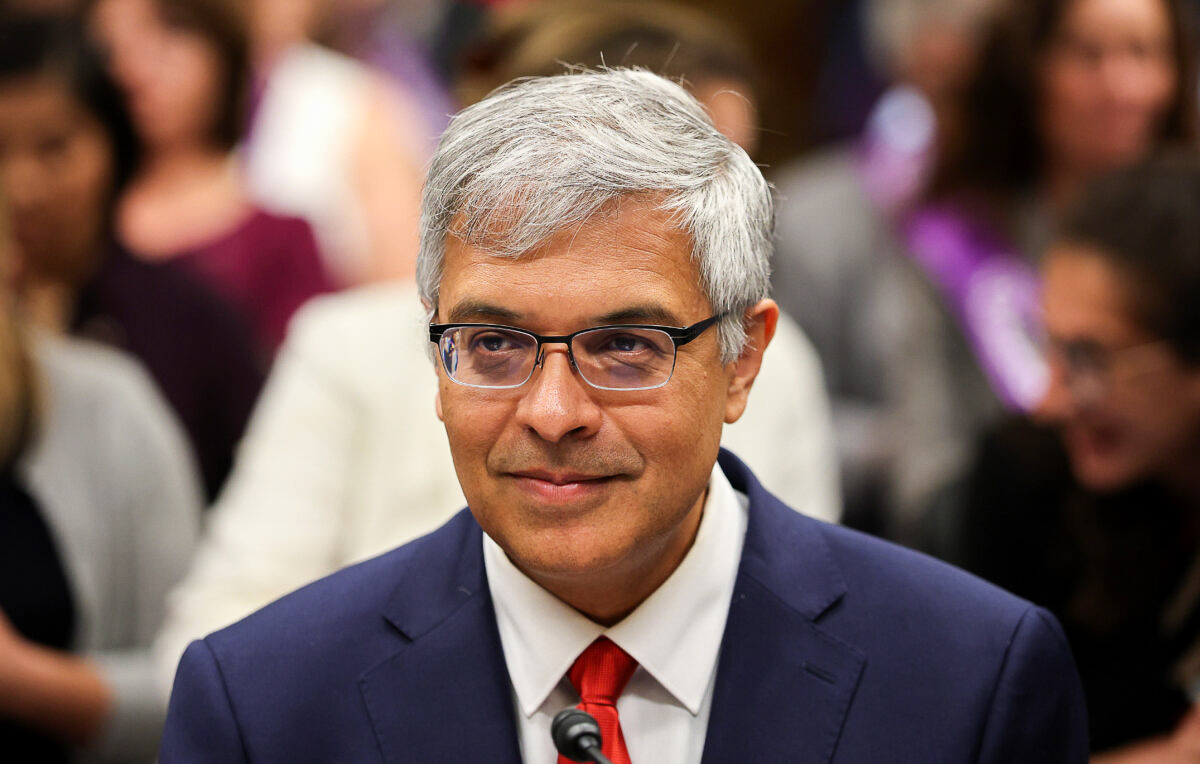

The director of the National Institutes of Health (NIH) has become the new acting director of the Centers for Disease Control and Prevention.
Dr. Jay Bhattacharya will also serve as acting CDC director, two Trump administration officials told The Epoch Times on Feb. 18 on condition of anonymity.
The NIH and CDC are both part of the Department of Health and Human Services (HHS), which is led by Health Secretary Robert F. Kennedy Jr.
Bhattacharya, 58, will be the acting director “until a permanent CDC director is nominated and confirmed,” a White House official told The Epoch Times in an email.
Bhattacharya did not respond to a request for comment by publication time.
Bhattacharya was selected by President Donald Trump in 2025 to lead the NIH. He was approved by the Senate in March 2025 in a 53–47 party-line vote.
Jim O’Neill, who had been serving as the acting CDC director in addition to his Senate-confirmed role of deputy health secretary, departed the CDC and HHS on Feb. 13.
President Donald Trump intends to nominate O’Neill to lead the National Science Foundation, according to the White House.
Bhattacharya and O’Neill “are eminently qualified for these positions, and the White House has confidence in them to deliver on the President’s agenda,” the White House official said.
O’Neill had become the top CDC official in the wake of the ouster of Susan Monarez, the first Senate-confirmed CDC leader in history. Monarez clashed with Kennedy, leading to her termination.
Monarez told senators in a hearing in September 2025, after she was fired, that Kennedy wanted her to commit to signing off on changes to vaccine guidance recommended by the CDC’s advisory panel, which Kennedy remade by removing the members and selecting new ones.
Kennedy said in a separate appearance before the Senate that Monarez had pledged not to approve any recommendations from the panel and that he only asked her to consider its advice, not agree to automatically approve it. He also said Monarez had told him she was not trustworthy.
Monarez also said that “the childhood vaccine schedule has been vetted and validated through science and evidence” and that every vaccine on the schedule is important.
O’Neill later approved each recommendation from the committee, including scaling back the CDC’s promotion of COVID-19 and hepatitis B vaccinations.
In January, acting on an order from Trump, O’Neill accepted advice from other HHS officials to stop recommending six vaccines for nearly all children.
“The data support a more focused schedule that protects children from the most serious infectious diseases while improving clarity, adherence, and public confidence,” O’Neill said at the time.
Bhattacharya and Food and Drug Administration Commissioner Dr. Marty Makary also supported the change.
“Science demands continuous evaluation,” Bhattacharya said at the time. “This decision commits NIH, CDC, and FDA to gold standard science, greater transparency, and ongoing reassessment as new data emerge.”
Some groups, such as the Independent Medical Alliance, have praised the update, while others, such as the American Academy of Pediatrics, have criticized it. The academy and other groups have asked a federal judge to enjoin the schedule, and the judge said on Feb. 13 that he might do so.
The revised schedule keeps eight vaccines, including for polio, as routinely recommended while downgrading shots against diseases such as rotavirus to shared clinical decision-making, or only advised following consultation with a health care professional.
 Friends Read Free
Copy
Facebook
Tweet
Friends Read Free
Copy
Facebook
Tweet