



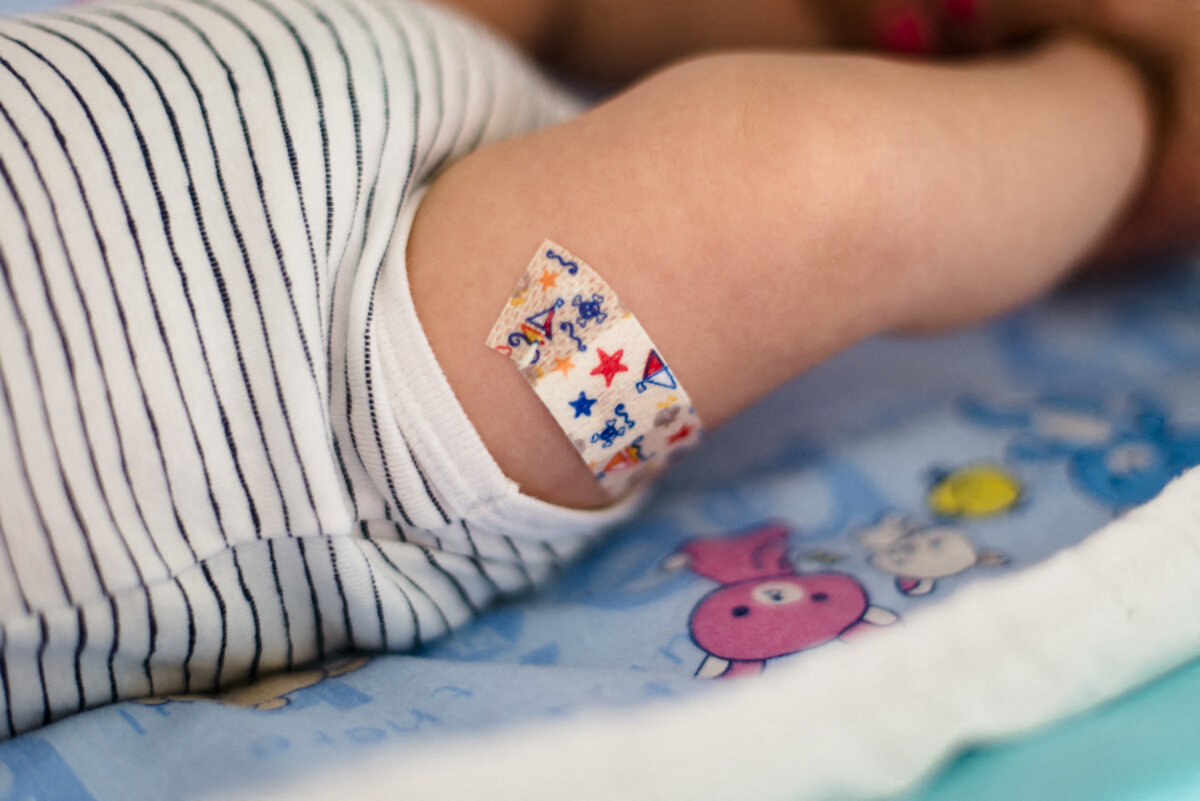
The Centers for Disease Control and Prevention no longer recommends that all newborns receive a dose of the hepatitis B vaccine soon after birth.
The CDC on Dec. 16 announced it adopted advice from the Advisory Committee on Immunization Practices (ACIP), a panel of independent experts that on Dec. 5 said officials should only recommend hepatitis B vaccination within 24 hours of birth for infants of women who tested positive, or did not undergo a test, for hepatitis B.
“This recommendation reflects ACIP’s rigorous review of the available evidence,” Jim O’Neil, acting CDC director and deputy secretary at the Department of Health and Human Services, said in a statement. “We are restoring the balance of informed consent to parents whose newborns face little risk of contracting hepatitis B.”
The CDC had previously recommended that all newborns in stable condition receive an early dose of a hepatitis B vaccine. The agency has credited the universal early dose with reducing the rates of hepatitis B in the country, although a CDC contractor told ACIP during the recent meeting that data indicated that other changes, such as increased blood screening for infected people, were the largest drivers of the reductions.
The department said in a fact sheet the change reflects how there is a low incidence of transmission of hepatitis B from pregnant women “due to existing prevention systems.” It also stated that pregnant women should get tested for hepatitis B, that the test is covered by insurers, and that infants born to women who have a positive or unknown hepatitis B status should receive a hepatitis B vaccine dose in addition to hepatitis B immune globulin shortly after birth.
For babies born to women who test negative for hepatitis B, parents and doctors should take into account the risks of infection as well as the benefits and risks of vaccination when deciding when or if to give the vaccine, the CDC now says. If they decide to proceed with vaccination, the initial dose should be administered no earlier than 2 months of age.
The CDC still recommends additional doses of the hepatitis B vaccine.
It is reviewing ACIP’s recommendation that when deciding whether children need any doses beyond the first dose, parents and health care providers should consider serology testing to see whether children have already achieved at least 10 milli-international units of anti-hepatitis antibodies per 10 milliliters, widely considered the minimum level of antibodies for adequate protection.
Historical data indicate that about a quarter of infants achieve those levels of antibodies after one dose, and about 90 percent reach those levels after three doses, Adam Langer, with the CDC’s National Center for HIV, Viral Hepatitis, STD, and Tuberculosis Prevention, said during a recent meeting. He said that “there really is no reason not to give the full series.”
Some experts said the adjustment was warranted.
“I look at hepatitis B and in the United States, it’s a very rare condition. In the United States, less than 1 percent of all pregnant women in the United States are positive for chronic hepatitis B, and that’s the only way babies in the U.S. get it,” Dr. Monique Yohanan, senior fellow for health policy at the Independent Women’s Forum, told The Epoch Times. “So a universal vaccine has never made sense in the United States.”
Others expressed concern about unvaccinated children being exposed to hepatitis B after birth.
“We don’t know who’s going to be taking care of them,” Dr. Sandra Fryhofer, a representative of the American Medical Association, said before the vote. “Are we going to test every patient that has access to or touches that baby? That’s not something that’s really doable.”
ACIP’s hepatitis B workgroup concluded that infants born to mothers who test negative for hepatitis B have an “extremely low risk” of contracting the virus from other sources during childhood, and particularly in their first months of life, and “therefore, do not need to be routinely vaccinated with the [hepatitis B] vaccine at birth.”
The CDC has said hepatitis B can remain viable on surfaces for at least seven days, citing a 1981 paper published by The Lancet. That figure was put forth by a representative for Merck, one of the hepatitis B vaccine manufacturers, who spoke to the CDC advisers ahead of their vote and advocated not changing recommendations for the vaccine.
Langer told CDC advisers that “we don’t have any recent data with regard to exactly how frequently horizontal transmission happens, but we do certainly have historical data that demonstrates horizontal transmission has happened in the United States.” On LinkedIn, he shared a post pointing to a 1989 case report from the CDC describing what researchers said was hepatitis B transmission between children in day care in the United States.
Langer also said that the lack of more recent data “doesn’t mean that it can’t happen” but “means that the vaccine is preventing it.”
Yohanan said that it would take a combination of a high viral load in blood, in combination with poor sanitation, to lead to such transmission.
“Certainly, somebody might point to a single case report where they might make an inference, but to say that there’s any evidence that babies are getting this in a casual way, I would strongly disagree with that,” she said.