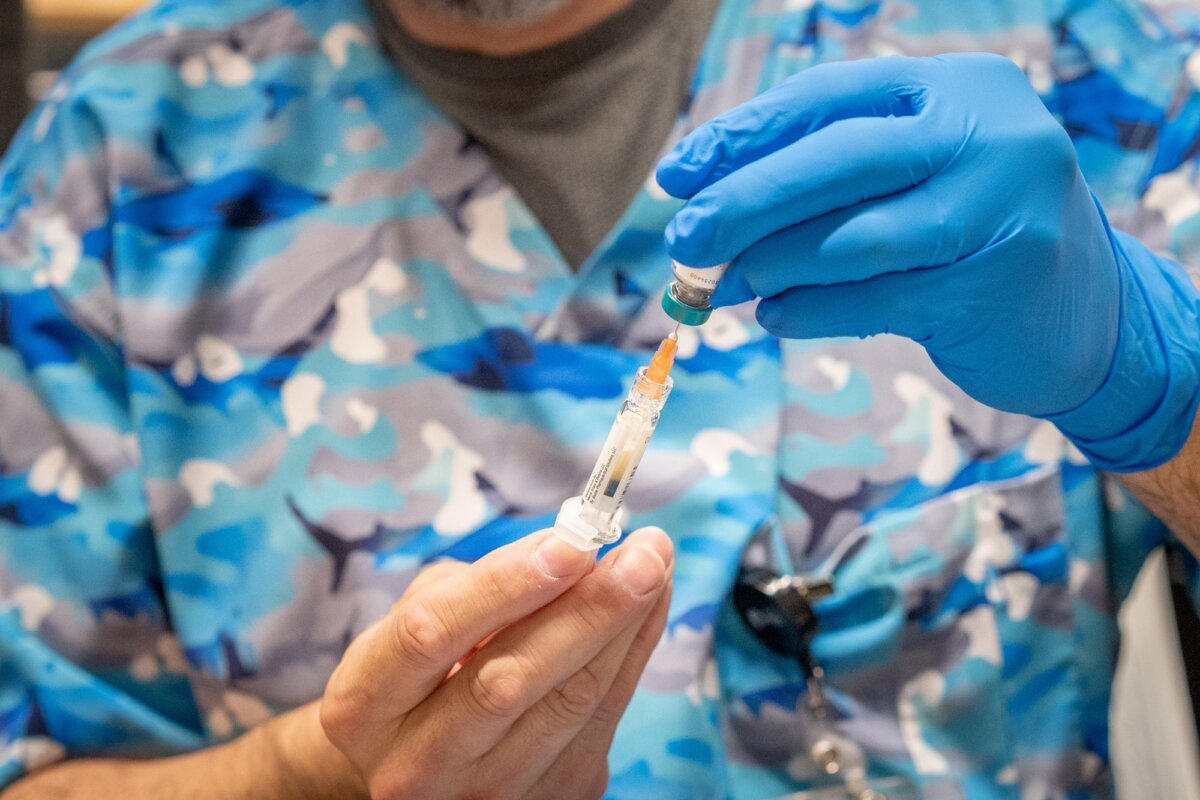

The new acting director of the Centers for Disease Control and Prevention (CDC) said on March 2 that people should receive the measles vaccine.
“Measles is preventable, and vaccination remains the most effective way to protect yourself and those around you,” Dr. Jay Bhattacharya said in a video statement.
Bhattacharya was recently tapped to lead the CDC after Jim O’Neill, who had been acting director, was selected by President Donald Trump to lead the National Science Foundation.
Bhattacharya is already in a Senate-confirmed position as director of the National Institutes of Health.
In his first public comments on measles since being appointed acting CDC director, Bhattacharya said in the video that the CDC’s mission is to protect Americans from infectious and chronic diseases, to provide scientific guidance in a transparent way, and to serve as a credible source of information.
He also said the CDC has been in communication with officials across the country to contain measles amid a rising number of cases.
The CDC can provide vaccines, therapeutics, laboratory support, and CDC staff upon request, he said, and state partners are engaging faith leaders to support the promotion and administration of the measles, mumps, rubella (MMR) vaccine.
Bhattacharya said that because there is no cure for measles, it is important to prevent cases of the infectious disease, and that the MMR vaccine is “the most reliable and effective” source of prevention.
“Vaccination protects not only individuals, but entire communities,” he said.
Confirmed cases of measles in the United States in 2025 hit 2,281, the highest number since 1991. As of Feb. 27, there have been 1,136 confirmed measles cases in the country, according to the CDC. There are several ongoing outbreaks, including an outbreak in the Carolinas.
The CDC estimates that one dose of MMR vaccine provides 93 percent protection against measles and that two doses confer 97 percent protection. Those estimates come from a paper published by the CDC in 2013 that analyzed studies performed more than a decade ago, a CDC spokesperson told The Epoch Times previously.
A number of outside groups, such as the American Academy of Family Physicians, which partners with vaccine manufacturers, also recommend measles vaccination.
Advancing a contrary view, the nonprofit Physicians for Informed Consent estimates that contracting measles is safer than receiving the vaccine, which has side effects that include fever and headache.
Bhattacharya also said on March 2 that he recognizes and respects that peoples’ health choices for themselves and their children are personal, and he encouraged them to take questions to their doctors and nurses.
“We will continue working with health departments and communities to build trust,” he stated. “Our goal is simple: healthy children, thriving families, and strong communities today and into the future.”
 Friends Read Free
Copy
Facebook
Tweet
Friends Read Free
Copy
Facebook
Tweet