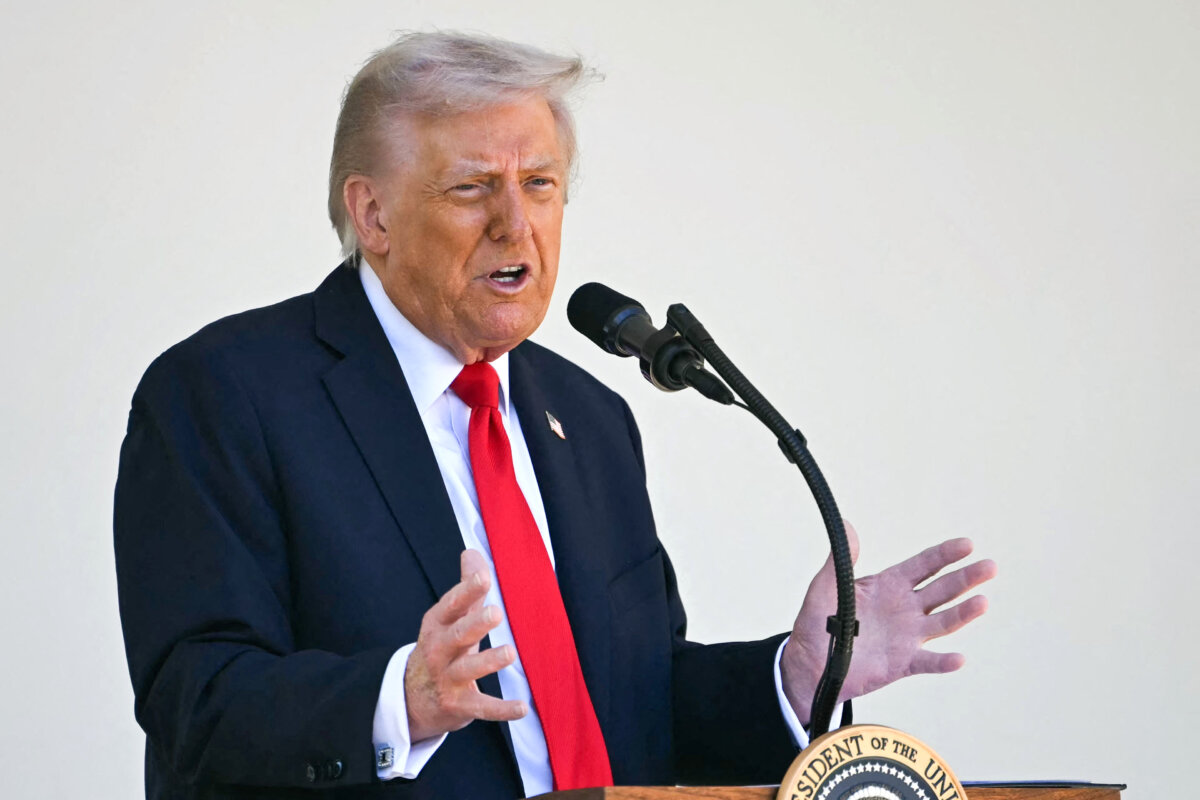

President Donald Trump on Oct. 21 said he would talk with Democrat leaders if they reopen the government by approving a Republican-led stopgap funding bill designed to temporarily fund U.S. government operations.
“I would like to meet with both of them, but I said one little caveat, I will only meet if they let the country open,” Trump said, referring to requests by Senate Minority Leader Chuck Schumer and House Minority Leader Hakeem Jeffries to meet “anytime, any place.”
Trump’s choice to withhold discussions with Democratic leaders without a prior resolution to the shutdown, now entering its fourth week, has come as Schumer and Jeffries have said that they are open to speak “anytime, anyplace.”
The first major shutdown under the second Trump administration began on Oct. 1 after Congress failed to pass appropriations bills for Fiscal Year 2026, resulting in a lapse of funding for nonessential federal operations.
Essential services, such as national security and emergency response, are ongoing, but thousands of federal employees have been furloughed, and programs spanning several agencies have been scaled back. The White House has underscored the economic toll of the shutdown, with conjectures revealing billions of dollars in daily losses in productivity and delayed services.
The source of the shutdown is Democratic opposition to a Republican-proposed continuing resolution (CR) to finance the government through Nov. 21 at current levels, which has failed numerous times in the Senate.
Democrats are committed to extending enhanced premium tax credits under the Affordable Care Act (ACA), which are set to expire on Dec. 31.
These subsidies grew during the COVID-19 pandemic, and Democrats say they are responsible for reducing healthcare costs for more than 20 million Americans.
Premiums could increase by 25 percent to 50 percent in many states if the subsidies expire, according to analyses from health policy groups. Republicans view the demand as an unrelated rider that is getting in the way of government funding efforts. They say they’re open to negotiations on reforming the ACA, but only after the government is funded.
Senate Majority Leader John Thune (R-S.D.) proposed a longer-term CR into 2026 to make time for negotiating the full 12 appropriations bills.
Sen. Susan Collins (R-Maine) said Republicans will likely need to extend their stopgap bill to reopen the government and fund operations beyond its end date.
“There’s a realization that we’re going to have to have an extension because we’ve wasted all these weeks,” Collins, who chairs the Senate Appropriations Committee, told reporters on Oct. 21.
At least seven Democratic senators must break with their party to get closure on the shutdown saga, which has yet to happen in 10 failed attempts to advance the House-passed CR.
The government shutdown could mean disaster relief delays by FEMA, as well as lawsuits challenging the federal layoffs. States also face impacts to Medicaid programs and infrastructure projects.
Reuters contributed to this report
 Friends Read Free
Copy
Facebook
Tweet
Friends Read Free
Copy
Facebook
Tweet