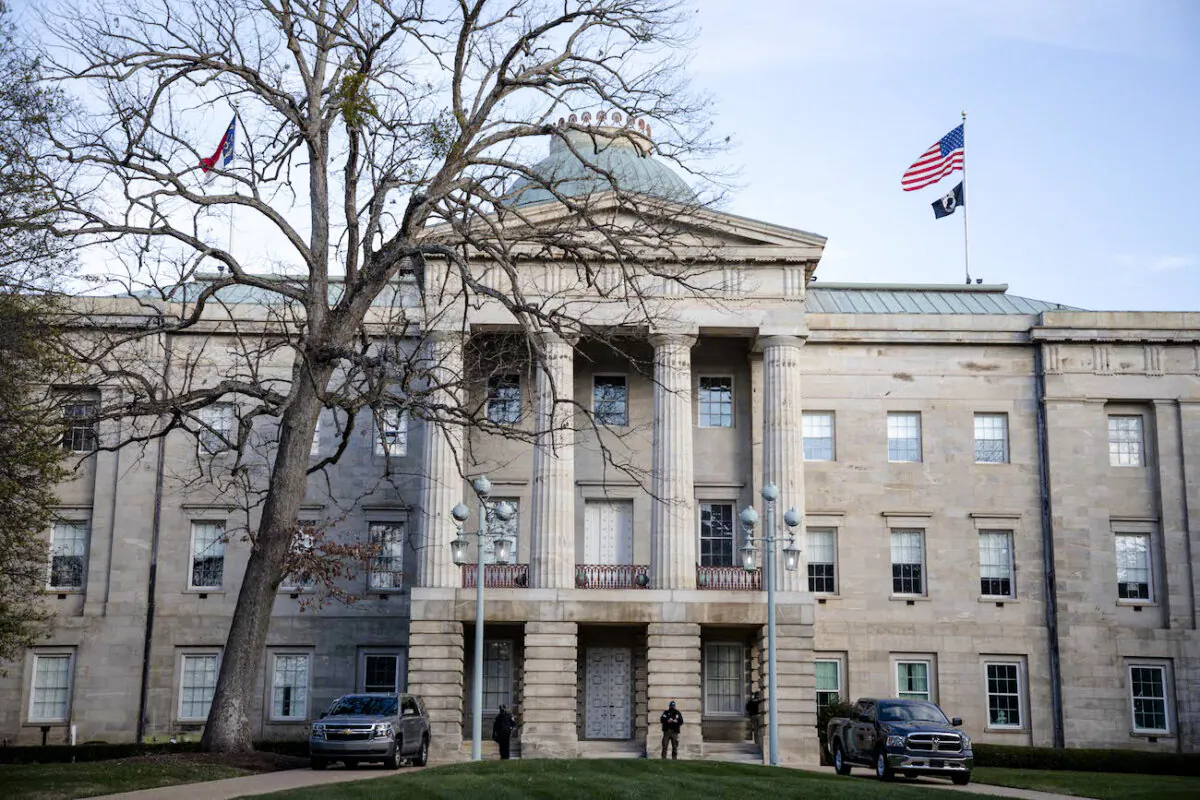

The North Carolina Senate on Oct. 21 passed legislation to implement new district maps for elections to the U.S. House of Representatives, which will likely turn one longtime Democratic-leaning district into a Republican-leaning one.
Senate Bill 249, which would change the boundaries of North Carolina’s 1st and 3rd Congressional Districts—both located in the eastern part of the state—was passed in the Senate by a vote of 26-20 along party lines. The bill will now go to the Republican-led state House of Representatives, where it is expected to pass.
The bill would remove several African American-majority counties from the 1st Congressional District, which has been held by a Democrat in Congress in some configuration since 1899, and transfer them to the 3rd District. Some Republican-leaning areas of the 3rd District, such as New Hanover County where the coastal city of Wilmington is located, will join the district, and this is expected to turn it into a safe Republican seat, according to an analysis.
“Across the country, Democrat-run states have spent decades ensuring that Republicans would be drawn out of Congress. North Carolina Republicans will not sit quietly and watch Democrats continue to ignore the will of the people in an attempt to force their liberal agenda on our citizens,” North Carolina Senate President pro tempore Phil Berger (R-Rockingham), who is the leader of Republicans in that body, wrote on social media. “This new map respects the will of the North Carolina voters who sent President Trump to the White House three times,” he stated.
Leaders of the North Carolina General Assembly have cited the State of California’s actions as the main reason for the bill. In November, California’s citizens will vote on Proposition 50, a referendum that seeks to redistrict the state’s U.S. House maps in favor of Democrats, which is expected to cost several Republicans their seats. Democrats in California, in turn, claim their measure is a response to actions by the State of Texas to redraw its maps.
“Our state won’t stand by while Democrats like [California Gov.] Gavin Newsom redraw districts to aid in their effort to obtain a majority in the U.S. House,” North Carolina Speaker of the House Destin Hall (R-Caldwell) wrote.
Of North Carolina’s 14 U.S. House members, currently 10 are Republicans and four are Democrats.
The state has been the site of many redistricting controversies.
Changes to the North Carolina Constitution enacted in 1995 prevent the governor from vetoing redistricting legislation, meaning that, despite the state having a Democratic governor, the proposed maps are likely to become law.
Gov. Josh Stein (D-N.C.) issued a statement attacking the bill.
“They are failing the people of North Carolina … they are failing the voters of North Carolina by deciding for them who their congressional representation will be,” Stein said in a video posted on X. “The representatives should not be choosing their voters.”
If enacted, the changes mean that the 1st District’s current representative, U.S. Rep. Don Davis (D-N.C.), would be vulnerable during the 2026 general election. Davis won reelection in 2024 by a narrow margin of 1.7 percent.
President Donald Trump has enthusiastically supported the redistricting effort, which he claimed on social media will enable North Carolina to gain “an additional MAGA Republican in the 2026 Midterm Elections.” He has supported other similar efforts in Republican-run states—including Kansas, Indiana, Ohio, and Utah—that are currently underway.
The Associated Press contributed to this report.
 Friends Read Free
Copy
Facebook
Tweet
Friends Read Free
Copy
Facebook
Tweet