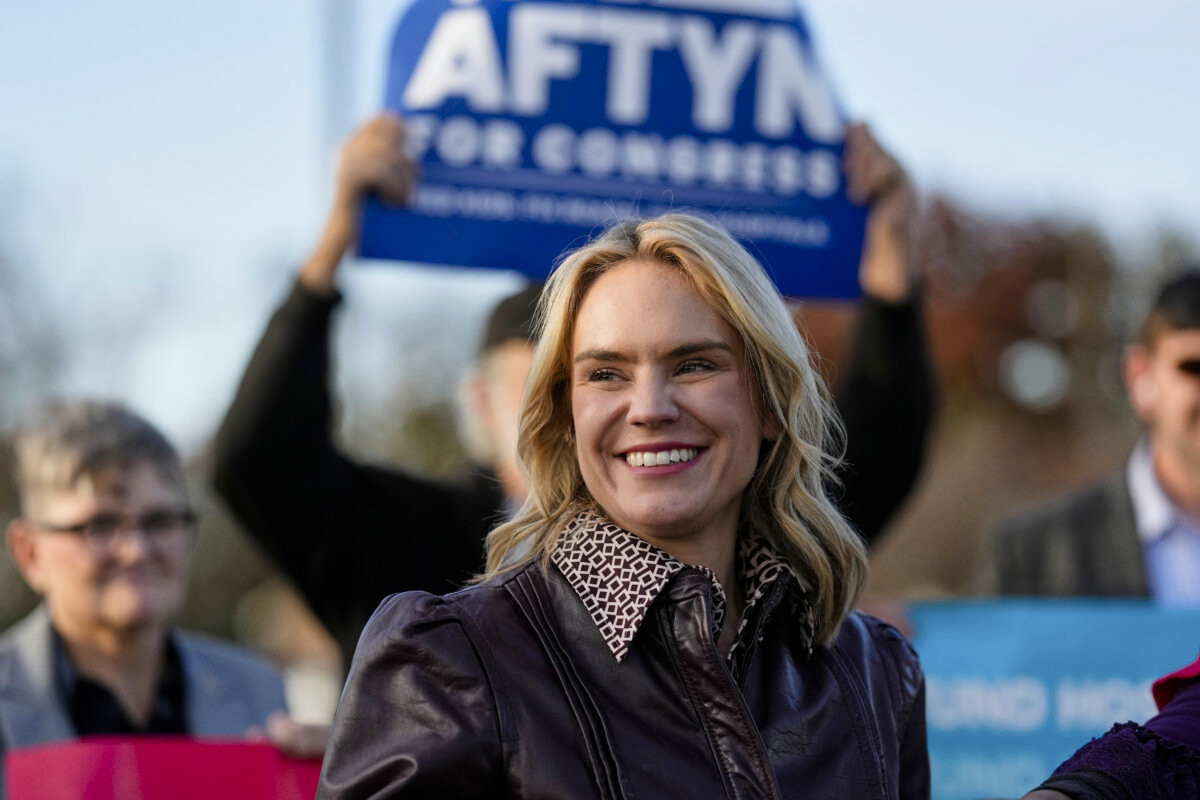

Democrats have spent much of the past year pointing to “overperformance” in deep-red districts as evidence that their message is breaking through in Donald Trump country.
The special election in Tennessee’s 7th Congressional District is the latest test of that theory. Democrat Aftyn Behn lost to Republican Matt Van Epps this week in a district that backed President Donald Trump by more than 20 points in 2024, but she cut the margin to single digits after a flood of money, national attention, and “AOC of Tennessee” buzz on the left.
Party committees on both sides rushed to frame the result as a sign of things to come. Behind that spin is a quieter argument over what these kinds of races actually tell Democrats about their path in rural and conservative areas—and how much weight to put on “overperformance” in places they still cannot flip.
A Benchmark, Not a Blueprint
Mike Nellis, a Democratic strategist who has worked on races in Tennessee, told The Epoch Times he views special elections such as the TN-7 contest as “benchmarks for how the broader electorate is feeling.”
“We get a deluge of polling and focus group information. It’s hard to know what’s real and what’s not, so getting an opportunity to see how people are voting in a special election is key,” he said in written responses.
In this case, he said, the race was “especially predictive” because Republicans “worked so hard to juice the turnout up to midterm levels.” He pointed to what he called roughly a 13-point swing toward Democrats compared with the 2024 presidential results and said it “confirms my belief that we are creating the conditions for a nationwide blue wave.”
At the same time, he pushed back on the idea that Democrats should treat a narrower loss on its own as a win.
“I don’t think there’s anything like—I don’t think there are moral victories; I don’t believe in moral victories,” Nellis said. “But I think it’s good to see a result like that, even though Behn was maybe a little too liberal for the district.”
He said Behn “was able to compete” despite prior positions, including comments about defunding police, that “likely hurt her in that district.”
Both Parties Claim a Win
Democratic leaders quickly described the result as a danger sign for Republicans. In a post-election press release, the Democratic National Committee called the outcome a “historic overperformance” in a Trump +22 district and said Republicans were “forced to spend more than three million dollars to squeak out a slim, single-digit margin.”
DNC Chair Ken Martin said Behn centered her campaign on lowering costs for groceries, housing, and health care, while Van Epps “ran his campaign focused on Donald Trump” and needed “a massive Republican spending onslaught to barely hold this traditionally safe Republican seat.” The DNC said Democrats have now “won or overperformed” in nearly 90 percent of key special elections this year, and that the Tennessee result shows the party is “on offense” heading into the midterms.
Republicans offered a different reading. In a statement, Republican National Committee Chair Joe Gruters said voters “didn’t just reject Aftyn Behn and her anti-Tennessee, abolish-the-police agenda—they rejected the Democrats’ entire radical platform.” He said Republicans “stood behind Matt Van Epps, a patriot who loves his state and loves this nation,” and argued that the win shows that voters want “leaders who deliver for hardworking Americans, not far-left candidates who hate the very people they claim to represent.”
 Rep.-elect Matt Van Epps delivers his victory speech as wife Meg looks on at Millennium Hotel Maxwell House Nashville in Nashville, Tenn., on Dec. 2, 2025. Tennessee’s 7th district elected Republican Matt Van Epps in a special election to fill a House of Representatives seat vacated by the resignation of Republican Mark Green earlier this year. (Brett Carlsen/Getty Images)
Gruters was referring to criticisms against Behn during the election, after a 2020 podcast clip resurfaced. In the clip, she criticized Nashville’s tourism scene, saying she “hates” bachelorette parties, pedal taverns, and country music. Throughout the campaign, she said the comments were taken out of context and posted a video saying she did not hate the city she represented in the state House.
The RNC added that it deployed full-time field staff, partnered with the state party on get-out-the-vote work, and used mail to target voters in the district.
‘Moral Victory’ or Capacity Building
Outside analysts are cautious about trying to read too much into a single contest.
“It is always dangerous to draw too much about the nation as a whole from one congressional election,” James Newman, who teaches state and local government at Southeast Missouri State University, told The Epoch Times. Local issues, candidate quality, and turnout can all shape the outcome, he said, and special elections tend to draw fewer voters.
In TN-7, about 29 percent of adults of voting age cast ballots in the special election, according to figures cited to The Epoch Times by Lindsey Cormack, an associate professor at Stevens Institute of Technology and director of DCinbox.com. She noted that the gap between the winner and loser came down to fewer than 16,000 votes, or about 3 percent of the potential electorate.
“In 2024, turnout was higher, as it always is in presidential elections,” Cormack said in written responses. “So all things considered, the ‘performance’ of a Democrat in TN-7 was better in this special election than expected based on the most recent election, but it seems like the more interesting takeaway is how pivotal voters can be when there is true competition for a seat.”
She said Democrats in Republican-leaning districts “don’t have easy routes to victory,” but that investments in those races can still matter.
“As long as donors realize they might not be victorious in this instance, but they see the value in practice for candidates, campaign operations, and voters, and the value in resulting data moving forward, investments in a ‘loss’ aren’t necessarily a loss,” she said. Tighter margins, in her view, can “set up for a more competitive and potentially winnable race in the future,” or at least “a more capable opposition party.”
Newman described Behn’s showing as a “moral victory” that offers Democrats “momentum and hope” heading into the 2026 midterms, even as Republicans still control the seat.
Republican leaders, he suggested, may have made a conscious choice to spend enough to win without chasing a blowout.
“While I am sure Trump and Republicans would have liked to have had a higher margin of victory, there is something to be said for not spending a lot of time, money and effort in trying to win an election by a large margin versus spending enough time, money and effort to win the election,” he said.
A Test of ‘Overperformance’ as a Metric
For Nellis, the Tennessee race fits into a broader pattern rather than standing alone.
“Yes, overperformance is a useful metric for figuring out where the party stands,” he said. “There’s a consistency to it, and you get to see it over and over again. You shouldn’t look at one race in a silo; you should look at all the races together.”
He pointed to Democrats’ recent special-election results and off-year races in states such as New Jersey and Virginia, where Democrats overperformed as signs that “the recipe’s pretty good,” while noting “legitimate structural limits to winning in deep red states.”
The Democratic strategist also pushed for a broader map.
“In my view, given how increasingly unpopular Donald Trump is, and how frustrated people are with the economy, Democrats should be competing everywhere,” Nellis said. “For too long, the party’s been afraid to compete in places where we aren’t particularly welcome, and so we’ve ceded that territory to Republicans—and we can’t do that anymore.”
He said national dollars and talent in races such as Behn’s “are useful” because they “create momentum,” develop local activists and party leaders, and build infrastructure.
“I do think these races are always worth fighting,” he said.
Lessons From Earlier Tennessee Hopes
Behn is not the first Democrat in Tennessee to attract national attention, outside money, and favorable press—and still fall short.
Former Gov. Phil Bredesen, a two-term Democrat once popular enough to carry all 95 counties in his second gubernatorial race in 2006, raised significant money and drew national interest when he ran for Senate in 2018. He lost by double digits amid a national climate that favored Republicans, despite high expectations.
Former state Rep. Gloria Johnson, one of the “Tennessee Three” who gained national prominence after a gun-policy protest on the House floor, lost her high-profile 2024 Senate bid by even larger margins, even as she became a fundraising draw and a symbol for many Democrats.
Nellis, who said he worked for Bredesen in earlier races, cautioned against treating those examples as a neat trend line.
“I don’t see any clear lessons from recent Tennessee examples,” he said. “I thought he ran a good campaign—it just got caught up in the national mood and environment at the time, given the Supreme Court race.”
What Democrats choose to see in TN-7 may depend on what they believe these races are for. If the goal is to flip a double-digit Trump-won seat in one cycle, Behn’s loss may look like a ceiling. If the goal is to test messages, train organizers, and chip away at lopsided margins, party strategists say the result can still shape decisions about where to compete, how much to invest, and what counts as progress.
For now, both parties can point to Tennessee’s 7th District as proof of their case. Republicans kept the seat. Democrats cut the gap. The real verdict on whether “overperformance” in places like this adds up to something larger will not come until voters decide the next Congress in the 2026 midterms.
 Friends Read Free
Copy
Facebook
Tweet
Friends Read Free
Copy
Facebook
Tweet