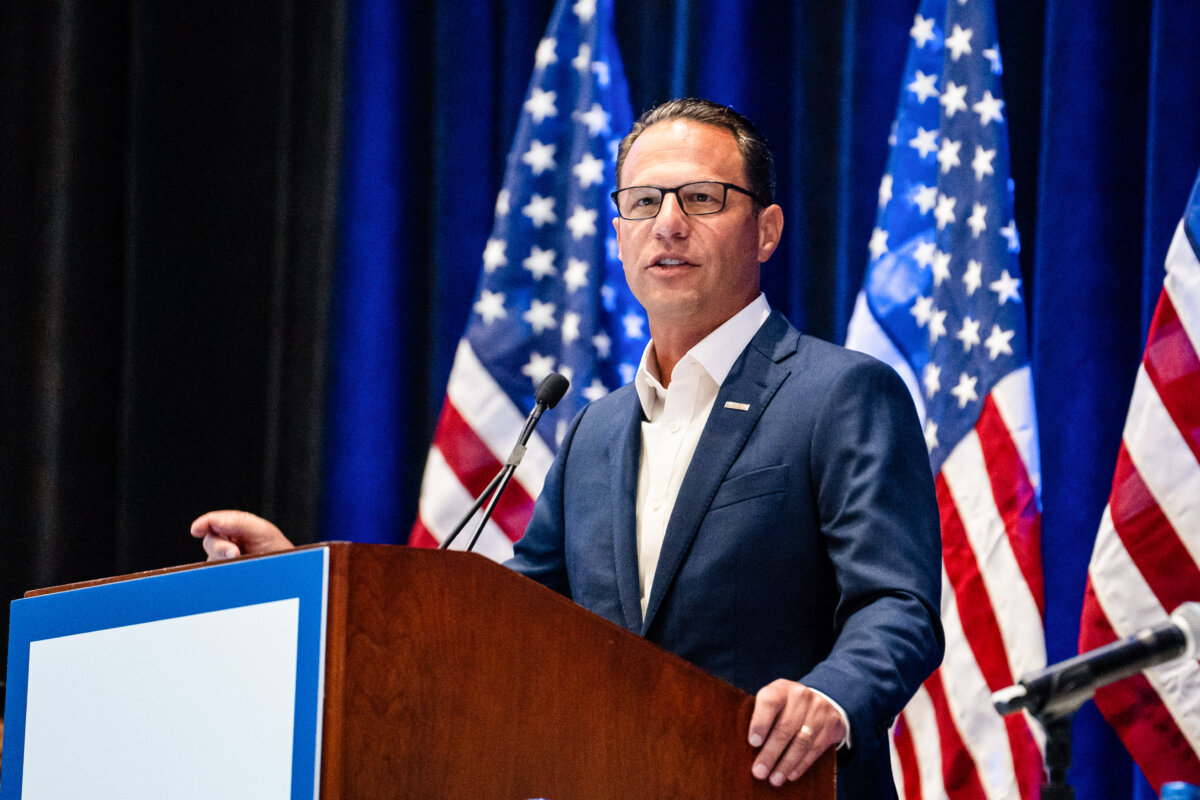

Pennsylvania Gov. Josh Shapiro, a Democrat, signed an executive order Tuesday aimed at curbing the growth of AI data centers in the state.
Shapiro wrote on X that the action was about “implementing the strictest standards in the nation for AI data centers—because I will not allow Pennsylvanians to be bullied by greedy developers and bulldozed by the lawyers working for these big tech companies.”
The Pennsylvania executive order was titled “Protecting Pennsylvania Consumers from Data Center Impacts.”
The order charges the state’s Department of Environmental Protection (DEP) with drafting “strict guardrails” that developers of data centers that are designed to use more than 25 megawatts (MW) must follow going forward.
Above that threshold, projects would require a consent order, an agreement, and sign-off from the municipality or county where the data center would be located.
The 25 MW threshold is a significant amount of electricity. One megawatt on a continuous basis is what it takes to power about 750 homes in the United States. So 25 megawatts could power more than 18,000 homes.
These significant energy requirements have led to concerns that the proliferation of data centers will bid up power prices for ratepayers.
More than 100 data centers have been proposed in the Keystone State, according to the order. The DEP has received permitting applications related to 20 of them. Currently, 14 data centers are well along the way to development; among those, five centers have the necessary permits to open but are not running yet.
The move to limit or even stop data centers in his state marked a policy shift by the governor. Last year, Shapiro welcomed Amazon’s plans to build data centers there.
“With Amazon’s commitment of at least $20 billion to build new state-of-the-art data center campuses across our Commonwealth, we just secured the largest private sector investment in the history of Pennsylvania. Pennsylvania is on the rise – and we’re not slowing down,” he posted to X on June 9, 2025. “Pennsylvania is on the rise—and we’re not slowing down.”
In prepared remarks that the governor’s office directed The Epoch Times to, the governor acknowledged the policy change.
Data center developers are “scaring our communities,” Shapiro said, by “being aggressive with township officials, bullying our neighbors, and refusing to listen to the people of Pennsylvania.”
Shapiro said the Democrat-controlled state House had passed “strict protections that require data centers to bring their own power and pay for all the costs associated with that electricity, be transparent with the local community, hire local workers and provide benefits to the local community, and protect our air and water.”
The Republican-controlled state Senate has not passed the legislation to put it on his desk.
“In fact, the Senate Majority Leader even said he had no intention of taking action,” Shapiro said, adding he was left with “no other option but to protect the people of Pennsylvania by taking executive action.”
The Pennsylvania majority leader, Joe Pittman, traded charges with the governor. Pittman wrote that Shapiro had been “all in on AI” and said that his comments and executive order showed “how afraid he’s become over his previous record of embracing data centers.”
The majority leader said that while his Senate colleagues had moved to remove favorable tax treatment from data centers in the state budget, the state House, controlled by Shapiro’s party, had “proceeded to amend the measure into something unrecognizable.”
“Together, I am confident we can work to safeguard our communities, foster economic growth, and build a stronger Pennsylvania for future generations to come,” Pittman wrote.
AI Around the Country
Data centers are a growth industry, with significant money being invested in AI, which Goldman Sachs projects to exceed $1 trillion in 2026.
Data centers are used to train and run large language models (LLMs) that have been nicknamed chatbots. These include OpenAI’s ChatGPT, Google’s Gemini, Anthropic’s Claude, and xAI’s Grok.
Data centers also power image generation, media production, and heavy computation related to financial and scientific research.
Constructing data centers is how AI firms are increasing their “compute” or raw processing power on an industrial scale.
Nationally, the number of running data centers is disputed, though sources all put the number above 1,000.
A Pew Research Center analysis in April had 3,000 data centers up and running with about 1,500 more proposed.
As companies get better at building data centers, activists are stepping up their protests.
The first quarter this year saw 75 U.S. data center projects worth about $130 billion blocked or set back by protests, according to a report by Data Center Watch. That roughly matched the value that protesters had managed to get canceled or set back in all of 2025.
Protests at the local level are leading to regulatory moves at the state level.
New York Gov. Kathy Hochul, a Democrat, signed an executive order last month curtailing the construction of large data centers in her own state.
 Friends Read Free
Copy
Facebook
Tweet
Friends Read Free
Copy
Facebook
Tweet