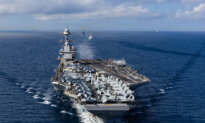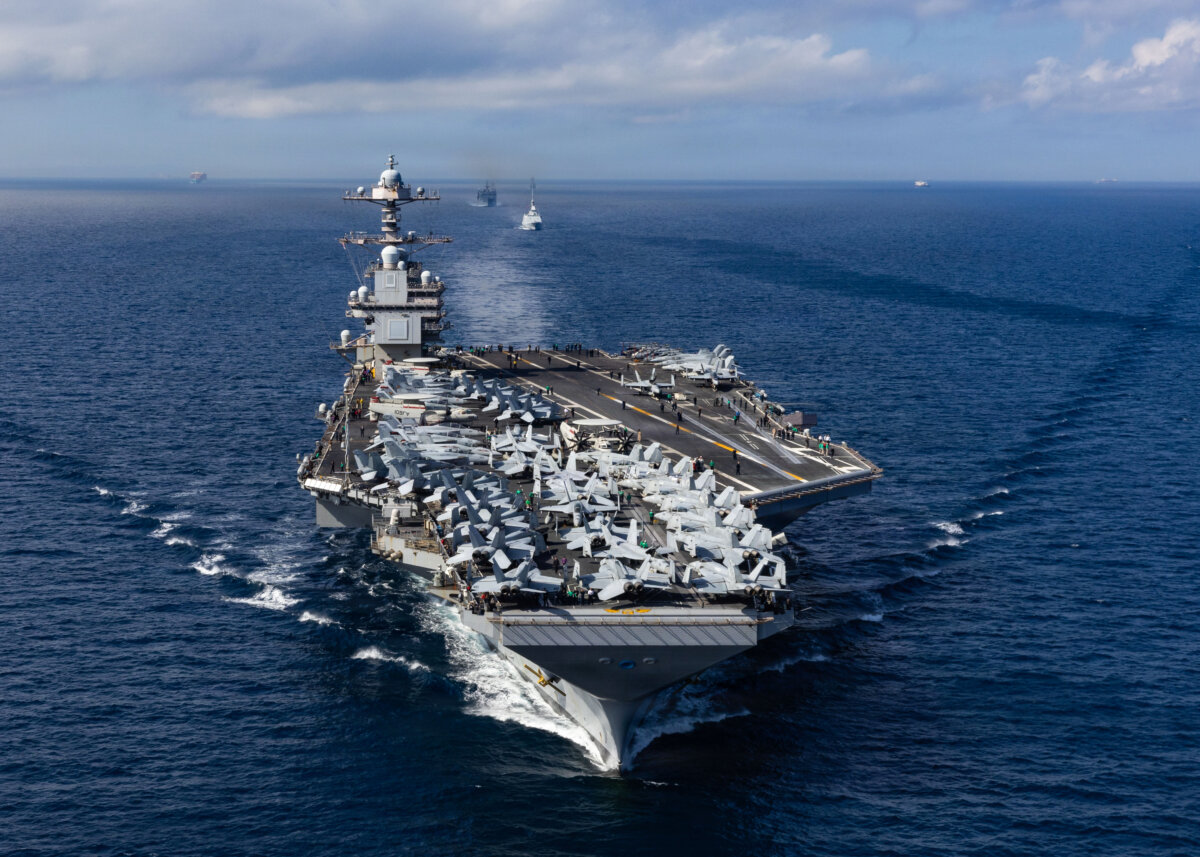

The Department of War confirmed that the USS Gerald R. Ford aircraft carrier strike group arrived in the Latin American area of responsibility on Tuesday as the Trump administration puts more pressure on Venezuelan drug boats.
“The enhanced U.S. force presence in the [Southern Command area of responsibility] will bolster U.S. capacity to detect, monitor, and disrupt illicit actors and activities that compromise the safety and prosperity of the United States homeland and our security in the Western Hemisphere,” Pentagon spokesperson Sean Parnell said in a statement on Tuesday.
The aircraft carrier force “will enhance and augment existing capabilities to disrupt narcotics trafficking and degrade and dismantle Transnational Criminal Organizations,” Parnell added.
The USS Ford, which was commissioned in 2017, is the United States’ newest aircraft carrier and the world’s largest, with more than 5,000 sailors aboard.
Since September, American forces have destroyed several boats off the Venezuelan coast and in other areas, saying those boats were involved in trafficking drugs into the United States. At least 19 confirmed strikes have been carried out in the Caribbean Sea and off the Pacific coasts of Latin American countries.
“Through unwavering commitment and the precise use of our forces, we stand ready to combat the transnational threats that seek to destabilize our region,” said Southern Command Commander Adm. Alvin Holsey in Tuesday’s statement.
“The USS Gerald R. Ford Carrier Strike Group’s deployment represents a critical step in reinforcing our resolve to protect the security of the Western Hemisphere and the safety of the American homeland.”
Venezuelan President Nicolás Maduro has repeatedly alleged that the U.S. military buildup is designed to drive him from power.
The White House in August doubled its reward for information leading to Maduro’s arrest to $50 million, accusing him of links to drug trafficking and criminal groups that Maduro denies.
Tensions between the United States and Venezuela’s neighbor, Colombia, have also spiked in recent weeks, with Trump and Colombian President Gustavo Petro trading barbs on social media. The Trump administration in September also revoked the visa for Petro after he called on American troops to disobey Trump outside of the United Nations headquarters in New York.
Afterwards, the Department of State wrote in a post on X: “Earlier today, Colombian president (Gustavo Petro) stood on a NYC street and urged U.S. soldiers to disobey orders and incite violence. We will revoke Petro’s visa due to his reckless and incendiary action.”
In public comments to reporters last month, Trump suggested the possibility of a ground operation in Venezuela and indicated that “the land is going to be next” after the boat strikes.
Trump also told “60 Minutes” in a Nov. 2 interview that Maduro’s days are likely numbered, while he appeared to downplay the possibility of land strikes.
Secretary of War Pete Hegseth has said on social media that the strikes are needed because drug cartels and smuggling organizations “are waging war on our border and our people,” comparing them to the al-Qaeda terrorist group.
Multiple Mexican drug cartels and several transnational gangs were declared as foreign terrorist organizations by the Trump administration earlier this year.
Reuters contributed to this report.
 Friends Read Free
Copy
Facebook
Tweet
Friends Read Free
Copy
Facebook
Tweet