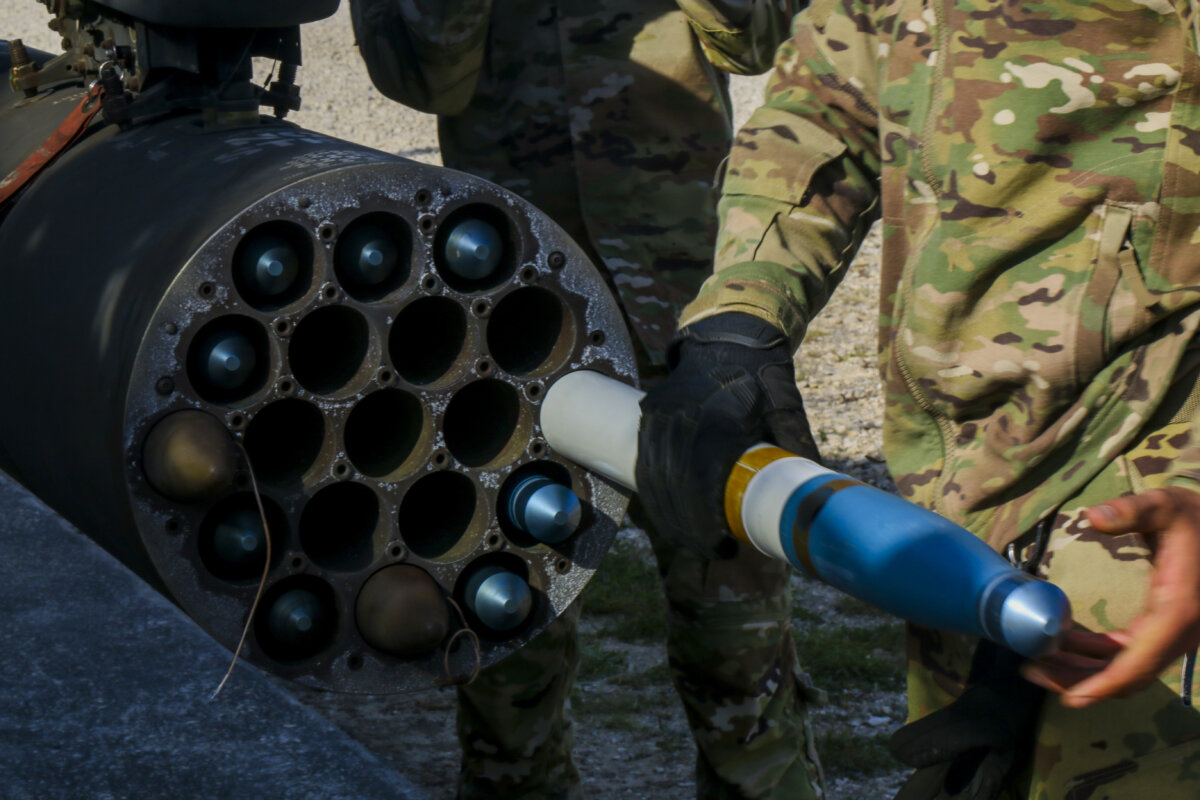

The Department of War has signed a framework agreement to increase production of interceptor kits used to defend against drones and other aerial threats as the Pentagon moves to boost the development of counter-drone systems.
The agreement announced with BAE Systems on Oct. 19 expands production of the Advanced Precision Kill Weapon System (APKWS). Under the deal, the Pentagon will purchase up to 25,000 weapon system guidance kits each year for up to seven years.
The APKWS kits produced by BAE Systems convert unguided 2.75-inch rockets into precision-guided munitions. Utilized by the Army, Navy, Air Force, and Marine Corps, the kits can be used for air-to-air, air-to-surface, surface-to-surface, and surface-to-air engagements.
The announcement came after Secretary of War Pete Hegseth’s memorandum last month directing the Pentagon to remove what he described as “unnecessary barriers,” and accelerate both the development and use of technology and weapons systems that provide defense against unmanned aircraft systems.
The Pentagon said the agreement with BAE Systems signals the sustained demand the defense contractor needs to expand its skilled workforce and procure items that have longer lead times.
“The Arsenal of Freedom exists for one purpose: to guarantee our warfighters decisive advantage on the battlefield,” Michael Duffey, under secretary of war for acquisition and sustainment, said in a statement.
“By securing multi-year demand, this agreement keeps production lines running at capacity, provides our forces with interceptor inventory, and flips the cost calculus in the taxpayer’s favor.”
The APKWS units are also available for purchase by U.S. allies. The U.S. State Department in July approved a potential foreign military sale to Saudi Arabia worth $1.96 billion that would include up to 20,000 of the weapons system units.
The Pentagon said the APKWS provides the department with “a combat-proven, high-lethality interceptor” to counter different types of aerial threats.
Tom Arseneault, president and CEO of BAE Systems, Inc., said the APKWS offers “proven, reliable, and affordable precision at scale to counter evolving threats and ensure our warfighters maintain a decisive advantage.”
Under the agreement, BAE Systems will increase production of the APKWS while the Pentagon and the defense contractor negotiate a multi-year contract.
The agreement outlines a plan for BAE Systems to increase production to as many as 35,000 units per year. The additional units would be available for foreign military sales to U.S. allies.
The units are manufactured at the defense contractor’s facilities in Austin, Texas, and Hudson, New Hampshire. Earlier this year, BAE Systems announced that it had delivered 100,000 APKWS laser-guidance kits.
The Pentagon said the creation of new domestic production lines to meet the demand by U.S. allies for weapons systems strengthens America’s industrial base, which could be used for “surge capacity” if the United States needed expanded manufacturing infrastructure in the future.
The cost of the new framework agreement was not disclosed Monday by the Pentagon or BAE Systems. The Epoch Times reached out to the Pentagon for confirmation on the cost. The Pentagon told The Epoch Times it had nothing further to provide.
The Epoch Times also reached out to BAE Systems for additional comment but did not receive a response before publication time.
U.S. military bases have been repeatedly targeted by drones in recent years. In August, Army Lt. Gen. Joseph Jarrard, deputy commander of U.S. Northern Command, warned that the bases were “ill-equipped” to defend against swarms of small attack drones.
To counter the drone technology threats, the Pentagon created Joint Interagency Task Force 401 in August 2025. Earlier this year, the task force selected five military installations to test the defensive use of high-energy lasers and high-powered microwave systems.
Last month Hegseth directed the Pentagon to consider delays in counter-drone capabilities as “an operational risk.” He told officials to reduce timelines and accelerate development by eliminating some of the common barriers in testing and approval for counter-drone capabilities.
The Pentagon’s current approval for anti-drone technology is often delayed by slow processes that place U.S. military members at risk, he said.
 Friends Read Free
Copy
Facebook
Tweet