
The Salvation Army’s red donation kettles, often manned by a volunteer bell ringer, are a familiar sight across the United States during the five weeks between Thanksgiving and Christmas Eve.
First used in San Francisco in 1891, the kettle—now a sturdy bucket with a lid and padlock—has long been a principal fundraising tool for the evangelical Christian organization’s local outposts, called “corps,” following the military terminology used since the organization’s founding.
In 2024, the kettles brought in $99.5 million nationwide, a small share of the estimated $4 billion to $6 billion The Salvation Army raises annually in the United States through donations, grants, and other fundraising efforts.
Organizing, staffing, placing, and—most critically—collecting the kettles and their bell ringers is a demanding logistical effort.
During the roughly 35-day campaign, a Salvation Army minister can work 12-hour days overseeing locations, volunteers, and nightly collections.
Despite the workload, the kettles remain a highly visible public face of an organization that has operated in the United States for 145 years. Frequently depicted in movies, television programs, and popular music, the kettles have come to symbolize seasonal charity for many Americans.
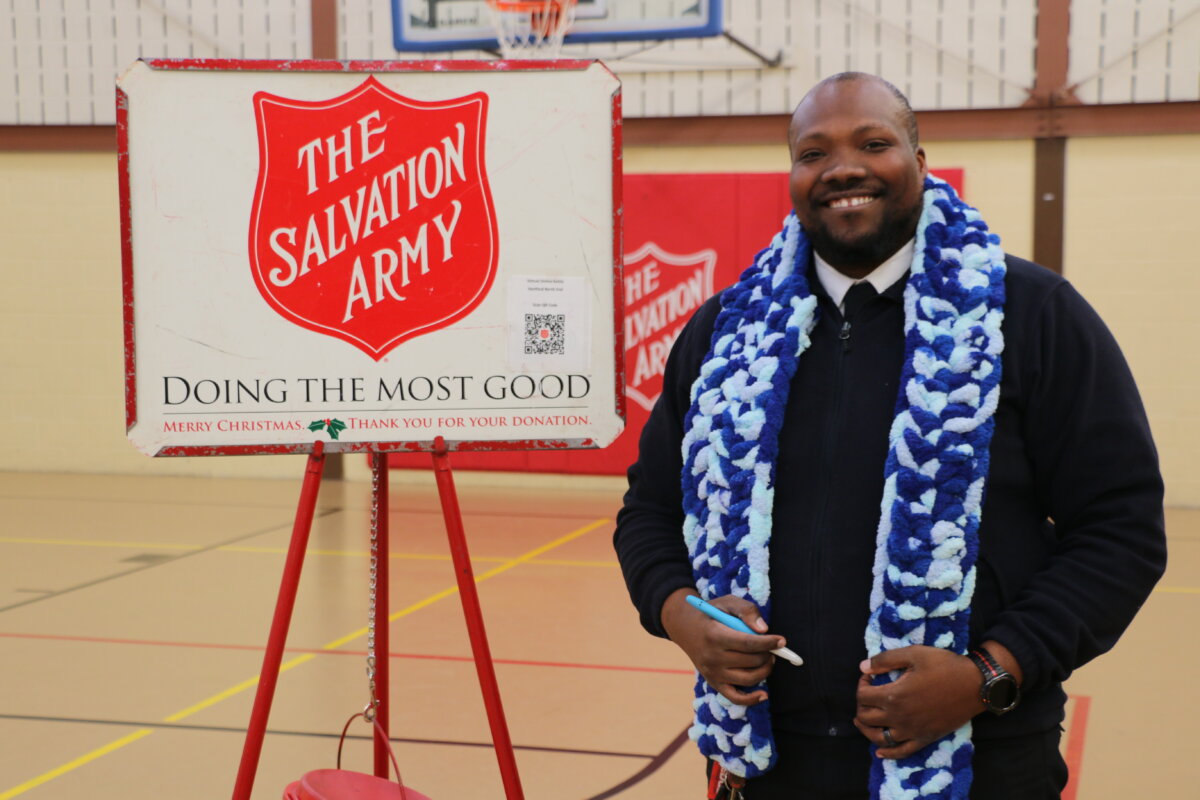
One man closely tied to that effort is Captain Steven Salmon of Hartford, Connecticut, who oversees seven kettle locations in the city’s North End.
Each evening, Salmon waits for volunteers to finish their shifts, then drives a white van bearing the Salvation Army shield to collect both bell ringers and donations.
While waiting, Salmon does not sit idle.
For the past two years, he has spent that time crocheting scarves, hats, and even a queen-sized blanket, many of which he gives away to volunteers, church members, and others connected to the corps.
“I was browsing social media, and I saw a video of crocheting, that it looked kind of easy,” Salmon told The Epoch Times.
“And in our building, we have a lot of yarn. I found the crochet needle, and I didn’t know what it was for [until] I saw the videos. I was like, ‘Let me try it out.’ I found out it was easy, and once I did that, it was just, ‘Let me try to see if I can make anything.’”
Salmon, 35, said the reaction to handmade items has surprised him.
People respond more warmly to something created by hand than to items purchased in stores, he said, because they reflect time and personal effort.
“They like to receive stuff that meant something, that someone put their time and effort into, so they do appreciate it much more than anything else,” Salmon said.
Although he is typically the only man attending his congregation’s knitting and crocheting sessions, Salmon said he is unfazed by that distinction.
“Other guys might be jealous, but it’s fun to be a part of it,” he said.
Salmon’s corps serves Hartford’s North End, which he described as “a generally black area” facing persistent challenges, including housing insecurity, food shortages, and community violence.
At the same time, he said, residents are deeply committed to helping one another.
In the North End community, The Salvation Army provides a diaper bank for young mothers, financial assistance for rent and utilities, and structured youth activities during after-school hours.
Those efforts include a kids club and a young men’s basketball league designed to build discipline and provide mentorship.
The kettle campaign is essential to sustaining those programs, Salmon said.
Money raised during its five-week period helps support operations for the remainder of the year, making the success of each location critical to long-term planning.
Beyond crocheting, Salmon said the experience has encouraged him to pursue other hands-on skills.
Over the past two years, he has experimented with 3D printing, learned to play the saxophone and guitar, practiced soldering, and explored spray painting and airbrushing techniques.
“Once I realized something is really easy, or looks easy to do, like I think I could do it, then I try test it out if my mindset is right, and I do it,” he said.
Salmon has also begun teaching crocheting at his corps, creating a shared activity that brings together people with different backgrounds and experiences.
He said the informal sessions foster community in the same way the kettles do, through small, consistent acts of service.
As another holiday season draws to a close, the red kettles will soon disappear from sidewalks and storefronts.
For Salmon, the end of the bell ringing marks not a conclusion, but the beginning of a year-long effort to translate those donations into daily help for neighbors in need.
Those quiet exchanges, he said, reflect the same spirit of generosity that keeps volunteers returning each year, even after long days, cold nights, and modest individual gifts across Hartford and communities nationwide.
 Friends Read Free
Copy
Facebook
Tweet
Friends Read Free
Copy
Facebook
Tweet