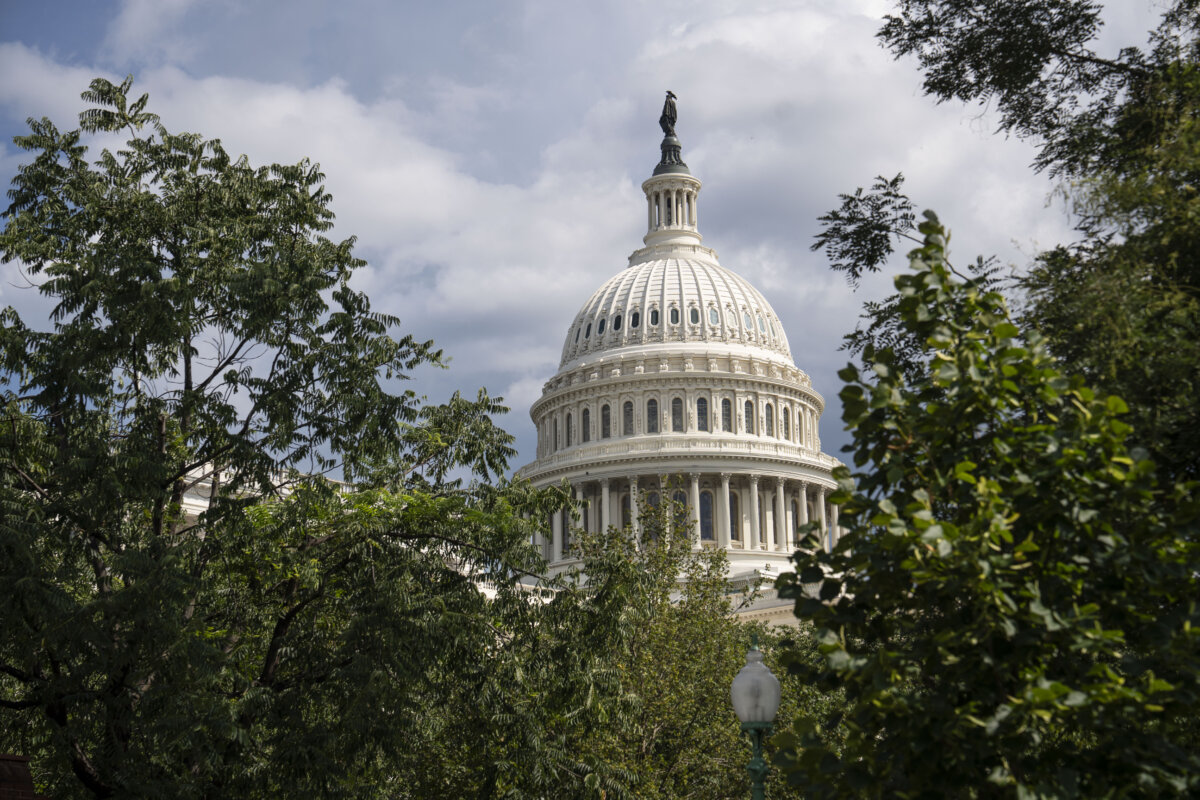


Senate Democrats on Wednesday blocked a Republican bill previously passed by the House that would encourage states to require data centers to pay for their own energy costs.
In a 57–43 vote, the Senate rejected the bid by Sen. Jon Husted (R-Ohio) to overcome the 60-vote filibuster threshold to advance the bill.
All but four Democrats—Sens. Jon Ossoff (Ga.), Raphael Warnock (Ga.), Amy Klobuchar (Minn.) and Maggie Hassan (N.H.)—voted against the bill.
The law would call on states to consider adopting models that make data centers fund their own energy within a year, but would set no requirements that states ultimately adopt them.
Senate Democrats have broadly dismissed the bill as legislatively toothless, pushing for the adoption of alternative proposals.
They say the bill is being considered now for political reasons as the Senate finishes out its final week on Capitol Hill until November.
“What a silly piece of nonsense!” Sen. Elizabeth Warren (D-Mass.) told reporters when asked about the legislation, reflecting many of her colleagues’ attitudes toward the bill.
“I’m not into political theater. Give us something substantive.”
Sen. Dick Durbin (D-Ill.) also said the bill was being considered due to election concerns.
“This is being designed by one Republican secretary because it’s a tough time for the election,” Durbin told reporters on Wednesday, suggesting that “much better policy” could be crafted.
The bill, which passed the House in a 417–3 vote on Sept. 16, was introduced by Husted in the Senate earlier this week.
Husted noted at the time that as many as 1,000 new data center constructions are expected in the United States over the next five years.
“Americans are becoming ever more reliant on computing power from data centers for their daily lives, from medicine to manufacturing, education to agriculture, national defense, and the way we deliver basic services,” Husted said.
“Data centers are used not just for AI; they support almost every aspect of modern life, including online shopping, streaming video, social media, and the broadcast of this very debate.”
After Husted sought to pass the bill under unanimous consent on Sept. 17, Sen. Martin Heinrich (D-N.M.) blocked the motion, saying the Senate’s bill to address this topic should have more stringent federal enforcement mechanisms.
“It’s not enough for us to tell states to consider making data centers pay for grid updates. Rather than voluntary pledges or suggestions to states, Congress needs to pass real legislation with real teeth,” Heinrich said.
Heinrich noted that for many Americans, utility rates had already increased—and that Americans would not gain relief from the state opt-in process of the Ratepayer Protection Act.
Instead, he proposed consideration of his bill, the Grid Savings Act, “to require—not a voluntary agreement—to require large-load customers like data centers to pay for the facilities needed to connect them to the grid.
“Not to consider it, not to make pledges—to actually do it, to pay for the upgrades they need.”
Data centers are top of mind for many American voters this year.
The data centers used to power artificial intelligence (AI) services such as ChatGPT, Claude.ai, Grok, and others—aside from their extensive land requirements—require massive amounts of energy.
Estimates indicate that currently, data centers use about 4 percent of the U.S. electric grid, according to online energy shopping and consultation platform Electric Choice.
 Friends Read Free
Copy
Facebook
Tweet
Friends Read Free
Copy
Facebook
Tweet